



Description
Collector's Note – Why This Issue Matters
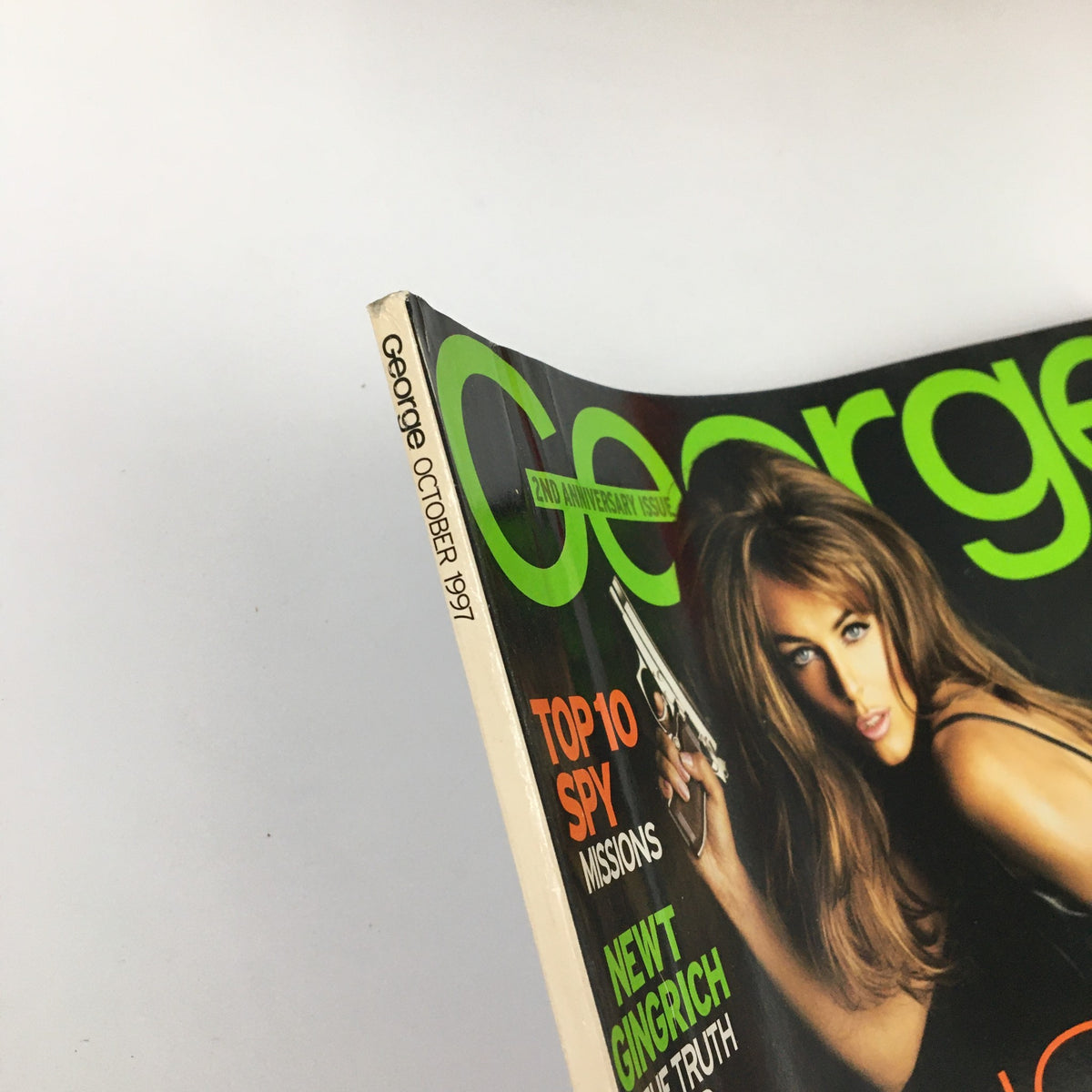
This October 1997 issue of George — the Spy Issue — features Elizabeth Hurley on the cover and Chris Rock in an interview, a pairing that illustrates precisely what John F. Kennedy Jr.'s magazine was attempting to do at the height of its ambition. Rock in October 1997 was at a pivotal moment in his career. His HBO special Bring the Pain had aired in June 1997 and was in the process of being recognized as one of the greatest stand-up comedy specials ever recorded — it would win two Emmy Awards and establish Rock as the defining comedic voice of his generation. His material on race, politics, class, and American hypocrisy was explicitly political in ways that made him a natural subject for George's editorial mission. A magazine that insisted celebrity and politics were inseparable could hardly ignore the most politically acute comedian in the country at the moment his cultural authority was being definitively established. For collectors building a complete archive through the full George magazine run, this issue is notable for combining two subjects — Hurley and Rock — whose simultaneous presence reflects the magazine's range at its most confident.
The specific framing of the issue as the "Spy Issue" with Hurley in an "undercover" scenario adds a layer of conceptual coherence that George's best themed editions always achieved. Hurley's public identity in 1997 was built around a kind of performative glamour — the Versace dress, the Estée Lauder campaigns, the studied presentation of elegance — and the spy/undercover framing allowed George to play with that image in ways that were both visually compelling and editorially pointed. The magazine was always most interesting when its cover concept did genuine work rather than simply providing a celebrity photograph, and the October 1997 Spy Issue is an example of that approach functioning at full effectiveness. The Chris Rock interview inside provides the issue's intellectual center of gravity — his perspective on American politics, race, and culture in late 1997 would have been characteristically unsparing and characteristically precise. Anyone researching the cultural and political landscape of 1997 through its print record will find this issue unusually rich in substantive content.
The October 1997 timing also places this issue in the immediate aftermath of Princess Diana's death on August 31, a event that had generated extraordinary global conversation about celebrity, surveillance, the paparazzi, and the machinery of public visibility — all themes with direct relevance to a spy-themed issue featuring one of Britain's most photographed women. Whether or not the editorial team made that connection explicitly, the resonance is real and gives this issue a layer of cultural texture that collectors and researchers attuned to the period will recognize. The combination of Hurley's undercover framing, Rock's political commentary, and the post-Diana cultural atmosphere makes October 1997 one of the more densely layered months in George's publishing history.
About the Publication
George magazine, co-founded by John F. Kennedy Jr. and Michael Berman and launched in September 1995, built its editorial identity around the argument that politics and popular culture were not separate domains but a single continuous conversation. Its themed issues — of which the October 1997 Spy Issue was among the most conceptually developed — deployed celebrity cover subjects in politically resonant scenarios while its interior combined serious political journalism with cultural profiles and commentary. Kennedy served as editor-in-chief until his death in July 1999, and the magazine ceased publication in 2001. Its complete run is today collected as a document of a specific and unrepeatable sensibility that was particular to the Clinton era and to Kennedy's personal vision of what political media could be.
Key Highlights Inside
- Cover featuring Elizabeth Hurley in the Spy Issue's "undercover" scenario — a conceptually developed cover that used her carefully constructed public image as raw material for George's characteristic editorial commentary on celebrity and performance.
- Chris Rock interview — a conversation with the comedian whose Bring the Pain HBO special had aired just months earlier and was already being recognized as a landmark of American stand-up comedy and political commentary, published at the precise moment of his cultural ascension.
- Spy Issue framing throughout — an editorial concept that allowed George to examine themes of intelligence, secrecy, and the performance of identity through both journalistic and cultural lenses consistent with Kennedy's broader editorial mission.
- Publication context of October 1997 — seven weeks after Princess Diana's death had generated global conversation about celebrity surveillance and visibility, themes that resonate directly with the issue's undercover and espionage framing.
- Note: Specific additional article titles, bylines, and features beyond the confirmed cover subject and Chris Rock interview have not been independently verified from the listing. Interior details should be confirmed against a physical copy for comprehensive research purposes.
Condition & Rarity
Surviving copies of this issue in good condition with mild wear and a subscriber address label on the front cover present the expected profile of a late-1990s glossy magazine that has been handled through nearly three decades before entering a collection. Good condition for a publication of this age indicates structural integrity — covers attached, spine intact, pages present and legible — with the light softening and handling marks that characterize a well-read copy of this vintage. The subscriber label is treated by most collectors as a provenance marker rather than a significant detraction; copies without labels carry a premium for display purposes. A plastic protective sleeve confirms deliberate preservation effort. This issue's dual appeal — Hurley cover for display-oriented collectors and the Chris Rock interview for content-focused researchers — gives it a broader collector base than single-subject issues, sustaining consistent demand across multiple communities.
Looking for More Issues Like This?
The October 1997 Spy Issue is one of the more content-rich and conceptually coherent editions in the George run, combining a strong cover with an interior interview of genuine historical significance. If this one has already found a home, the full George magazine collection at OriginalMagazines.com is the essential destination for anyone building a serious archive of Kennedy's publication across its complete run. The complete 1997 magazines collection is also worth exploring for anyone researching the broader cultural and political landscape of an exceptionally eventful year.