

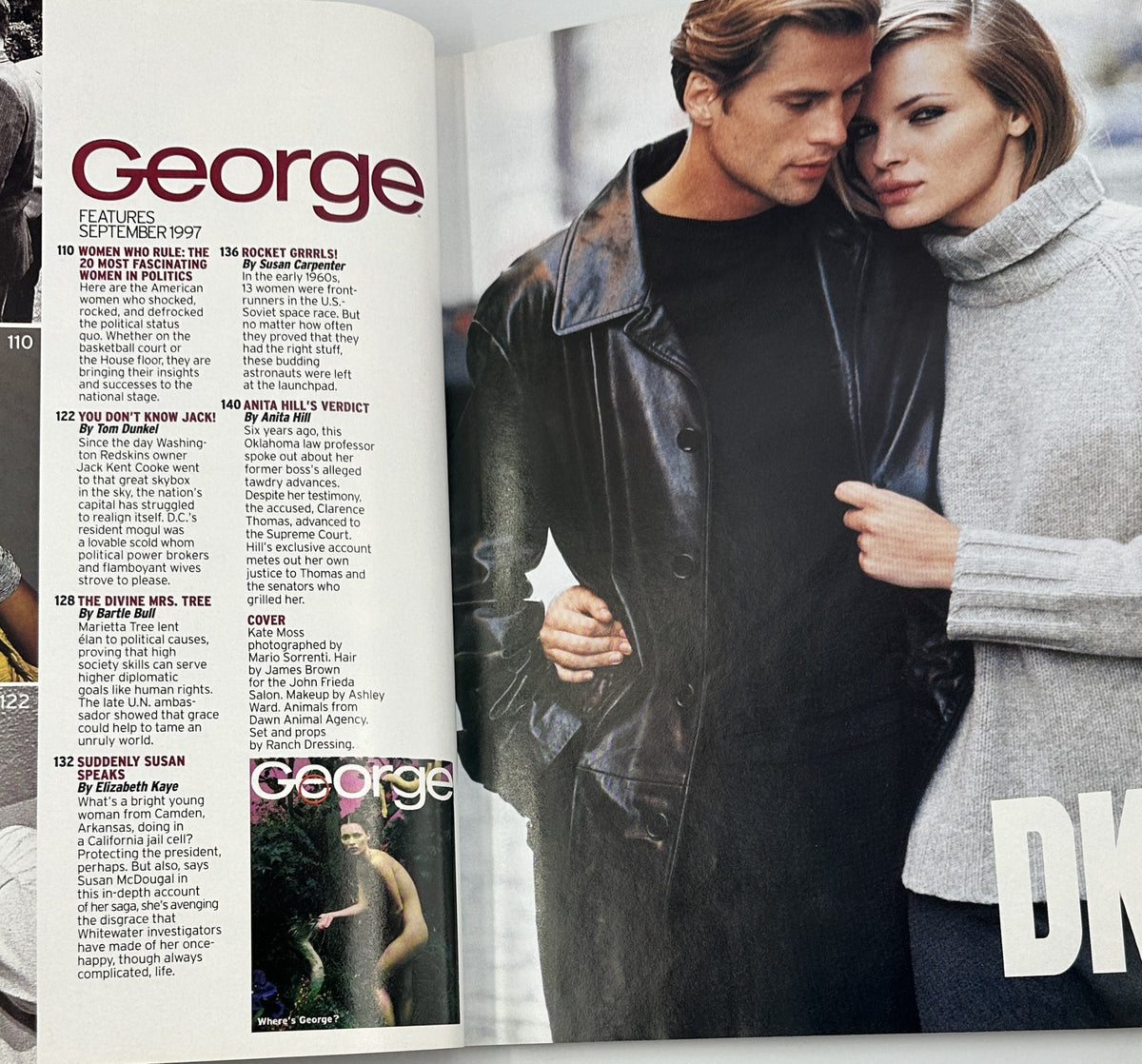


Description
Collector's Note – Why This Issue Matters
September 1997 is a remarkable publication date for George Magazine on multiple levels simultaneously. The Clinton presidency was in the middle of the year that would prove its most consequential — the Paula Jones civil lawsuit was active, the Whitewater investigation was ongoing, and the specific political and cultural tensions that would produce the impeachment proceedings of 1998 were fully visible to anyone paying close attention. George, as the publication that had most deliberately and thoughtfully explored the intersection of politics and popular culture since its 1995 launch, was in some ways uniquely positioned to read this moment — and the September 1997 issue demonstrates that positioning with unusual editorial precision. The Anita Hill exclusive account, Susan McDougal's in-depth saga, the "Woman Who Knows Too Much" piece on Betsey Wright, and the Paula Jones polling feature collectively constitute a remarkable document of the specific political landscape of late 1997, assembled in a single issue with the kind of editorial coherence that only a publication with George's particular editorial philosophy could have achieved. For collectors building an archive of George Magazine issues from across the publication's run, this September 1997 edition is among the most historically loaded entries in the catalog — an issue whose contents have only grown more significant as the events it was documenting have been revisited, reanalyzed, and reassessed across the subsequent decades.
Kate Moss on the cover — photographed by Mario Sorrenti, with hair by James Brown for the John Frieda Salon and makeup by Ashley Ward — is an editorial choice whose logic is both transparent and sophisticated. By September 1997 Moss was the most discussed and culturally significant model in the world, a figure whose influence on the aesthetic of the nineties extended well beyond the fashion industry into the broader culture. George's decision to put her on its cover and include "If I Were President: Kate Moss" as a closing department feature was a characteristically George maneuver — using a fashion figure of maximum cultural visibility to make a statement about the relationship between celebrity and politics that neither a purely fashion magazine nor a purely political publication would have attempted. Sorrenti, who had been Moss's partner and had photographed some of the most significant fashion images of the mid-nineties, brought an intimacy to the cover shoot that distinguishes it from the more formally composed celebrity covers that George typically ran. For collectors researching Kate Moss magazine covers and features, this George appearance is one of the more unusual and politically contextualized entries in her extensive magazine history — a fashion icon in an explicitly political publication at the height of her cultural influence. Collectors researching political and cultural magazines from 1997 will find this issue a precisely dated artifact of a specific and consequential cultural moment.
The feature roster documented in the listing's table of contents makes this one of the editorially strongest George issues to surface with full content documentation. Anita Hill's exclusive first-person account — published six years after her 1991 testimony and engaging her own verdict on Clarence Thomas and the senators who questioned her — is a primary source document of extraordinary significance, representing Hill's own sustained reflection on an event whose cultural and legal legacy was still being actively contested when this issue was published. James Meredith's Eyewitness account of his first day at the University of Mississippi, thirty-five years after the event, adds another layer of civil rights history to an issue already dense with politically charged content. The "Rocket Grrrls!" feature on the thirteen women front-runners in the early-1960s space race reflects George's consistent interest in recovering overlooked women from American political and institutional history. Paul Begala's first-person Rant on affirmative action, Simon Sebag Montefiore on the Spice Girls as an electoral force, and Stanley Crouch's memorial to Betty Shabazz — killed in June 1997, just three months before this issue — collectively constitute an editorial range that demonstrates why George at its best was genuinely unlike any other publication in the American market.
About the Publication
George Magazine was founded by John F. Kennedy Jr. and Michael Berman in 1995 and published monthly until its closure in 2001 following Kennedy's death in July 1999. It occupied a genuinely original position in the American magazine market — a publication that treated politics with the visual production values, celebrity cover approach, and cultural breadth of a mainstream lifestyle magazine, while maintaining substantive political journalism across its features and departments. Its editorial philosophy was built on Kennedy's conviction that politics and popular culture were not separate spheres but deeply interpenetrating ones, and that the intersection deserved a publication capable of addressing both with equal seriousness and craft. By September 1997 George had been publishing for two years and had built a distinctive editorial identity and a readership that found in it something no other magazine offered: political journalism with genuine cultural ambition and cultural content with genuine political intelligence. The Kate Moss cover and the Anita Hill exclusive in the same issue are as precise a summary of that identity as any single issue in the magazine's history provides.
Key Highlights Inside
- Kate Moss cover photographed by Mario Sorrenti — an intimate fashion cover image from the model's most culturally significant period, photographed by her then-partner in a style that distinguished this George appearance from conventional celebrity magazine photography, and contextualised within a political publication in a way that made it one of the more conceptually interesting Moss cover appearances of the decade.
- "Anita Hill's Verdict" exclusive first-person account on page 140 — Hill's own sustained reflection on her 1991 testimony, Clarence Thomas's confirmation, and the senators who questioned her, published six years after the event and constituting one of the most significant primary source documents of that period's cultural and legal history to appear in any mainstream magazine, delivered as a George exclusive at a moment when the Clinton administration's own conduct was generating renewed public attention to questions of sexual harassment and accountability.
- "Suddenly Susan Speaks" by Elizabeth Kaye on page 132 — an in-depth account of Susan McDougal's imprisonment during the Whitewater investigation, published as the Clinton political crisis was deepening and providing a primary source record of one of its central figures at a moment of maximum personal and political stakes.
- "Women Who Rule: The 20 Most Fascinating Women in Politics" on page 110 — George's comprehensive survey of the women reshaping American political life in 1997, representing the magazine's consistent editorial commitment to centering women's political achievement and providing a documented roster of the figures the publication considered most significant at this specific moment in American political history.
- "Rocket Grrrls!" by Susan Carpenter on page 136, James Meredith's Eyewitness account of his first day at Ole Miss on page 86, and Stanley Crouch's memorial to Betty Shabazz on page 92 — three pieces of recovered and recent history that collectively demonstrate George's range across civil rights history, institutional gender discrimination, and contemporary political mourning in a single issue.
- Paul Begala on affirmative action (page 88), Simon Sebag Montefiore on the Spice Girls as electoral force (page 90), the "Naked Truth" poll on Paula Jones (page 96), and the "Woman Who Knows Too Much" feature on Betsey Wright (page 80) — the full supporting editorial architecture of an issue whose political journalism density was exceptional even by George's demanding standards, documented here with the precision that makes the full table of contents an unusually complete research resource.
Condition & Rarity
George Magazine issues from September 1997 are approaching their twenty-ninth year of existence — old enough that condition variation among surviving copies is meaningful, particularly for issues with the specific editorial significance that this one carries. Very Good condition with only light edge wear is an honest and strong grade for a nearly three-decade-old monthly magazine, indicating a copy that displays cleanly, reads completely, and retains the full visual integrity of the Kate Moss-Sorrenti cover without the structural compromise that would reduce its collector and display value. The listing confirms the photos show the exact item, providing the condition transparency that serious collectors require. The plastic protective sleeve provides ongoing archival protection for a coated-stock publication whose cover surface benefits from protection against scuffing and oxidation in long-term storage. Collectors evaluating surviving examples of this issue should prioritize cover surface quality and the Sorrenti-Moss image integrity as the primary visual criterion, alongside spine condition and the completeness of the documented interior content — the Hill exclusive, the McDougal feature, and the "Women Who Rule" survey are the editorial assets most directly relevant to the issue's research utility and historical significance.
Looking for More Issues Like This?
A Very Good copy of George Magazine from September 1997 with the Kate Moss cover, an Anita Hill exclusive, and a fully documented table of contents is among the most historically significant issues in the entire George back-catalog — the combination of the Sorrenti cover, the Hill first-person account, and the Susan McDougal feature makes this one of the issues most directly connected to the political events that would define the magazine's final years. If this issue is no longer available, the Kate Moss magazine collection at OriginalMagazines.com is the most focused resource for other cover appearances and features from her career across publications and years. The full George Magazine collection offers surviving issues across the publication's 1995–2001 run for collectors building a comprehensive archive, and the 1997 magazine collection brings together issues from across that year's major publications for collectors documenting the full breadth of American political and cultural journalism during one of the most consequential years of the Clinton era.