

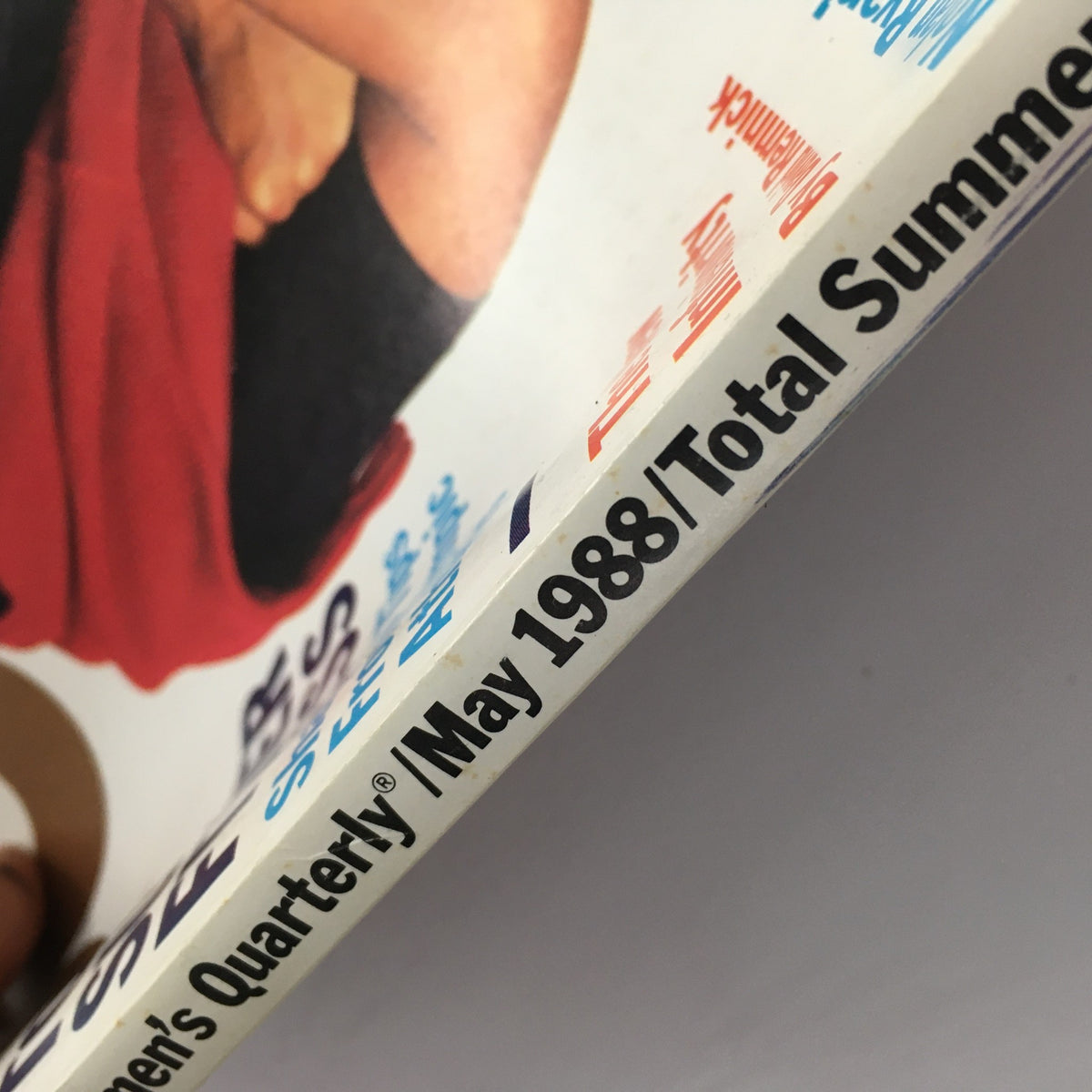


Description
Collector's Note – Why This Issue Matters
The May 1988 issue of GQ featuring Greg Louganis as "The Fanciest Diver" arrives in the year that would produce one of the most dramatic and emotionally resonant moments in Olympic history. Louganis was, by the spring of 1988, the most decorated diver in American history — a two-time double Olympic gold medalist from the 1984 Los Angeles Games, where he had achieved perfect scores in competition and redefined what was considered possible in his sport. The Seoul Olympics were approaching that September, and the anticipation surrounding his attempt to repeat his 1984 achievement was considerable. A GQ cover profile in May 1988 captures Louganis at the peak of his athletic prime, in the months before Seoul, at a moment when his public image was one of almost unqualified admiration. The story of what actually happened in Seoul — his head striking the springboard during a preliminary round, his completion of the competition despite a concussion, and his ultimate gold medal performance — would become one of the defining narratives of the 1988 Games and of Olympic athletics more broadly. This GQ cover thus documents the man just before his most famous chapter was written.
The deeper dimensions of Louganis's story were not yet public in May 1988 — he would not disclose his HIV-positive status until his 1995 memoir, and the full complexity of his life during this period would only be understood in retrospect. What the GQ profile captures is the public Louganis: an athlete of extraordinary grace and technical perfection, a figure who had brought genuine artistry to a sport not always recognized for it, and a man whose combination of physical ability and aesthetic intelligence made him genuinely distinctive among American sports stars of the era. GQ's framing of him as "The Fanciest Diver" reflects the magazine's characteristic approach to athletes — engaging with the style and cultural dimension of sporting excellence rather than treating athletics as a purely statistical enterprise. For collectors focused on vintage GQ magazine issues that document sports figures at significant moments in their careers, a pre-Seoul Louganis cover is a historically layered artifact whose significance has only deepened with time.
The pairing with a Nolan Ryan feature gives this issue an additional layer of sports history significance that collectors of late-1980s American athletics will recognize immediately. Ryan in 1988 was in the extraordinary late chapter of a career that would eventually produce seven no-hitters and 5,714 strikeouts — records that remain untouched decades later. He had joined the Houston Astros in 1979 and would move to the Texas Rangers in 1989, and by 1988 he was already understood as one of the most remarkable physical specimens in the history of professional sports, a forty-one-year-old pitcher still throwing in the upper nineties. A single issue that profiles both Louganis and Ryan in the same month documents two of the most singular athletic careers of the era simultaneously, from the particular vantage point of a men's style magazine that understood how to engage with excellence across multiple registers. Among surviving magazines from 1988, issues that capture multiple significant sports figures at peak moments of their careers carry the kind of historical density that rewards collector attention.
About the Publication
GQ (Gentlemen's Quarterly), founded in 1931 and relaunched under Condé Nast in the 1970s as a men's fashion and lifestyle magazine of genuine cultural ambition, had by 1988 established itself as the most authoritative American men's magazine for the professional, fashion-conscious male reader. Its editorial formula combined men's fashion coverage with substantial feature journalism on sports, politics, culture, and entertainment, and its profiles of athletes were consistently among its strongest editorial content — treating sports figures as full cultural subjects rather than mere statistics. By the late 1980s its circulation was at a sustained peak and its cultural authority in the men's lifestyle space was unquestioned. Its covers from this period routinely featured figures from the full range of American public life — entertainment, sports, politics — and the decision to put Louganis on the May 1988 cover reflected the magazine's consistent instinct for subjects who embodied excellence and style simultaneously.
Key Highlights Inside
- "The Fanciest Diver" — Greg Louganis cover feature, profiling the two-time Olympic double gold medalist in the months before the 1988 Seoul Games, where he would produce one of the most dramatic and celebrated performances in Olympic history — making this a document of Louganis at the precise moment before his most famous chapter.
- Nolan Ryan feature, documenting one of baseball's most extraordinary physical specimens in the late stage of a career that would ultimately produce records — seven no-hitters, 5,714 strikeouts — that remain unmatched in the sport's history.
- Fashion and style content reflecting GQ's late-1980s aesthetic — the specific clothing, grooming, and lifestyle sensibilities of a magazine at the peak of its cultural authority in the American men's market.
- The broader editorial mix characteristic of GQ in this period, combining sports profiles of genuine depth with the fashion and cultural coverage that defined the magazine's identity and distinguished it from conventional sports publications.
- Note: Specific additional articles, fashion features, and named contributors beyond the Louganis and Ryan coverage are unconfirmed for this issue. The two sports features are the documented editorial centerpieces.
Condition & Rarity
Excellent condition with only minor wear and smooth edges is a strong grade for a GQ issue from 1988, and the overall very good appearance indicates a copy that has been stored carefully and handled minimally since its original publication. The presence of an address label on the front cover identifies this as a subscriber copy — a common configuration for GQ in this period, when subscription distribution significantly outnumbered newsstand sales, and a condition attribute that is standard rather than penalizing in the collector market for this category. The label's placement and its effect on the visibility of the Louganis cover image are the primary display considerations for collectors evaluating any surviving copy of this issue. GQ used heavy coated stock for its covers in the late 1980s that ages well and retains color fidelity in stable storage conditions, and excellent condition with minor wear indicates a copy near the top of what the market typically offers for issues of this vintage. A plastic protective sleeve provides meaningful ongoing preservation. When evaluating any surviving copy, the priority attributes are the surface condition and color fidelity of the Louganis cover photograph, the flatness of the spine, and the completeness and condition of the interior pages — particularly the fashion photography sections, which use the same heavy coated stock as the cover and are among the most visually significant pages in any late-1980s GQ issue.
Looking for More Issues Like This?
Greg Louganis GQ coverage from the 1988 Olympic year is a historically specific and genuinely meaningful find — this is the profile from before Seoul, and its significance has only grown as the full story of Louganis's career and life has become more widely understood. If this issue has already moved on, the GQ magazine collection at OriginalMagazines.com spans multiple decades of the magazine's run and regularly surfaces strong issues from the late 1980s worth serious attention. For collectors building a broader picture of American sports and cultural life in the year of the Seoul Olympics, the 1988 magazine collection covers the year across multiple titles — a rich archive from one of the most eventful years in late twentieth-century American sports history.