
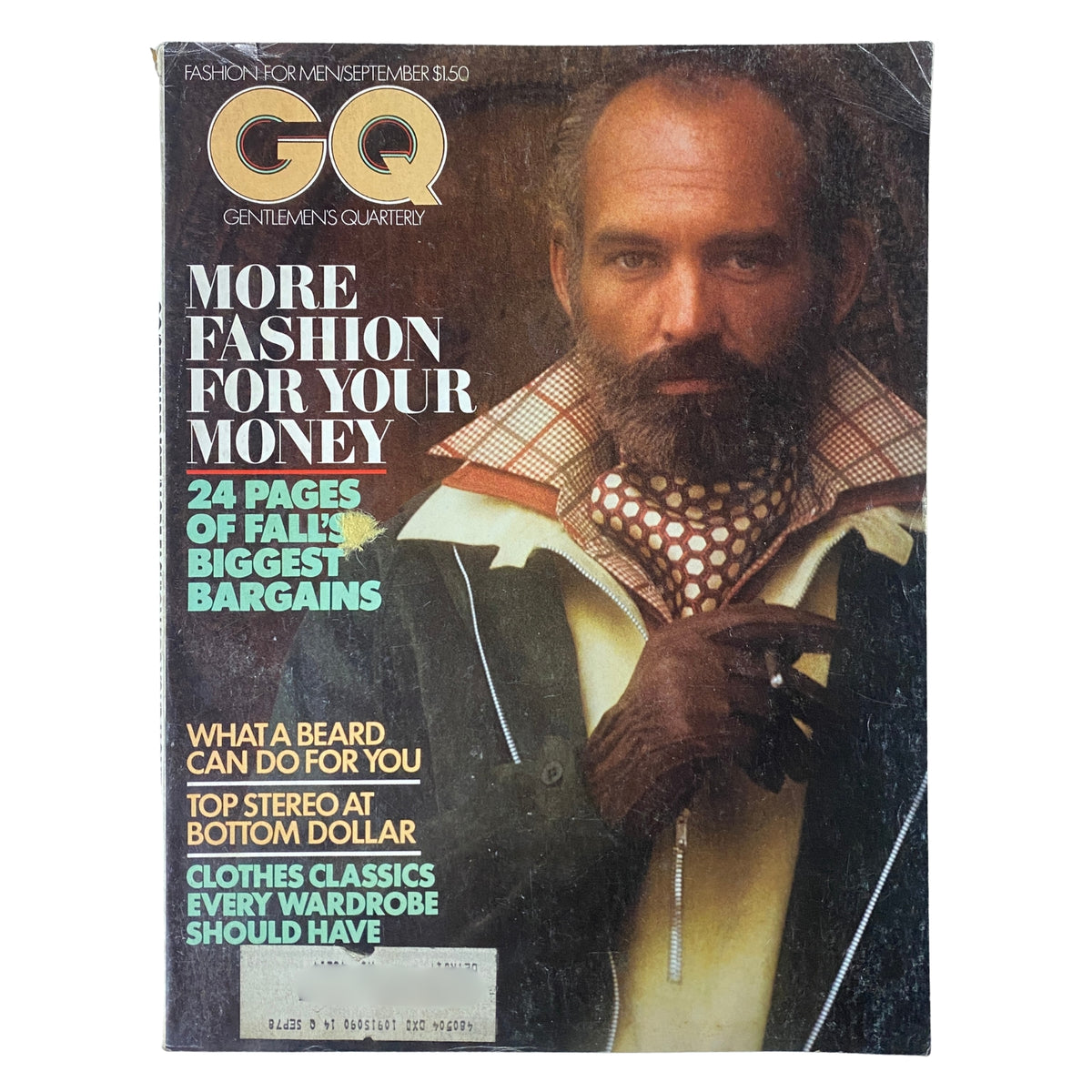


Description
Collector's Note – Why This Issue Matters
The September 1975 issue of GQ: Gentlemen's Quarterly, featuring Denis Lamarsh on the cover, is a primary document of American men's fashion publishing at its most consequential annual moment — the fall fashion flagship issue — during one of the more interesting and underappreciated periods in GQ's long publishing history. September was the single most commercially and editorially significant month in any fashion magazine's annual calendar, and a September issue of GQ from 1975 received the full concentration of the publication's fall fashion authority, its most intensive advertiser engagement, and its most elaborate editorial production of the year. The confirmed table of contents for this issue is unusually detailed and reveals an editorial scope that goes well beyond routine fall fashion coverage: investment advice, stereo equipment guidance, wine pairing for game hunting, terrace gardening, and a profile of an individual man's elevated fashion sensibility alongside the practical wardrobe guides that formed the commercial foundation of the issue. That breadth — the deliberate positioning of fashion advice within a larger context of financial, cultural, and lifestyle sophistication — is characteristic of GQ's mid-1970s editorial identity at its most fully developed and most historically distinctive. For collectors building archives around GQ's complete publishing history, the September 1975 flagship issue with its unusually comprehensive documented table of contents is a primary source of unusual specificity for the magazine's pre-Condé Nast independent period.
The broader cultural context of September 1975 gives this issue its specific historical positioning. The mid-1970s were a period of genuine economic anxiety in the United States — the 1973-74 oil crisis and the subsequent recession had produced significant consumer caution, and the confirmed "Don't Buy Stock!" investment article and the multiple features oriented toward value and accessible pricing ("The Price is Right," "Prices You Can Live With," "Long-Term Security") reflect a publication that was directly addressing its readership's economic concerns rather than pretending they didn't exist. The "Long-Term Security — Building a wardrobe with timeless value" framing is particularly revealing as a document of how GQ was positioning fashion advice within the specific economic anxieties of 1975: investment in quality clothing as a rational economic decision rather than mere vanity, a framework that anticipated the more explicitly investment-oriented fashion discourse that would emerge in the power-dressing era of the early 1980s. The confirmed "One Man's Wardrobe: 'Clothes Are My Hobby'" profile of Roy Williams adds a human-interest dimension to the fashion content that reflects GQ's characteristic mid-1970s strategy of making fashion engagement feel like a legitimate masculine intellectual interest. Collectors researching American men's lifestyle and fashion publishing from 1975 will find this issue one of the more thoroughly documented primary sources from the year, given the exceptional detail of the confirmed table of contents.
About the Publication
GQ — Gentlemen's Quarterly — was founded in 1931 as Apparel Arts, a menswear trade publication, before evolving through multiple incarnations into the consumer-facing men's lifestyle magazine that Condé Nast would acquire in 1983. By September 1975, GQ was operating in its independent pre-acquisition period, actively developing the editorial voice and reader relationship that would eventually make it one of the most commercially successful men's publications in American history. The magazine's mid-1970s editorial formula combined fall fashion authority with the kind of broadly conceived lifestyle guidance — investments, food and wine, grooming, cultural commentary — that positioned being a well-dressed man as part of a coherent intellectual and aesthetic project rather than a superficial vanity. September flagship issues received the year's heaviest advertiser engagement and most elaborate editorial production, making the September 1975 issue representative of the publication's full editorial ambitions at their annual commercial peak.
Key Highlights Inside
- The fall fashion content — "You're on Your Own," "The Big Bundle," "Long-Term Security," "The Price is Right," and "Prices You Can Live With" — collectively frames autumn 1975 wardrobe investment within the specific economic anxieties of mid-decade America, positioning fashion advice as rational value-oriented decision-making rather than luxury consumption, a historically revealing editorial choice that reflects GQ's direct engagement with its readership's 1975 economic concerns.
- "One Man's Wardrobe: 'Clothes Are My Hobby'" profiling Roy Williams documents GQ's characteristic mid-1970s strategy of humanizing fashion engagement through individual profiles — making elevated fashion consciousness feel like a legitimate and personally distinctive masculine interest rather than an industry-imposed obligation.
- "Don't Buy Stock!" on page 90 positions unconventional investment thinking alongside fashion advice in a single issue — a juxtaposition that captures GQ's deliberate editorial strategy of situating men's fashion within a broader framework of intelligent lifestyle and financial decision-making that distinguished the publication from purely fashion-focused competitors.
- "Which Vintage with Venison?" — a wine pairing guide for game hunters — and the terrace gardening feature together document GQ's consistent cultivation of the intersection between traditional masculine pursuits and sophisticated lifestyle knowledge, a combination that defined the publication's specific mid-1970s reader identity.
- The comprehensive departments section — Pulse, Clotheslines, Sounds, Selling Yourself, Money, Shaping Up, and more — confirms the full-spectrum lifestyle magazine format that GQ was deploying at its most ambitious and most historically characteristic in this period of its pre-acquisition independent operation.
Condition & Rarity
Surviving copies of this issue are graded at the Good level with typical age-related wear — a condition designation that indicates a complete and readable publication showing honest aging consistent with fifty years of existence. For a GQ flagship September issue from 1975, Good condition is a workable survival grade for both research and collection purposes: the magazine was produced on a combination of coated stock for photography and lighter paper for text sections, a format that ages unevenly and is susceptible to tanning and edge brittleness over time without careful storage conditions. The confirmed detailed table of contents documented in this listing represents an unusual degree of editorial verification that makes this issue more specifically researchable than most surviving GQ issues from the same period — collectors and researchers can confirm the presence of specific features before acquisition rather than inferring content from publication date alone. The plastic protective covering provides appropriate stabilization for a fifty-year-old publication, helping to prevent further cover surface deterioration and spine damage during handling and storage. Condition assessment from the provided photographs is the appropriate standard for evaluating the specific degree of wear and aging that distinguishes condition grades within the Good range for this specific issue.
Looking for More Issues Like This?
GQ September flagship issues from the mid-1970s pre-Condé Nast independent period — particularly those with comprehensive confirmed tables of contents that allow specific editorial features to be verified — are among the more thoroughly documentable and historically specific entries in the publication's long archive of men's fashion journalism, and the September 1975 issue is one of the more richly confirmed examples from this distinctive period. The GQ collection at OriginalMagazines.com is the most comprehensive place to browse available issues across the publication's decades of American men's lifestyle and fashion documentation. For collectors building a broader picture of American men's publishing and popular culture in 1975, the 1975 magazines collection offers a wide cross-section of titles that together capture the full range of that mid-decade year's American print culture.