

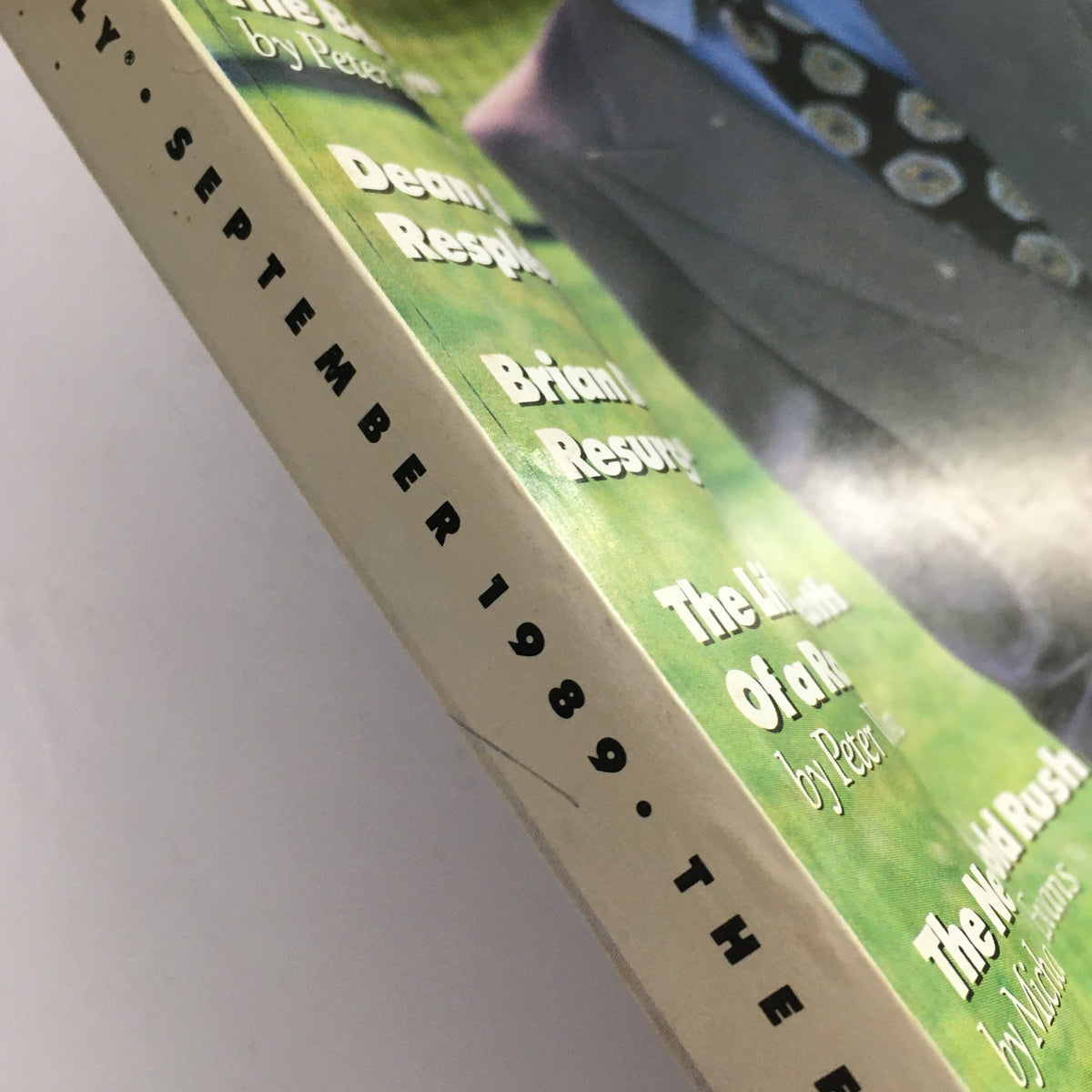


Description
Collector's Note – Why This Issue Matters
The September 1989 issue of GQ featuring Andre Agassi, Dean Stockwell, and Brian De Palma arrives at a precise cultural crossroads where sports, cinema, and style were converging in ways that made late-1980s GQ one of the most culturally alert magazines in American publishing. Andre Agassi in September 1989 was one of the most electrifying and divisive figures in professional tennis — a nineteen-year-old Las Vegas native with a bleached mullet, acid-wash denim, and a baseline game of terrifying power who had burst onto the ATP Tour and immediately polarized the tennis establishment between those who found his showmanship refreshing and those who found it an affront to the sport's traditions. He had not yet won a Grand Slam title — that would come at Wimbledon in 1992 — but his celebrity had already outrun his results in a way that very few athletes achieve, fueled by his Nike advertising campaigns and a personal style that made him as relevant to fashion and popular culture as to sports. A GQ feature on Agassi in 1989 was not simply sports journalism. It was a recognition that he had become a cultural figure whose significance extended well beyond the tennis court, and whose image was actively reshaping how athletic identity and personal style intersected in the late-Reagan-era American imagination. For collectors building a focused archive of Andre Agassi magazine features and covers, this September 1989 GQ appearance documents him at the precise moment his celebrity was being constructed and contested in real time.
The pairing of Agassi with Dean Stockwell and Brian De Palma in a single issue is itself a statement about what GQ understood its readership to care about in September 1989. Stockwell was in the midst of a remarkable career renaissance — his performance in Wim Wenders' 1984 film Paris, Texas had reintroduced him to serious critical attention after decades of work, and his role in the television series Quantum Leap, which had premiered in March 1989, was bringing him a new generation of mainstream recognition just as this issue went to press. Brian De Palma, meanwhile, was one of Hollywood's most discussed and controversial directors, with a filmography that encompassed Scarface, Carrie, and The Untouchables — the latter having been a major critical and commercial success in 1987 — and a visual style so distinctive and debated that his name had become shorthand for a particular approach to cinematic excess and virtuosity. The decision to feature all three men in a single September issue reflects GQ's editorial intelligence about the specific cultural conversation of late 1989: a moment when the boundaries between sports celebrity, film stardom, and style leadership were more fluid and mutually reinforcing than they had ever been. Collectors of vintage GQ magazines from this period consistently regard multi-subject issues like this one as among the most editorially rich in the publication's late-1980s archive.
September 1989 carries additional historical weight as one of the final months of the decade — a moment when the cultural and political assumptions of the Reagan years were beginning to give way to something not yet fully defined. The Berlin Wall would fall in November 1989, the Cold War was visibly loosening its grip, and American popular culture was in a state of feverish creative productivity across music, film, fashion, and sport simultaneously. GQ's September issues were traditionally among its most ambitious of the year — fall fashion, major feature journalism, and the cultural reckonings that the end of summer and the beginning of autumn reliably generated in a monthly magazine attuned to the rhythms of its readership's lives and interests. An issue featuring three figures as culturally distinct as Agassi, Stockwell, and De Palma captures that end-of-decade energy with unusual completeness, documenting a moment when American celebrity culture was simultaneously looking back at what the 1980s had produced and forward toward a decade whose character it could not yet fully anticipate. Issues from 1989 occupy that threshold position in American cultural history, and this September number is among the most representative single issues of the year.
About the Publication
GQ — Gentlemen's Quarterly — was founded in 1931 and had evolved by the 1980s into the dominant American men's style magazine, combining fashion coverage of exceptional depth and visual quality with long-form journalism, celebrity profiles, cultural criticism, and the kind of sophisticated lifestyle content that addressed its readership as intelligent, ambitious adults with genuine cultural curiosity alongside their interest in clothes. Under the editorship of Art Cooper, who took over in 1983 and led the magazine through one of its most creatively successful periods, GQ developed an editorial formula that balanced serious fashion photography with substantive feature writing on the figures — athletes, actors, directors, musicians, politicians — who were shaping American culture in real time. Its September issues were consistently among the year's strongest, combining major fall fashion editorial with the feature journalism that Cooper's GQ was producing at a level that drew direct comparison with the best general-interest magazines of the era. By 1989, GQ had a national circulation in the millions and an editorial authority that extended well beyond the fashion world into the broader landscape of American male cultural identity — making individual issues from this period valuable documents of how masculinity, style, celebrity, and cultural aspiration were being defined and negotiated at the close of the decade.
Key Highlights Inside
- Feature on Andre Agassi during his breakthrough period as professional tennis's most controversial and culturally visible young star — documenting his image, his style, and his celebrity at the precise moment they were being constructed and debated, before his Grand Slam victories had confirmed the athletic greatness that his early career had promised and his detractors had doubted.
- Feature on Dean Stockwell capturing his career renaissance of the late 1980s — encompassing his critical reintroduction through art-house cinema and his simultaneous return to mainstream television prominence with Quantum Leap, which had premiered just months before this issue's publication and was rapidly establishing itself as one of the most discussed new series of the 1989–90 television season.
- Feature on Brian De Palma — one of American cinema's most stylistically distinctive and critically polarizing directors — at a point in his career when his reputation for operatic visual excess and his genuine technical mastery were both at the center of ongoing critical debate, and when his commercial and artistic profile remained among the highest of any working Hollywood filmmaker.
- Fall fashion editorial consistent with GQ's September standard of producing the year's most visually ambitious and editorially substantial fashion coverage — representing the publication's creative peak of the annual publishing cycle and reflecting the full range of late-1980s men's style at a moment of considerable aesthetic energy and commercial vitality.
- Cultural commentary and feature journalism reflecting the specific late-1989 moment when the decade's dominant cultural assumptions were beginning to shift and the outlines of a new decade were becoming faintly visible — making this issue a particularly rich document of the transitional sensibility that characterized the final months of the 1980s.
- Note: Specific interior article titles, additional features, and bylines beyond those referenced on the cover and in the listing description have not been independently confirmed for this issue. The above reflects only what is verifiable from the named subjects, the listing description, and well-documented public knowledge of the publication's editorial format and the featured figures during this period.
Condition & Rarity
GQ issues from 1989 were printed on the high-quality coated stock that distinguished the publication's production values from less premium monthly competitors — heavier, glossier, and more durable than standard newsmagazine paper, but still subject to the edge softening, spine stress, and surface wear that thirty-five years of storage and handling inevitably produce in a perfect-bound monthly of this size and paper weight. The newsstand provenance of any surviving copy of this issue is a meaningful positive attribute, confirming that the cover has not been obscured by subscriber address labels, ink stamps, or mailing marks — a distinction that matters considerably for display purposes given the visual quality of GQ's late-1980s cover photography and design. A Good condition grade with minor edge wear, small rips, and occasional creases is an honest assessment for a magazine of this age and format, indicating a copy that retains its completeness and documentary integrity with the surface characteristics that decades of storage produce in publications that were read and handled rather than archived from new. The protective plastic sleeve represents appropriate basic conservation for a magazine of this period and significance, limiting further light oxidation and handling wear on cover stock that has already demonstrated considerable survival longevity. For collectors evaluating surviving copies of this issue, the cover's visual clarity, the binding's structural integrity, and the completeness of the interior page block — including the fashion editorial and the Agassi, Stockwell, and De Palma features — are the primary condition attributes that determine suitability for display and long-term preservation in a serious collection.
Looking for More Issues Like This?
A September 1989 GQ featuring Andre Agassi, Dean Stockwell, and Brian De Palma in a single issue is the kind of multi-subject, end-of-decade editorial package that serious collectors of late-1980s American magazine culture pursue with genuine intentionality — it documents three distinct but equally significant cultural figures at pivotal career moments, and label-free newsstand copies in Good or better condition are not encountered with any regularity after three and a half decades of collector circulation. If this particular issue has already been claimed, the Andre Agassi magazine collection at OriginalMagazines.com is the natural first stop for continuing the search, with appearances spanning his full career arc from teenage phenomenon to Grand Slam champion and elder statesman of the sport. The complete vintage GQ archive offers the broadest selection for collectors building a run of the publication through the Art Cooper era, while the full 1989 magazine collection provides the wider cultural context of that extraordinary final year of the decade for anyone assembling a thematically focused late-1980s archive.