


Description
Collector's Note – Why This Issue Matters
April 1941 places this issue of Harper's Bazaar at one of the most genuinely complicated moments in the history of American fashion publishing. The United States had not yet entered the Second World War — Pearl Harbor was still eight months away — but the European conflict had already severed the transatlantic pipeline that had supplied American fashion with its creative direction for generations. Paris, the undisputed center of haute couture, had been under German occupation since June 1940. The French fashion houses that Harper's Bazaar had covered as primary subject matter were either shuttered, compromised, or operating under conditions that made meaningful coverage impossible. American fashion editors, designers, and publishers were navigating a forced creative independence that would ultimately reshape the industry permanently. An issue from this precise window documents that transition in real time — not as history, but as the lived present of its editors and readers. Collectors tracing the full arc of the magazine's editorial history will find the Harper's Bazaar archive at OriginalMagazines.com an essential resource for issues spanning the prewar, wartime, and postwar periods.
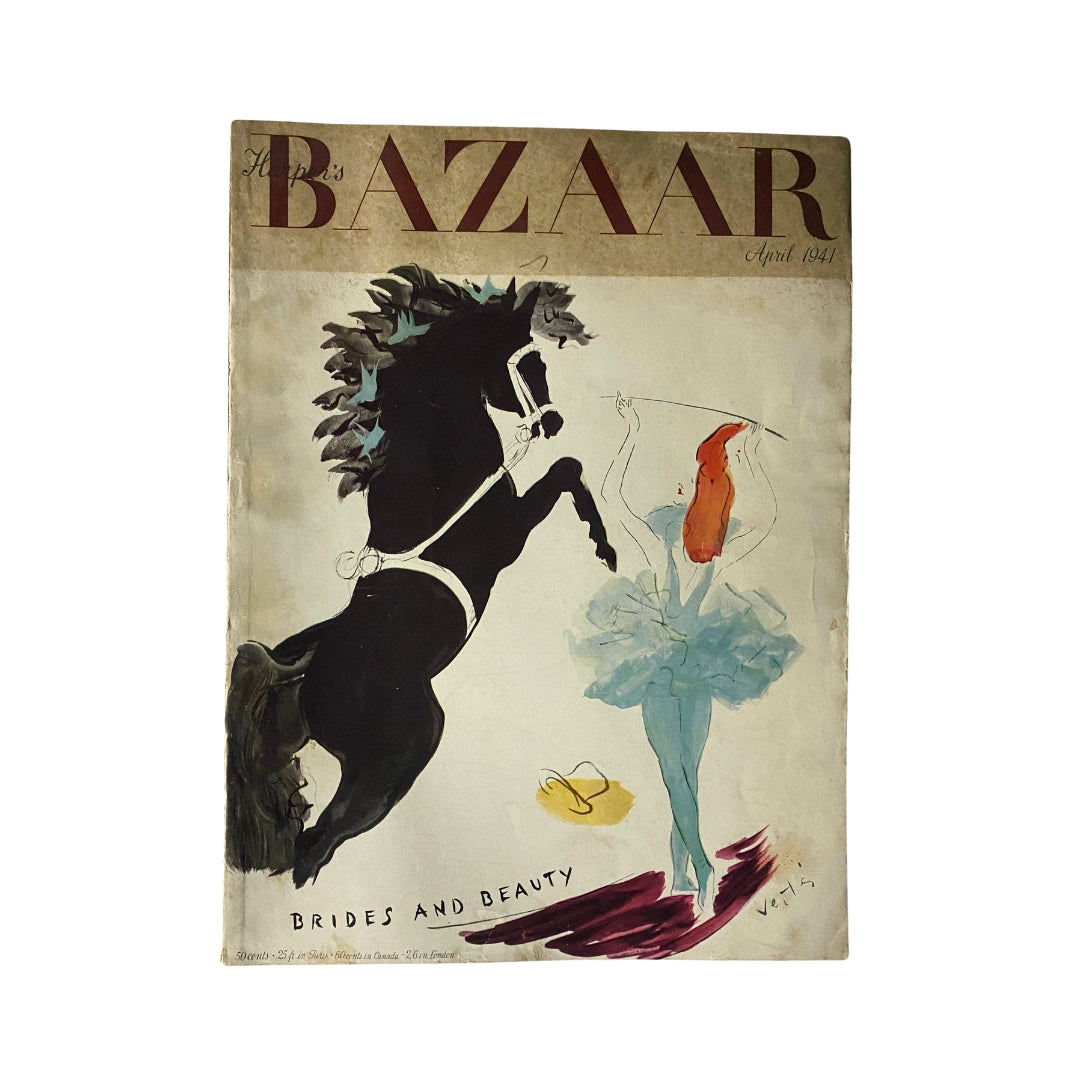
The "Brides and Beauty Circus" cover concept is worth pausing on. A spring bridal issue was a fixture of the fashion magazine calendar, but the circus framing signals something more playful and visually inventive than a standard bridal feature — consistent with the art direction that defined Harper's Bazaar during the tenure of Alexey Brodovitch, who served as the magazine's art director from 1934 to 1958 and transformed it into one of the most visually adventurous publications in American history. Brodovitch's influence on every cover and layout decision during this period was profound, and any issue from his tenure is implicitly a document of his design thinking as much as its editorial content. The specific features confirmed in this issue — "Suzy is Here!" and "The Black and White Striped Hat" among the fashion content, and fiction by Liam O'Flaherty — reflect the magazine's characteristic blend of high fashion, practical style guidance, and serious literary ambition that set it apart from competitors. Those researching the broader cultural and publishing landscape of this extraordinary year can find additional context in the 1941 magazines collection at OriginalMagazines.com.
Liam O'Flaherty's presence in the fiction lineup is itself a notable detail. The Irish author, best known for his 1925 novel The Informer, was an established literary figure by 1941 — his inclusion reflects Harper's Bazaar's serious engagement with literary fiction as an integral part of its editorial identity, not an afterthought. The magazine published significant fiction and poetry throughout its classic era, and the appearance of a writer of O'Flaherty's reputation in an April 1941 issue is consistent with the caliber of literary contributors the magazine regularly attracted under editor Carmel Snow.
About the Publication
Harper's Bazaar was founded in 1867, making it the oldest fashion magazine in the United States. By the 1930s and 1940s, under editor Carmel Snow and art director Alexey Brodovitch, it had established itself as the most visually and editorially sophisticated fashion publication in America — a peer of the great European fashion press and in many respects their superior in design ambition. Its audience was affluent, educated women with serious interest in fashion, beauty, culture, and the arts. The magazine's editorial format blended high fashion coverage with fiction, poetry, cultural commentary, and photography by some of the most significant image-makers of the twentieth century, including Richard Avedon and Martin Munkácsi. The Brodovitch era in particular — spanning 1934 to 1958 — produced issues that are now studied as landmarks in the history of graphic design as much as fashion journalism.
Key Highlights Inside
- "Brides and Beauty Circus" cover concept — a spring bridal issue framed with a circus theme, reflecting the inventive art direction of the Alexey Brodovitch era and the magazine's consistent resistance to conventional fashion cover treatments.
- "Suzy is Here!" — a confirmed fashion feature, the specific nature of which is consistent with the magazine's coverage of emerging designers and style personalities during a period when American fashion was asserting its independence from Paris.
- "The Black and White Striped Hat" — a confirmed fashion or accessory feature, reflecting the focused, object-centered style coverage that was a Harper's Bazaar editorial signature under Snow and Brodovitch.
- Fiction by Liam O'Flaherty, "The Lament" — a confirmed short fiction contribution from the Irish author of The Informer, representative of the magazine's sustained commitment to publishing serious literary work alongside its fashion content.
- Issue published April 1941, situating its fashion content in the first full spring season following the fall of Paris — a moment when American designers and editors were actively constructing a new independent fashion identity under wartime conditions.
Condition & Rarity
The noted condition describes an excellent copy with light wear typical for its age — a meaningful distinction for a publication now more than eighty years old. Harper's Bazaar issues from the early 1940s were printed on paper stock of varying quality, and the large-format pages that Brodovitch favored for his layouts are particularly susceptible to edge wear, corner rounding, and spine stress over decades of storage. A copy retaining excellent condition with only light age-consistent wear represents genuine preservation well above the average survival rate for issues of this vintage. The absence of a subscription label is a significant attribute: mailed copies routinely received address labels applied directly to the cover, and their removal frequently caused adhesive residue or paper loss that permanently compromises the cover art — particularly damaging on an issue where the cover design is a primary point of collector interest. A no-label copy with an intact cover in this condition is the configuration a serious collector of Brodovitch-era Harper's Bazaar would prioritize.
Looking for More Issues Like This?
Clean, no-label copies of Harper's Bazaar from the Brodovitch and Carmel Snow era are among the more rewarding finds in vintage fashion magazine collecting — the design ambition of those issues holds up against anything produced since, and examples in excellent condition are genuinely uncommon after more than eight decades. If this April 1941 issue has already been claimed, the Harper's Bazaar collection at OriginalMagazines.com is the best place to search for other issues from this defining period of the magazine's history. Collectors with broader interest in the extraordinary cultural and historical pressures of this particular year will also find the 1941 magazines collection rich with period material spanning fashion, news, and popular culture.