


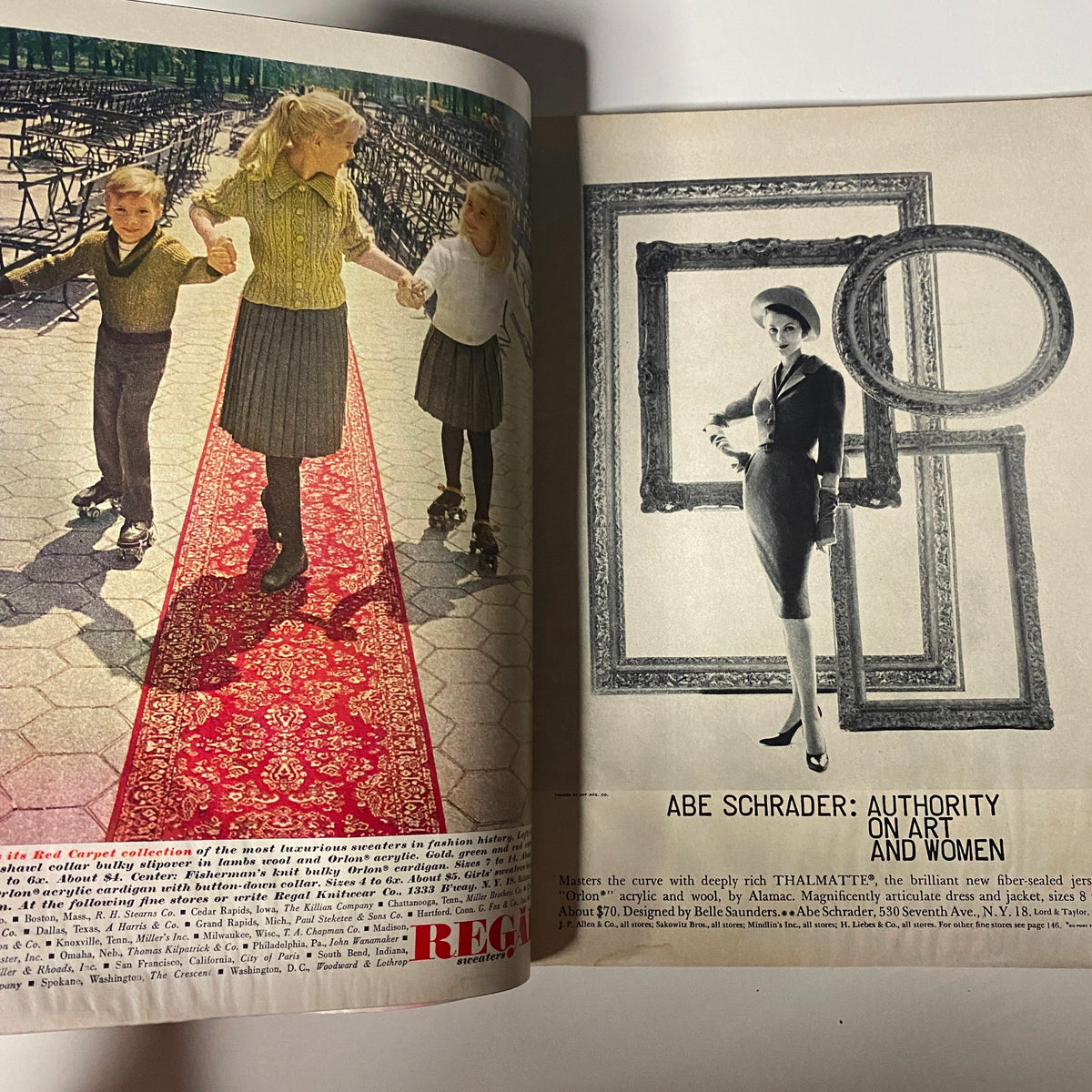


Description
Collector's Note – Why This Issue Matters
August 1960 is a historically precise and editorially significant moment in Harper's Bazaar's history, and this issue — Number 2985, the magazine's ninety-third year — captures the publication at a creative peak that is now recognized as one of the most important in American fashion journalism. The cover is a Richard Avedon photograph, and that attribution alone places this issue within one of the most significant bodies of work in the history of fashion photography. Avedon had been associated with Bazaar since 1945, when the legendary art director Alexey Brodovitch had brought him onto the magazine's staff, and his covers and editorial work from this period are among the most studied and collected in the history of the medium. The cover's documented specificity — a Lilli Ann coral suit in imported French wool piqué, a blackamoor turban by Emmé, gloves from Crescendoe, hair by Enrico Caruso, lips in Antoine de Paris' Glorious lipstick, available at Saks Fifth Avenue for approximately $110 — reflects Bazaar's editorial commitment to the fully documented fashion image, in which every element of the visual was a precise editorial statement rather than an atmospheric suggestion. For collectors building an archive of Harper's Bazaar issues from the Avedon era, this August 1960 edition is a primary document of that collaboration at one of its most creatively confident moments — a cover that is simultaneously a fashion record, a photographic artifact, and a primary source of early-sixties American style at its most authoritative.
The documented table of contents preserved in the listing is one of the most complete primary source records of a single Bazaar issue's editorial range that a collector could encounter, and several entries carry specific historical significance beyond their immediate fashion context. The fiction contribution "Anyway, Bless You" by Sylvia Ashton-Warner is a documented appearance by one of the most significant New Zealand writers of the twentieth century — Ashton-Warner's Spinster had been published in 1958 and her Incense to Idols in 1960, making August 1960 a specific and active moment in her literary career, and a Bazaar fiction placement represents the specific intersection of literary ambition and fashion editorial that distinguished the magazine's cultural range. "If Apples Had Teeth" by Milton and Shirley Glaser documents a contribution by Milton Glaser — one of the most significant American graphic designers of the century, co-founder of New York Magazine and creator of the I ♥ NY logo — at a specific early-career moment, three years before the founding of Push Pin Studios' most influential period. Anthony West's essay "Ichabod, Ichabod, for the Glory Has Departed" and Anthony Ostroff's poem round out a literary section of unusual quality and cultural range. Collectors researching fashion and cultural magazines from 1960 will find this Bazaar a primary source document of extraordinary editorial depth.
The fashion editorial documented across the full table of contents reflects a specific moment in early-sixties American fashion that the "Vivid, Vital and Vibrant" cover concept captures with unusual editorial precision. The color-forward aesthetic documented throughout — coral, clear green, stadium yellow, strong tweeds, vivid accessories — represents the specific transition from the late-fifties' more restrained palette toward the bolder, more saturated color sensibility that would define early-sixties fashion and eventually lead to the decade's most radical aesthetic departures. The "Dynamic Silhouette: Two-Piece Flannels" and "Dynamic Color Tweeds" features document the specific silhouette language of August 1960 fall fashion preview, a moment when Balenciaga's and Chanel's competing visions of the female silhouette were being translated for the American market with the specific editorial intelligence that Bazaar brought to the task. The "Young Perfectionist: The Year of the Cat" and "Young Ladies on the Rise" features reflect the magazine's active cultivation of its younger readership — the Junior Bazaar integration noted in the issue's header was itself an editorial statement about how Bazaar understood its audience's generational range. Howard Ketchum's feature "Color: Its Powers of Persuasion" on page 84 rounds out the issue with a theoretical engagement with the editorial theme that few fashion publications of any era attempted with this kind of intellectual seriousness.
About the Publication
Harper's Bazaar was founded in 1867 and by August 1960 — its ninety-third year of publication — had established itself as one of the most visually and editorially distinguished fashion publications in the world. Under the art direction of Alexey Brodovitch, who had shaped the magazine's visual identity from 1934 to 1958, and through its continued relationships with Avedon and the broader roster of photographers and writers Brodovitch had cultivated, Bazaar in 1960 retained the creative authority that had made it Vogue's most significant competitor for the previous quarter century. Its editorial format combined high-fashion photography with serious literary and cultural journalism — fiction, essays, poetry, and the kind of thoughtful feature writing that distinguished it from publications whose fashion authority was comparable but whose intellectual range was narrower. The August 1960 issue, with its Avedon cover, its Ashton-Warner fiction, its Glaser essay, and its fully documented color fashion editorial, represents Bazaar operating at the intersection of all those traditions simultaneously.
Key Highlights Inside
- Richard Avedon cover — a primary photographic document from one of the most significant fashion photographers in history at the height of his Harper's Bazaar creative partnership, featuring a precisely documented Lilli Ann coral suit cover composition whose full attribution — designer, fabric, retailer, price point, milliner, gloves, hairdresser, and lipstick — reflects Bazaar's editorial commitment to the fully specified fashion image rather than the atmospheric suggestion.
- "Anyway, Bless You" fiction by Sylvia Ashton-Warner — a documented literary contribution by the New Zealand novelist whose Spinster (1958) and Incense to Idols (1960) were actively establishing her as one of the significant literary voices of the period, representing Bazaar's consistent practice of publishing serious literary fiction alongside its fashion editorial in ways that distinguished it from all competitors.
- "If Apples Had Teeth" by Milton and Shirley Glaser — a documented contribution by the graphic designer who would go on to co-found New York Magazine and create the I ♥ NY logo, captured here at a specific early-career moment that constitutes a primary bibliographic record of his Bazaar work in the period before his most widely recognized achievements.
- "Vivid, Vital, Vibrant" color fashion editorial and "The Bazaar Look: Colors Coming in Clear and Strong" spanning pages 70 through 83 — the primary fashion documentation of the August 1960 fall color direction in the American fashion press, captured at the specific transitional moment when the early-sixties bolder palette was asserting itself over the more restrained late-fifties aesthetic.
- "Color: Its Powers of Persuasion" by Howard Ketchum on page 84 — a theoretical feature engaging the color editorial theme with intellectual seriousness unusual for any fashion publication of any era, representing Bazaar's consistent ambition to address its readership as educated, culturally engaged women capable of engaging ideas as well as images.
- Anthony West's essay, Anthony Ostroff's poem, the Royal Danish Ballet's Moon Reindeer feature, and the Yugoslavia travel report — the complete cultural and literary range of an August 1960 Bazaar operating with full editorial confidence across fashion, literature, dance, travel, and cultural commentary simultaneously, documented here with the attribution and page specificity that makes this table of contents an unusually complete primary source.
Condition & Rarity
Harper's Bazaar issues from August 1960 are approaching their sixty-sixth year of existence, and the condition landscape for surviving copies from this Avedon-cover period reflects both the general attrition of that age and the specific collecting pressure that a documented Avedon cover generates across multiple overlapping communities of fashion history collectors, photography enthusiasts, and Bazaar completists. Good condition is an honest and appropriate assessment for a sixty-five-year-old monthly fashion magazine — it describes a copy that retains structural integrity and readable content while carrying the authentic physical evidence of its age. The absence of a mailing label is a meaningful condition positive that preserves the full Avedon cover image without adhesive damage, identifying this as a newsstand copy and distinguishing it from the subscriber examples whose labels partially obscure the cover photography that is this issue's primary visual and documentary asset. For a cover produced by one of the most significant photographers in the history of the medium, the full visual integrity of the unobstructed cover image is the condition attribute most directly relevant to both display value and documentary completeness. The plastic protective sleeve provides ongoing archival protection. Collectors evaluating surviving examples should prioritize the Avedon cover image integrity, the completeness of the literary content pages, and overall structural soundness as primary condition criteria.
Looking for More Issues Like This?
A Good-condition, label-free newsstand copy of Harper's Bazaar from August 1960 with a documented Richard Avedon cover, Sylvia Ashton-Warner fiction, Milton Glaser essays, and a complete table of contents is among the most editorially rich and multiply significant entries in the early-sixties Bazaar archive — the convergence of photographic history, literary history, graphic design history, and fashion editorial history in a single issue gives it a research profile that extends well across multiple scholarly disciplines simultaneously. If this issue is no longer available, the full Harper's Bazaar collection at OriginalMagazines.com is the most comprehensive place to browse surviving issues from across the publication's history and locate other Avedon covers, significant literary contributions, or issues from the magazine's remarkable early-sixties creative period. The 1960 magazine collection brings together surviving issues from across that year's major publications for collectors working to document the full breadth of American fashion and cultural print journalism during the pivotal opening year of the decade that would transform both.