


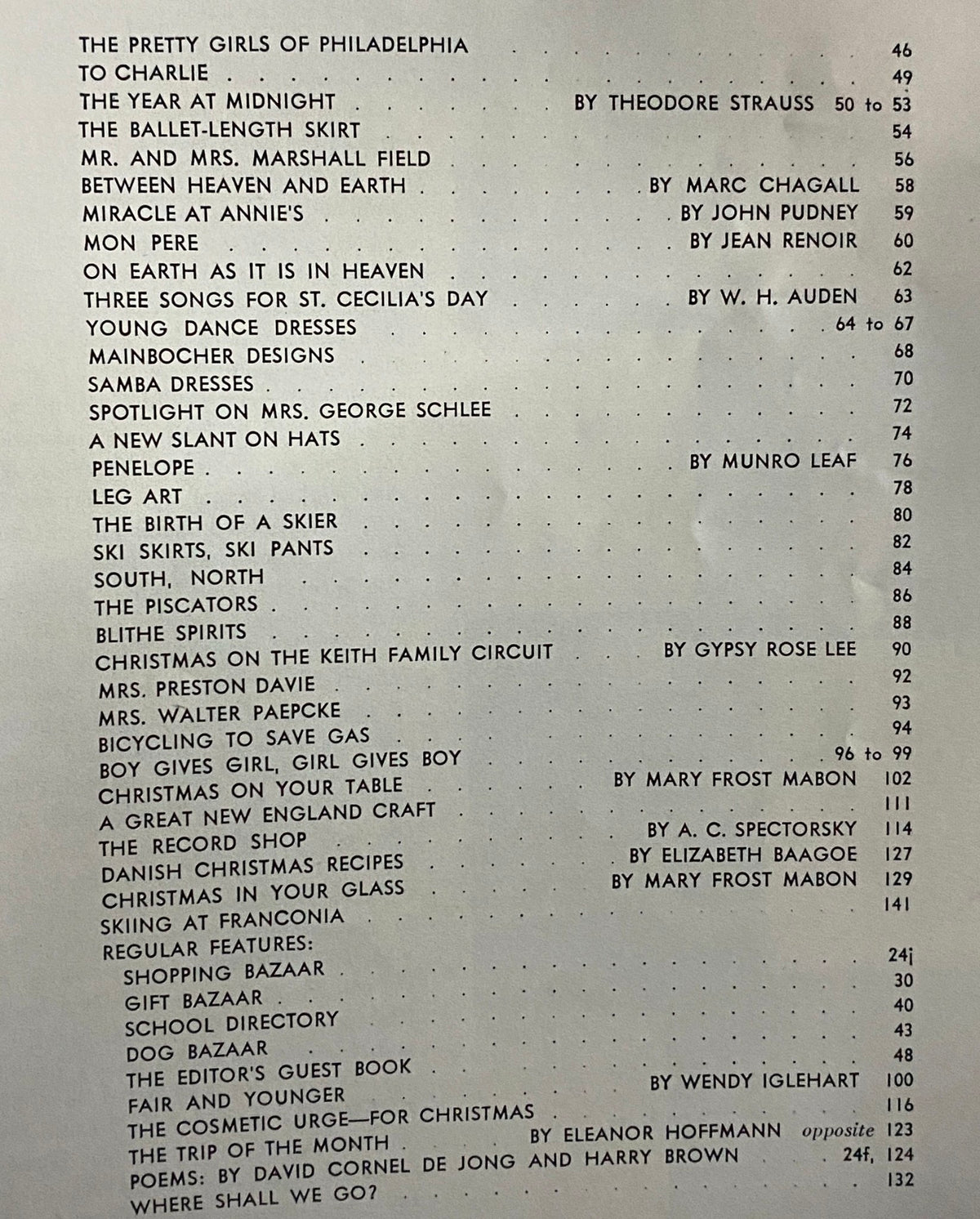


Description
Collector's Note – Why This Issue Matters
December 1941 is one of the most historically charged publication dates in the entire twentieth century. Harper's Bazaar's December issue would have been on newsstands and in subscribers' hands in the days immediately surrounding December 7, 1941 — the Japanese attack on Pearl Harbor that brought the United States into the Second World War. A fashion magazine published at this specific moment occupies a unique documentary position: it was produced and largely completed before the attack, in the America that still existed before that Sunday morning, and it arrived in readers' hands in a country that had been fundamentally and permanently transformed. The "Pretty Girls of Philadelphia" feature, the Danish Christmas recipes, the holiday gift guide, and the W. H. Auden poetry existed in editorial time before Pearl Harbor while being read and received in historical time after it — making this issue a document of the last moment of American peacetime prosperity, preserved in a form that could not have anticipated what would happen to its readership in the weeks of its circulation. For collectors building an archive of Harper's Bazaar issues from across the publication's history, the December 1941 edition carries a historical weight that no editorial intention could have planned — it is a document of a world that ceased to exist in the course of its own distribution.
The specific editorial contents documented in the listing are themselves historically rich beyond their Pearl Harbor context. W. H. Auden's poetry appearing in a December 1941 Harper's Bazaar is a primary document of the specific relationship between serious literary culture and fashion publishing that characterized the best American magazines of the mid-twentieth century — Auden had published "September 1, 1939" two years earlier, a poem that had already become one of the most-quoted responses to the European war's beginning, and his presence in Bazaar's December 1941 issue places the magazine in direct dialogue with the literary engagement with world historical crisis that was defining the most significant poetry of the era. Theodore Strauss's "The Year at Midnight" — the title alone resonates with the specific historical midnight through which this issue was being read — adds a further literary dimension to a publication that was simultaneously presenting holiday fashion and gift ideas. The Danish Christmas recipes carry their own historical poignancy: Denmark had been under German occupation since April 1940, and a feature on Danish Christmas traditions in December 1941 was, whether consciously or not, an act of cultural preservation for a tradition under threat. Collectors researching American magazines from 1941 will find this Harper's Bazaar one of the more layered and historically resonant documents of a year whose final month changed everything.
The "Pretty Girls of Philadelphia" feature that defines this issue's identity as a collectible reflects a specific and historically interesting strand of American fashion journalism in the early 1940s — the practice of identifying and celebrating the social and aesthetic achievements of young women in major American cities, a format that combined aspirational social portraiture with fashion editorial in ways that documented both the specific women photographed and the broader visual culture of affluent American femininity at a specific historical moment. Philadelphia in 1941 had its own distinct social world, and a Bazaar feature devoted to its most stylish young women was a document of that world's self-presentation at the last moment before the war reshaped American social life as completely as it reshaped everything else. The holiday Gift Bazaar content and the fashion editorial surrounding these features capture the specific aesthetic of early-forties American fashion — the transition from thirties streamlining toward the more structured, fabric-rationed silhouettes that wartime conditions would impose — preserving that aesthetic in a form that was literally on the stands as the transition from peacetime to wartime began.
About the Publication
Harper's Bazaar is one of the oldest American fashion magazines, founded in 1867 and published continuously ever since, making the December 1941 issue part of a publication that had already been in operation for seventy-four years at the time of its publication. By the early 1940s it had established itself as the primary high-fashion competitor to Vogue, distinguished by a particularly strong commitment to the visual arts — its art direction under Alexey Brodovitch, who served as art director from 1934 to 1958, was among the most sophisticated and influential in the history of American magazine publishing, and the visual character of Bazaar in this period is widely studied in design history as a defining example of modernist magazine aesthetics applied to fashion journalism. Its readership was affluent, educated, and cosmopolitan — women who expected their fashion magazine to engage literature, art, and cultural life alongside its fashion content, which is precisely what the Auden poetry and Strauss fiction in this issue delivered. Harper's Bazaar in December 1941 was operating under Brodovitch's full visual authority and with an editorial ambition that made it as much a cultural publication as a fashion one.
Key Highlights Inside
- "The Pretty Girls of Philadelphia" cover feature — a social and fashion portrait of Philadelphia's stylish young women in December 1941, documenting the specific visual culture of affluent American femininity at the last moment of American peacetime, and representing the kind of city-specific social fashion journalism that characterized Bazaar's editorial approach to American social life in the early forties.
- Poetry by W. H. Auden — a documented literary contribution from one of the most significant English-language poets of the twentieth century, whose engagement with the political and historical crises of the late thirties and early forties had made him one of the most culturally consequential literary voices in the English-speaking world, appearing in a December 1941 Bazaar at a moment whose historical resonance would only deepen in the days of the issue's circulation.
- "The Year at Midnight" by Theodore Strauss — a literary feature whose title carries particular historical weight given the specific moment of its publication, representing Bazaar's consistent commitment to including serious fiction and literary journalism alongside its fashion and lifestyle content, and constituting a primary source document of the literary-fashion magazine intersection that distinguished the best American periodicals of the early forties.
- Danish Christmas recipes feature — a culinary and cultural document published in December 1941 at a moment when Denmark had been under German occupation for twenty months, carrying an implicit cultural preservation quality that gives routine holiday recipe content an additional layer of historical meaning in this specific issue's context.
- Gift Bazaar holiday feature — a document of the consumer culture and gift-giving conventions of affluent American life in December 1941, capturing the specific products, aesthetics, and aspirational purchasing that defined the last American Christmas before wartime rationing and production shifts fundamentally altered the commercial landscape that this kind of editorial content reflected.
- Note: Specific fashion editorial titles, photography credits, and confirmed additional interior content details beyond the documented features have not been individually verified for this issue. The highlights above reflect Harper's Bazaar's well-established 1941 editorial format, the verified feature subjects, and the well-documented historical context of December 1941.
Condition & Rarity
Harper's Bazaar issues from December 1941 are approaching their eighty-fifth year of existence, and surviving copies from this period represent a genuinely small fraction of the original print run — wartime paper collection drives, the general attrition of eighty-plus years of storage, and the specific fragility of early-forties magazine paper stock have collectively reduced the survival rate of publications from this era to a level that makes any intact, displayable copy a meaningful collector find. Excellent condition with light wear typical for its age is a strong and credible assessment for a publication of this vintage — it describes a copy that has maintained structural integrity and visual clarity through eight decades of existence, indicating storage circumstances that were unusually favorable relative to what most surviving copies from this period have experienced. The early-forties Bazaar paper stock, while better than the wartime-substituted paper that would characterize later-war publications, was still inherently acidic and subject to the tanning and brittleness that affect all period-appropriate periodicals over multi-decade storage. Light wear on a paper this old is an honest and expected characteristic rather than a condition defect. The plastic protective sleeve provides ongoing archival protection that is essential for a publication of this age and paper chemistry. Collectors evaluating surviving examples of this issue should prioritize cover integrity — the "Pretty Girls of Philadelphia" image and the Bazaar masthead under Brodovitch's art direction are the primary visual documents — alongside interior page legibility and the completeness of the Auden poetry and Strauss fiction as primary condition criteria.
Looking for More Issues Like This?
A December 1941 Harper's Bazaar in excellent condition with confirmed W. H. Auden poetry, Danish Christmas content, and the "Pretty Girls of Philadelphia" feature is an eighty-five-year-old primary document of extraordinary historical resonance — issues from the final months of American peacetime in displayable condition surface very infrequently, and this specific combination of literary, fashion, and cultural content gives this issue a collector profile that extends well beyond the standard vintage fashion magazine category. If this issue is no longer available, the full Harper's Bazaar collection at OriginalMagazines.com is the most comprehensive place to browse surviving issues from across the publication's history and locate other wartime-era editions, significant covers, or specific years from Brodovitch's remarkable art direction tenure. The 1941 magazine collection brings together surviving issues from across that year's major American publications for collectors working to document the full range of American print culture during the last year of peacetime and the first days of the country's entry into the Second World War.