





Description
Collector's Note – Why This Issue Matters
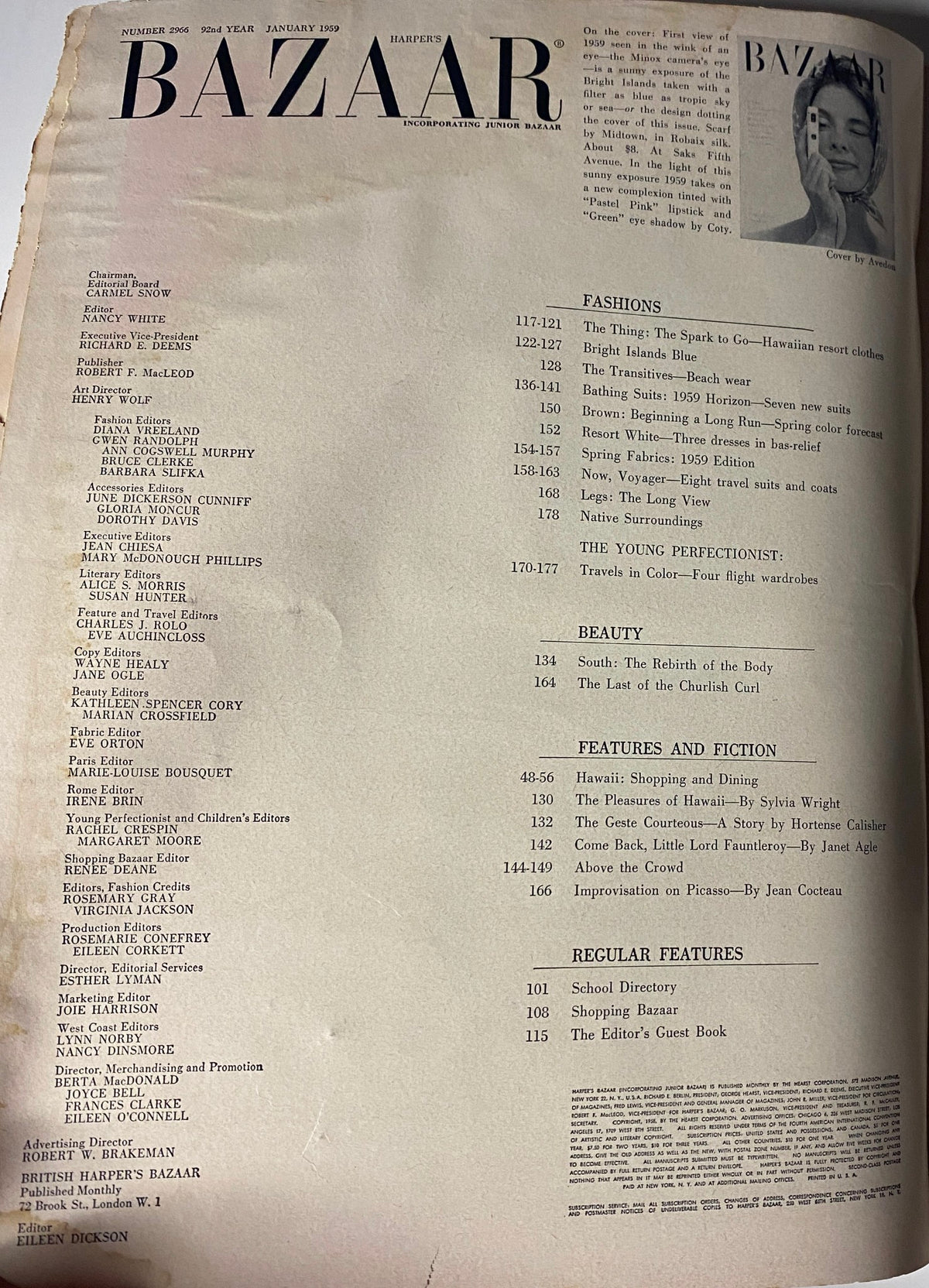
The January 1959 issue of Harper's Bazaar — Number 2965, the 92nd Year — with a cover by Richard Avedon is a primary document of one of mid-century American fashion photography's most consequential creative partnerships at a specific and historically significant calendar moment. Avedon had been Harper's Bazaar's primary fashion photographer since 1945, working under the editorial direction of Alexey Brodovitch, and by January 1959 his relationship with the magazine and its visual identity was at its most fully developed. The confirmed cover description — a woman and dog in motion, framed by what the listing describes as the "Minoan camera's eye," styled with a Milton scarf and Coty "Pastel Pink" lipstick — is characteristic of Avedon's late-1950s approach: the spontaneous motion, the specific emotional register, the editorial intelligence that made his Bazaar work the defining fashion photography of the era. A confirmed Avedon cover credit on the first issue of 1959 — a January number that sets the editorial tone for the year — is a primary document of his sustained contribution to the magazine's visual identity at the height of his most celebrated creative period. For collectors building archives of vintage Harper's Bazaar magazine issues, confirmed Avedon cover credits from the late 1950s represent the publication's most photographically significant primary documents.
The Hawaiian editorial focus of this January 1959 issue is historically specific in a way that requires context to fully appreciate. Hawaii had been admitted as the 49th state of the United States in August 1959 — seven months after this January issue's publication date. In January 1959, Hawaii was still a territory, and a major Harper's Bazaar editorial focus on Hawaiian resort fashion and lifestyle was engaging a destination that was at that specific moment transitioning from exotic colonial territory to American state. The confirmed Hawaii shopping and dining coverage, "The Pleasures of Hawaii" by Sylvia Wright, and the resort and beach fashion editorial together constitute a primary document of how American fashion journalism understood Hawaii at the specific pre-statehood threshold — the last full year it could be treated as a foreign-feeling luxury destination rather than an American state. The confirmed Jean Cocteau contribution — "Improvisation on Picasso" — gives this issue an independent literary and art-historical significance: Cocteau's late-career engagement with Picasso's legacy, published in an American fashion magazine in January 1959, is a primary document of two of the twentieth century's most significant creative figures in documented relationship. The confirmed fiction by Hortense Calisher — "The Geste Courteous" — adds a literary dimension consistent with Bazaar's consistent practice of publishing significant American fiction alongside its fashion content. Collectors of 1959 magazines focused on fashion, literary, and American cultural history will find this issue provides an unusually layered primary record of multiple converging historical moments.
The confirmed spring 1959 fashion content — spring color forecasts, 1959 spring fabrics, travel suits, and the seven new bathing suits horizon — provides a primary dated record of the specific aesthetic direction of the coming season as understood by one of American fashion journalism's most authoritative voices. The "Brown: Beginning a Long Run" spring color forecast and the "Spring Fabrics: 1959 Edition" feature document the specific color and material vocabulary of spring 1959 with the authority of Avedon's visual framing and Bazaar's editorial expertise combined.
About the Publication
Harper's Bazaar, founded in 1867 and by January 1959 in its 92nd year of publication, was by this point operating as one of the two dominant American fashion authorities alongside Vogue, distinguished by its consistent commitment to fine art, literary fiction, and the most ambitious fashion photography in the American market. Under the art direction of Alexey Brodovitch, who had been with the magazine since 1934, and with Richard Avedon as its primary photographer, the late-1950s Bazaar was producing consistently remarkable work — the combination of Brodovitch's design intelligence and Avedon's photographic vision made it the most visually sophisticated fashion magazine in the American market. Its January issue was its annual opening statement, combining the resort season's fashion coverage with the spring preview that set the aesthetic agenda for the year.
Key Highlights Inside
- Richard Avedon January 1959 cover — A confirmed Avedon cover credit on the first issue of 1959, with specific confirmed styling details — Milton scarf, Coty Pastel Pink lipstick, woman and dog in motion — representing his late-1950s spontaneous movement aesthetic at its most fully developed.
- Hawaii pre-statehood fashion and lifestyle editorial — A confirmed extended Hawaii focus including resort clothes, beach wear, shopping and dining coverage, and "The Pleasures of Hawaii" by Sylvia Wright, published seven months before Hawaiian statehood — primary documentation of American fashion journalism's engagement with Hawaii as a pre-statehood destination.
- "Improvisation on Picasso" — Jean Cocteau (page 166) — A confirmed art and literary contribution by the French polymath, providing a primary document of Cocteau's late-career engagement with Picasso's legacy published in an American fashion magazine context.
- "The Geste Courteous" — fiction by Hortense Calisher (page 132) — A confirmed fiction contribution by a significant American short story writer, consistent with Bazaar's practice of publishing substantial literary fiction alongside its fashion content.
- Spring 1959 fashion forecasts — color, fabric, and resort coverage — Confirmed spring preview content including "Brown: Beginning a Long Run," "Spring Fabrics: 1959 Edition," and seven new bathing suits, providing a primary dated record of the specific aesthetic direction of spring 1959.
- No subscription label — confirmed newsstand copy — The absence of a mailing label preserves the full Avedon cover image without address obstruction, confirming retail newsstand origin and the preferred state for display-grade collecting of an Avedon cover.
Condition & Rarity
Good condition with plastic protective covering and no subscription label represents a workable collector grade for a sixty-five-year-old monthly fashion magazine with a confirmed Avedon cover and the confirmed editorial depth this issue contains. Harper's Bazaar was printed on paper stock of good commercial quality, and issues from 1959 that survive in good condition have typically benefited from deliberate preservation. The no-label newsstand origin confirms the complete Avedon cover image is fully visible without address obstruction — particularly significant for a cover whose photographic content is its primary display attribute. The listing defers to photographs for detailed condition assessment beyond confirming overall good condition. For a confirmed Avedon cover issue, the cover's surface condition and the legibility and completeness of the Jean Cocteau contribution and the Hawaii resort fashion pages are the primary evaluation factors worth confirming from available photographs.
Looking for More Issues Like This?
Richard Avedon Harper's Bazaar covers from the late 1950s are among the most photographically significant primary documents in the publication's entire history, and a January 1959 issue with the confirmed Jean Cocteau Picasso piece and the pre-statehood Hawaii editorial focus makes this historically richer than most comparable numbers from the year. The broader Harper's Bazaar archive at OriginalMagazines.com spans many decades of the publication's run and is worth exploring carefully for other late-1950s Avedon-era issues from the magazine's most artistically celebrated period. For collectors focused on the specific cultural and fashion moment of 1959, the complete 1959 magazine collection documents a range of titles from a year that stood at the threshold of one of the most consequential decades in American cultural history.