




Description
Collector's Note – Why This Issue Matters
This May 1977 issue of Harper's Bazaar arrives at an extraordinarily precise moment in Farrah Fawcett's career, landing within days of the news that she had submitted her resignation from Charlie's Angels just before the first season finale aired on May 4, 1977. At the time, the show was a genuine television phenomenon, finishing the 1976-77 season among the most-watched programs on American television, and Fawcett's red swimsuit poster had already sold millions of copies, making her one of the most photographed and recognizable women in the country. Her decision to leave the series at the absolute height of its popularity, reportedly to pursue feature film roles rather than continue in episodic television, became a significant entertainment story of the period and led to a prolonged contract dispute with ABC over the following months. A Harper's Bazaar cover from this exact window captures Fawcett at the singular moment when her stardom and her departure from the role that created it were both unfolding simultaneously. For collectors, that timing places this issue at a genuinely pivotal point in 1970s pop culture, rather than simply during the broader span of her fame.
Fawcett's appearance on a fashion authority like Harper's Bazaar also reflects how quickly her image had transcended television itself by the spring of 1977. Beyond the swimsuit poster and her role as Jill Munroe, her feathered blond hairstyle had become a nationwide phenomenon, with women across the country requesting "the Farrah" from their hairdressers, and her look had been adapted into a wide range of licensed products. That level of cultural saturation made her a natural fit for a major fashion magazine cover, since her image carried aspirational appeal well beyond fans of her television work specifically. Harper's Bazaar's decision to feature her during this particular window suggests an editorial awareness of just how central she had become to the broader visual culture of the period, independent of whether readers had even seen an episode of her show.
For collectors, this issue sits at a genuinely rare intersection of timing and cultural significance: a major fashion magazine cover capturing Fawcett in the exact week her departure from television's biggest hit became public, at the absolute peak of the swimsuit-poster and Farrah-hairstyle phenomenon that defined her stardom. That specificity of timing is part of what distinguishes this issue within the broader landscape of Farrah Fawcett magazine collecting, where so much surviving material documents her fame in more general terms rather than this precise turning point.
About the Publication
Harper's Bazaar, first published in 1867, is one of the longest-running fashion publications in the United States and has historically positioned itself toward an upscale, style-conscious readership interested in high fashion, beauty, and cultural commentary. Through the 1970s, the magazine followed a monthly editorial format built around seasonal fashion previews, beauty features, and lifestyle reporting, often anchored by a single cover personality drawn from the worlds of modeling, film, or television. Issues from this period typically combined fashion-forward photography and trend coverage with shorter service-oriented sections addressing beauty, health, and seasonal style, a structure this May 1977 issue reflects in its coverage of summer fashion and fitness. Bazaar's willingness to feature television and film personalities alongside professional models on its cover reflected the magazine's broader recognition that fame itself, regardless of its source, had become a significant driver of fashion influence by the mid-1970s. This blend of high fashion authority and pop culture relevance is part of what distinguished Bazaar within the competitive landscape of American fashion magazines during this decade.
Key Highlights Inside
- Cover feature on actress Farrah Fawcett, published within days of her announced departure from Charlie's Angels at the close of its first season. The show was a major television hit at the time, and Fawcett's exit became a widely covered entertainment story. This issue captures her at the precise convergence of peak fame and a major career transition.
- "The Bazaar Thing: Stripes," a fashion feature highlighting striped clothing trends for the season. Seasonal trend features built around a single recurring motif were a common format for fashion magazines of this period. This kind of piece reflects Bazaar's typical approach to highlighting a specific style element each issue.
- "Silky Summer Evening Dresses," a feature on eveningwear suited to the summer season. Seasonal eveningwear coverage was a regular component of fashion magazine editorial calendars, particularly for issues released ahead of the summer social season. This piece fits squarely within Bazaar's typical late-spring fashion programming.
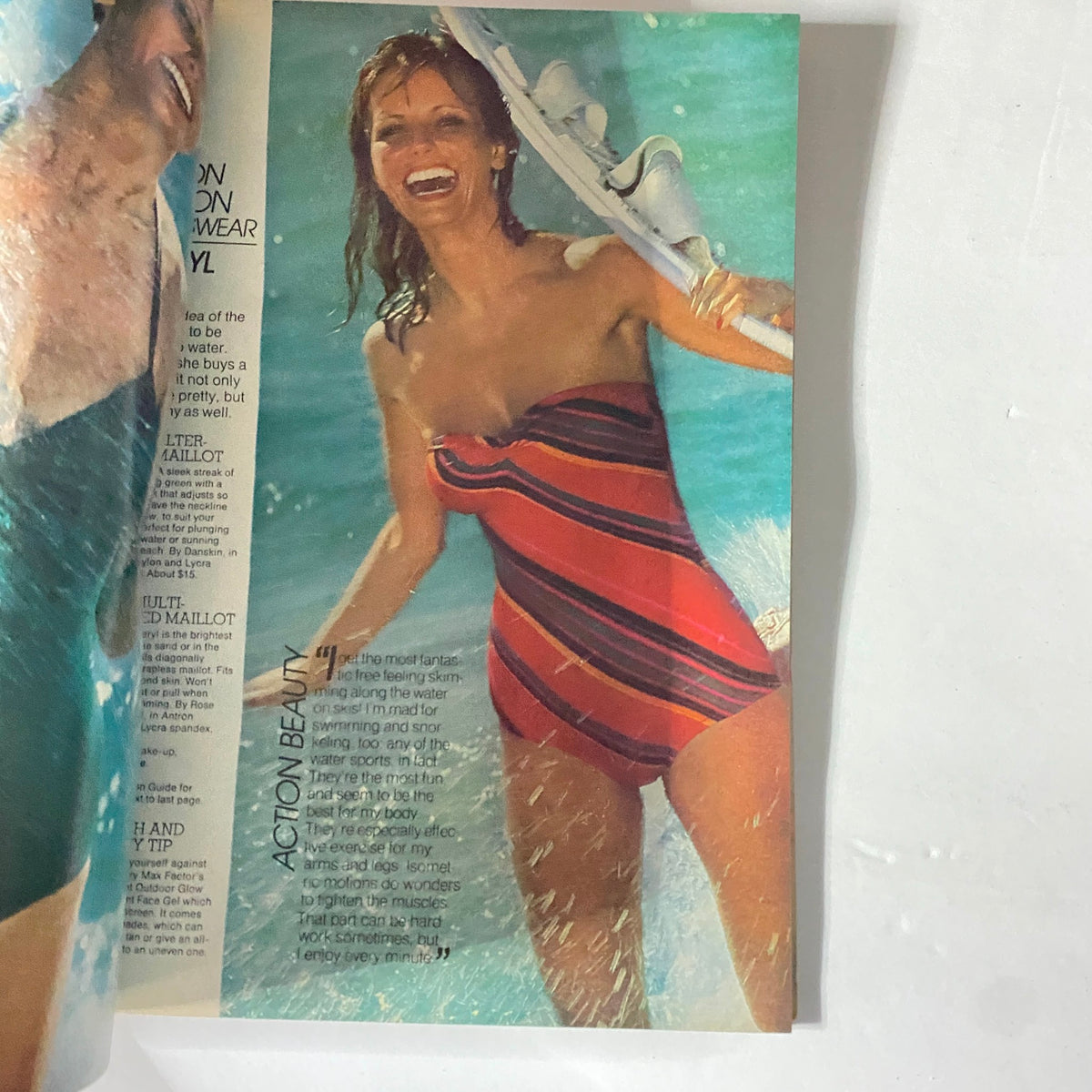
- "Bazaar's Action Sports Health Guide," a feature addressing fitness and health guidance tied to summer activity. Health and fitness content aimed at active, image-conscious readers was an increasingly common feature in fashion magazines during the late 1970s. Pairing this guide with a cover personality known for her fitness and physical image reflects a deliberate editorial choice typical of the era.
Condition & Rarity
Surviving copies of this issue are generally evaluated using the same standards collectors apply across vintage fashion periodicals: cover gloss and corner sharpness, spine integrity, absence of subscription labels or mailing stickers, and overall page condition free of tears, foxing, or moisture damage. A copy described as being in great shape for its age, with only minor wear on the edges, would be considered a strong example for a magazine now approaching fifty years old. A plastic protective sleeve is a standard and effective safeguard for issues of this vintage, helping prevent further handling wear, UV exposure, and humidity damage, though it has no bearing on the underlying grade of the magazine itself. As with most 1970s fashion titles, unlabeled newsstand copies tend to be more desirable to collectors than subscription copies, since they typically present cleaner covers without label residue or address imprinting. Given this issue's connection to such a specific and widely documented moment in Fawcett's career, cover presentation carries particular weight in overall condition assessments for collectors focused on this period of her stardom. Pages free of yellowing, brittleness, or prior tape repairs remain the benchmark for a well-preserved copy of any magazine from this era.
Looking for More Issues Like This?
A Harper's Bazaar cover capturing Farrah Fawcett at the exact moment of her departure from Charlie's Angels, during the height of the swimsuit-poster and Farrah-hairstyle phenomenon, represents a genuinely significant find for collectors tracing this specific turning point in 1970s pop culture. If this particular issue isn't available, it's worth browsing the full Farrah Fawcett magazine collection for other covers spanning her decades in entertainment. The broader Harper's Bazaar collection is also worth exploring for more from this title's long run. Collectors focused on the era itself may want to look through the full range of 1977 magazines for other issues from that pivotal year. Each of these collections offers a different way into the period, whether the interest lies in a specific public figure, this title's editorial history, or the broader cultural snapshot of a single year. A single year's worth of magazines often tells a fuller story than any one issue alone, particularly for a year as eventful as 1977 in American television and fashion. Whichever angle appeals most, these collections are a useful starting point for going further into this period of magazine and pop culture history.