


Description
Collector's Note – Why This Issue Matters
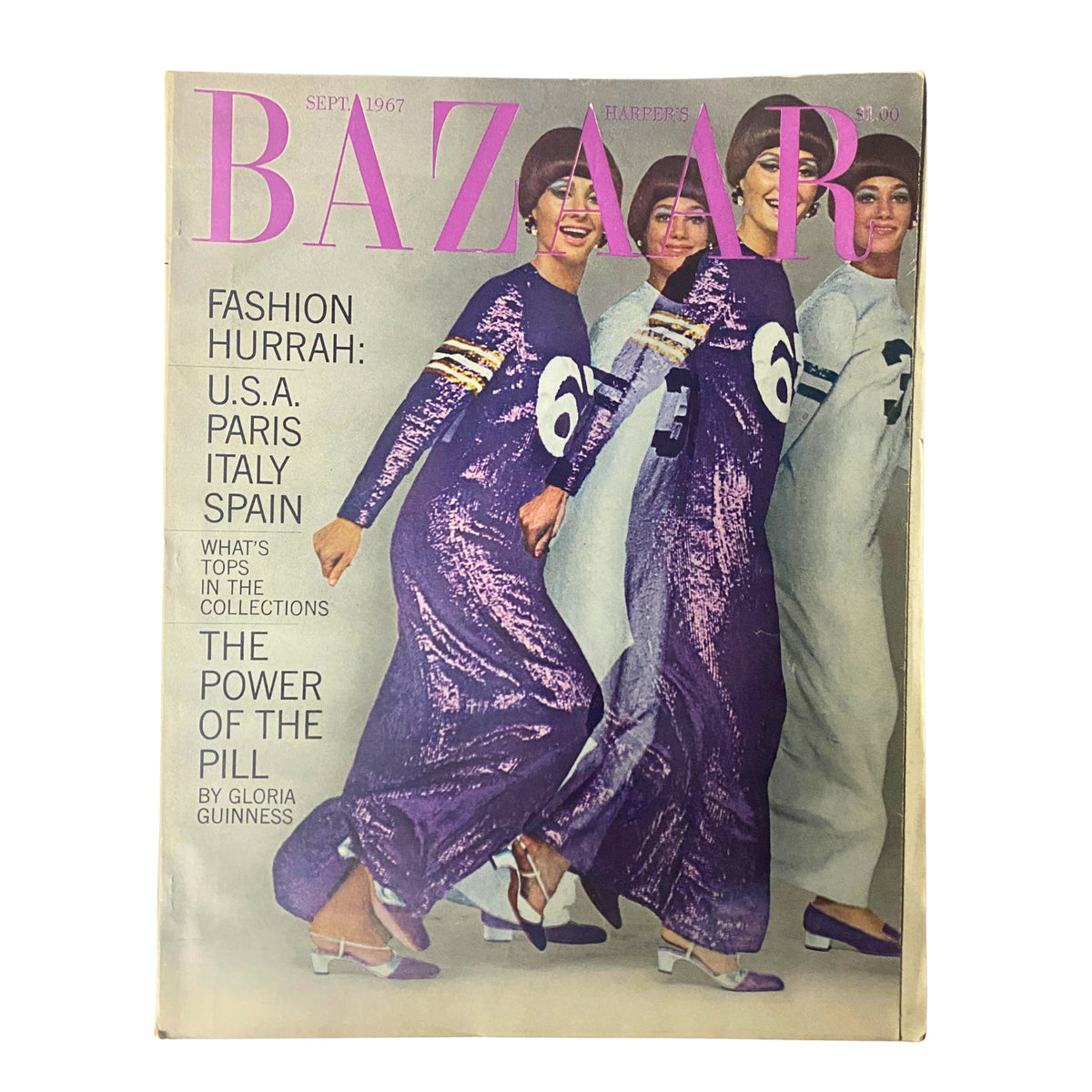
The September 1967 issue of Harper's Bazaar, with "The Starglow Look" cover photographed by Hiro, is a document of the publication at one of its most creatively ambitious moments — and of American fashion photography at the precise intersection of mid-1960s modernism and the impending aesthetic revolution of the late decade. Hiro — the Japanese-American photographer born Yasuhiro Wakabayashi who had become one of Richard Avedon's closest collaborators and one of the most technically inventive photographers in the American fashion press — was by September 1967 producing some of the most visually distinctive work appearing in any American magazine. His cover for this issue, deploying Geoffrey Beene's spangled jersey dresses with Frances Denney's incandescent makeup and Suga of Kenneth's mushroom-cap hairstyles under the "Starglow" editorial concept, is a document of 1960s fashion photography's engagement with light, surface, and glamour as primary editorial subjects in their own right. The "America Hurrah!" frame for the cover story was simultaneously an editorial celebration of American fashion's confidence and a reference point for the broader cultural nationalism that was reshaping the relationship between American design and European couture during this period. For collectors building an archive of Harper's Bazaar issues from the 1960s, this September 1967 edition is a primary document of the publication's editorial vision at its most photographically sophisticated.
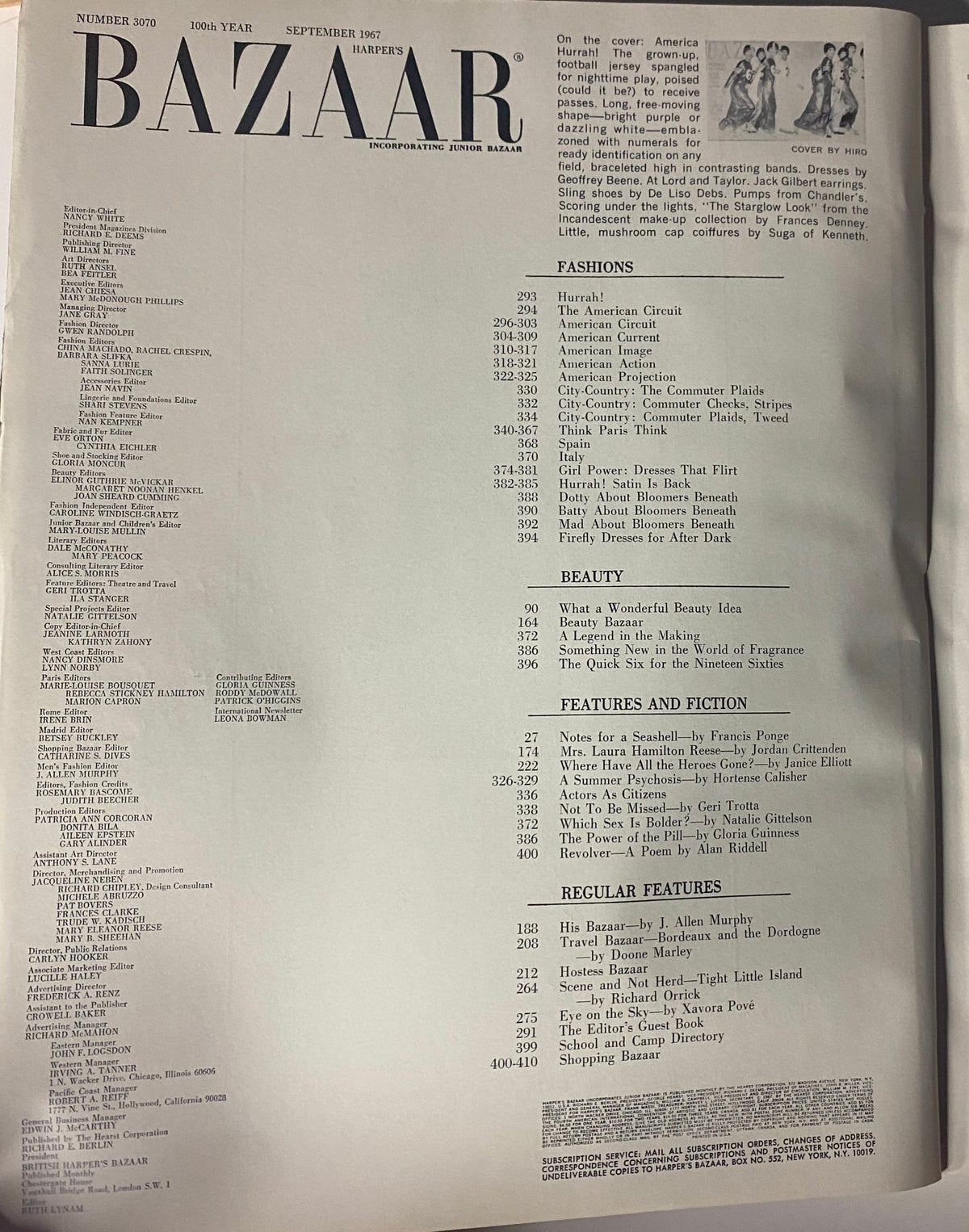
The confirmed table of contents gives this issue extraordinary depth as a historical document of late-1960s American fashion and cultural life. The September collections issue was traditionally the most substantial and ambitious of Harper's Bazaar's annual publishing calendar, and the confirmed editorial architecture — "Hurrah!", "The American Circuit," "American Current," "American Action," "American Projection" — reflects an explicit, sustained editorial argument about American fashion's coming of age as a global force rather than a European follower. Geoffrey Beene's prominence in the cover story is particularly significant: he was in 1967 one of the American designers most associated with the development of a specifically American approach to formal dressing that drew on sportswear principles while addressing evening glamour, and his spangled jersey dresses represent exactly that synthesis. Gloria Guinness's "The Power of the Pill" feature (page 386) and "Which Sex Is Bolder?" by Natalie Gitleson (page 372) confirm the issue's engagement with the social and sexual politics that were reshaping American women's lives alongside the fashion content. Hortense Calisher's fiction, Francis Ponge's poetry, and Jordan Crittenden's profile complete a cultural picture that extended well beyond fashion into the broader literary and intellectual life of the moment. Publications from 1967 document American fashion and culture at one of its most genuinely transformative years.
About the Publication
Harper's Bazaar, founded in 1867 and thus in its centennial year when this September 1967 issue appeared, was by this point one of the two most prestigious American fashion magazines — a publication whose combination of editorial ambition, photographic innovation, and literary seriousness distinguished it from purely commercial competitors. Under editor in chief Nancy White, who led the publication through this period, Harper's Bazaar maintained the tradition of serious fashion photography and cultural breadth that her predecessor Carmel Snow and art director Alexey Brodovitch had established, and its roster of photographers — including Hiro, Avedon, and Penn — gave it visual authority that sustained its standing even as the fashion landscape was being radically transformed by the late-1960s youth culture revolution.
Key Highlights Inside
- "The Starglow Look" cover by Hiro — one of the most technically inventive photographers in American fashion publishing, deploying Geoffrey Beene's spangled jersey dresses with Frances Denney's incandescent makeup and mushroom-cap hairstyles by Suga of Kenneth in an editorial concept built around light, surface, and evening glamour.
- "America Hurrah!" editorial framework — a sustained, multi-section argument across "The American Circuit," "American Current," "American Action," and "American Projection" documenting Harper's Bazaar's editorial position in September 1967 that American fashion had achieved international authority in its own right.
- "The Power of the Pill" by Gloria Guinness (p.386) — social commentary on contraception's transformative effect on women's lives, published in the same issue as the season's most ambitious fashion editorial, confirming the publication's engagement with the social politics shaping its readership's daily experience.
- "Bloomers Beneath" (pp.380–386) — documentation of a specific late-1960s fashion revival that was both a silhouette development and a cultural statement about the relationship between fashion and the body during a period of significant social change.
- Fiction and poetry contributions from Hortense Calisher, Francis Ponge, and Alan Riddell — confirming Harper's Bazaar's consistent practice of commissioning serious literary work alongside fashion editorial, a tradition that distinguished it from purely commercial competitors.
- Centennial year publication context — this September 1967 issue appeared in Harper's Bazaar's hundredth anniversary year, giving its editorial celebration of American fashion additional historical resonance as a statement of the publication's own cultural legacy.
Condition & Rarity
Good condition is an appropriate assessment for a monthly fashion magazine now nearly sixty years old — particularly the September collections issue, which was traditionally the largest and most densely produced edition of the publishing year. The absence of a mailing label confirms newsstand origin, the preferred configuration for display collectors of late-1960s Harper's Bazaar issues. The plastic protective covering indicates deliberate preservation storage. For a coated-stock monthly of this vintage, the primary condition factors are cover surface brightness and the clarity of Hiro's cover photography — the primary visual and collectible attribute — spine integrity given the September issue's likely substantial page count, and the completeness and flatness of the interior fashion editorial photography that constitutes the issue's most historically significant visual content.
Looking for More Issues Like This?
A label-free September 1967 Harper's Bazaar centennial-year issue with a Hiro cover, Geoffrey Beene fashion editorial, and this depth of confirmed social and literary content is a historically layered find that appeals to collectors of 1960s fashion photography, American design history, and late-1960s cultural journalism simultaneously. If this issue has already been claimed, the full archive of Harper's Bazaar issues spans the publication's long run and surfaces other significant Hiro covers and landmark editorial moments from across its history. The broader 1967 magazine collection offers additional context for this extraordinary year in American fashion and cultural life.