



Description
Collector’s Note – Why This Issue Matters
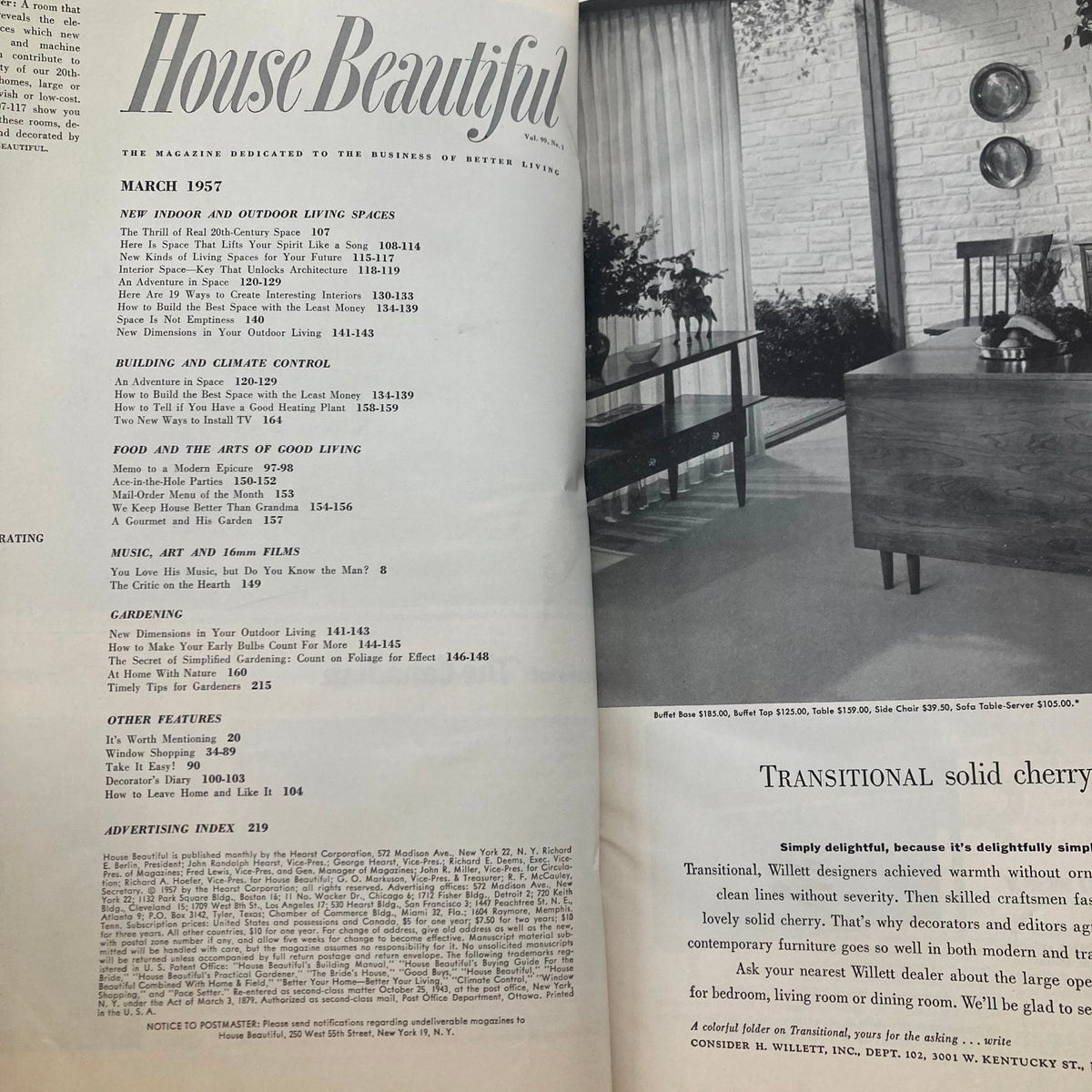
The March 1957 issue of House Beautiful belongs to one of the most influential periods in American shelter-magazine publishing. The supplied listing title highlights “The Critic on the Hearth,” a phrase that strongly suggests a reflective feature about judgment, taste, comfort, and the standards by which a home is evaluated. Because a reliable full contents transcription has not been verified, the phrase should not be treated as the magazine’s complete official theme unless confirmed from the printed issue. Even so, it fits the editorial world of House Beautiful in the 1950s, when domestic interiors were discussed not only as decoration but as expressions of judgment, personality, family life, and modern living. The “hearth” was more than a fireplace; it was a symbolic center of warmth, gathering, and household identity. A “critic” placed there suggests that the home itself was being examined from within, by the people who lived with its choices every day. That idea is especially appropriate for a magazine devoted to architecture, furnishings, color, materials, gardens, and the emotional experience of rooms. The issue therefore offers a useful entry point into the mid-century conversation about what made a house not merely fashionable, but livable.
In 1957, House Beautiful was operating under editor Elizabeth Gordon, whose long tenure shaped the magazine’s strong postwar voice. Gordon promoted a vision of home design that emphasized comfort, individuality, climate, regional character, craftsmanship, and what she considered humane modern living. Her approach often resisted purely abstract or impersonal modernism in favor of interiors that appeared responsive to family life, local conditions, and everyday use. A March issue would have reached readers at the beginning of the spring design season, a natural moment for thinking about renewal, rearrangement, painting, gardening, fabrics, and fresh domestic plans. The magazine’s readers were not simply looking at attractive rooms; they were being trained to judge scale, color, furniture placement, light, texture, and the relationship between indoor and outdoor life. House Beautiful treated these choices as matters of culture and personal values as much as matters of shopping. That makes even an issue with only partially verified contents historically valuable. It preserves the atmosphere of a moment when postwar American households were being asked to think seriously about taste.
The phrase “The Critic on the Hearth” also captures a central tension in 1950s home publishing. Magazines offered expertise, but the final test of any room was domestic experience: whether a family could live comfortably, move easily, entertain gracefully, and feel emotionally at home. House Beautiful’s authority came from combining professional design language with practical appeal to readers furnishing real houses. Its pages likely included interiors, furnishings, color ideas, advertisements, and service material aimed at homeowners trying to create beauty within the conditions of ordinary life. The listing’s no-label status is meaningful because it preserves the cover without the interruption of a subscriber address block. However, no-label status alone does not prove original newsstand distribution. As part of the House Beautiful magazine archive and the broader record of magazines published in 1957, this issue is best understood as a design-history artifact from the late Eisenhower era, when American interiors carried ideas about prosperity, comfort, taste, family life, and cultural confidence.
About the Publication
House Beautiful is an American shelter magazine founded in 1896. It became one of the longest-running and most influential publications devoted to domestic architecture, interiors, decoration, gardens, furnishings, and household taste. The magazine addressed readers who cared about houses as lived environments rather than merely as structures. Its pages typically combined photographs, floor plans, decorating advice, color guidance, furniture selections, product information, garden features, architectural commentary, and advertising. By the 1950s, House Beautiful occupied an important position between professional design discourse and middle-class domestic aspiration. It helped translate architectural and decorating ideas into language that homeowners could understand and apply. Under Elizabeth Gordon’s editorial leadership, the magazine became especially associated with arguments about livability, climate, comfort, regional character, and the emotional quality of interiors. Gordon’s House Beautiful did not treat decoration as surface alone. It framed home design as a cultural practice connected with health, family relationships, citizenship, craft, and personal independence. The magazine’s advertising pages documented furniture, fabrics, appliances, flooring, wall coverings, lighting, kitchen equipment, paint, tableware, and many other products central to postwar consumer life. Its editorial features helped readers imagine how those products might become part of coherent domestic environments. Surviving issues now provide primary-source evidence for design historians, architects, decorators, collectors, and researchers studying how Americans understood the meaning of home in the twentieth century.
Key Highlights Inside
- “The Critic on the Hearth” is the feature or phrase most directly associated with the supplied listing title. Its exact byline, page number, and full article content have not been independently verified from a complete contents page. It should therefore be preserved as documented listing wording rather than expanded with invented article details.
- The title phrase is historically suggestive because it joins judgment with the domestic center of the home. A hearth traditionally represents warmth, family gathering, shelter, and continuity. Placing a critic there implies that the true measure of design may be found in everyday living rather than in display alone.
- The issue belongs to House Beautiful’s Elizabeth Gordon period. Gordon’s editorial leadership gave the magazine a strong point of view about comfort, taste, regional character, climate, and humane domestic modernity. This context helps explain why a mid-century House Beautiful issue can be studied as design commentary rather than as simple decorating advice.
- The March 1957 date places the issue at the beginning of a spring design season. Spring issues of shelter magazines commonly addressed renewal, color, fabrics, gardening, cleaning, rearrangement, and fresh approaches to household life. Specific March 1957 features should still be confirmed from the printed contents before being listed individually.
- The no-label presentation is a meaningful visual detail. An address label would interrupt the cover design, masthead area, and any cover lines used to promote the issue. The absence of a label should not be used by itself as proof that the copy was originally sold at a newsstand.
- The magazine likely included advertising related to furniture, fabrics, appliances, paint, flooring, tableware, lighting, kitchens, gardens, and building materials. Such advertising is often as valuable as the editorial material for understanding mid-century design culture. Exact brands and products should be identified only after reviewing the issue’s pages.
- House Beautiful issues from this period are useful for studying how professional design ideas reached middle-class readers. The magazine translated architectural and decorating principles into rooms, photographs, captions, product suggestions, and practical arguments. That translation process is one reason the publication remains important to historians of American domestic life.
- The issue should be approached as a source on taste formation. It shows how readers were encouraged to judge proportion, color, texture, comfort, usefulness, and atmosphere. Those judgments reveal the values attached to the postwar American home in 1957.
Condition & Rarity
The supplied description characterizes this March 1957 issue as being in Excellent condition with only light age-appropriate wear. That wording should be treated as the seller’s general assessment rather than as a standardized or independently certified grade. The supplied title identifies the copy as having no subscriber mailing label on the front cover. This is visually important because it allows the cover image, masthead, and promotional wording to remain unobstructed. No-label status does not conclusively establish newsstand distribution. The description does not provide a detailed inventory of edge wear, corner wear, creasing, spine stress, rubbing, marks, fading, toning, or binding condition. It also does not confirm whether every page, advertisement, insert, plan, article, and department remains present. No definite statement has been supplied concerning detached pages, clipping, handwriting, staining, moisture exposure, tape repairs, missing material, or restoration. These characteristics should be evaluated from photographs of the exact copy whenever possible. A plastic protective covering is reported as part of the seller’s handling practice, but any such sleeve is a later storage accessory rather than an original component of the 1957 publication. House Beautiful was a national magazine, so this issue should not be called rare without copy-specific evidence. Historical and collector interest is best evaluated through the no-label cover, Elizabeth Gordon-era context, design content, completeness, and actual physical condition.
Looking for More Issues Like This?
Additional examples of mid-century interior design, architecture, and domestic taste can be explored through the House Beautiful magazine collection. Comparing issues from 1956, 1957, and 1958 can reveal how the magazine presented postwar modernity, traditional furnishings, regional design, gardens, kitchens, color planning, and family rooms. Issues from Elizabeth Gordon’s editorial period are especially useful for understanding her influence on American domestic taste. Researchers can compare her approach with other shelter magazines such as House & Garden, Better Homes & Gardens, and Architectural Forum. Collectors interested in fireplaces, living rooms, and domestic symbolism may find the phrase “The Critic on the Hearth” especially useful as a thematic anchor. Furniture historians can study these issues for evidence of woods, upholstery, tables, chairs, lighting, storage, and room arrangements promoted to mid-century homeowners. Advertising pages may reveal the materials and brands through which readers were encouraged to modernize their homes. Garden and outdoor-living features can also show how magazines connected interior comfort with patios, terraces, planting, climate, and suburban land. The wider 1957 magazine archive places House Beautiful beside contemporary news, fashion, entertainment, family, and general-interest publications. Studying those titles together helps reveal how American prosperity, design education, consumer culture, and ideals of family life overlapped in the late 1950s. The March issue is especially useful as a quiet but revealing artifact of the period’s concern with beauty, judgment, comfort, and the lived experience of home.