

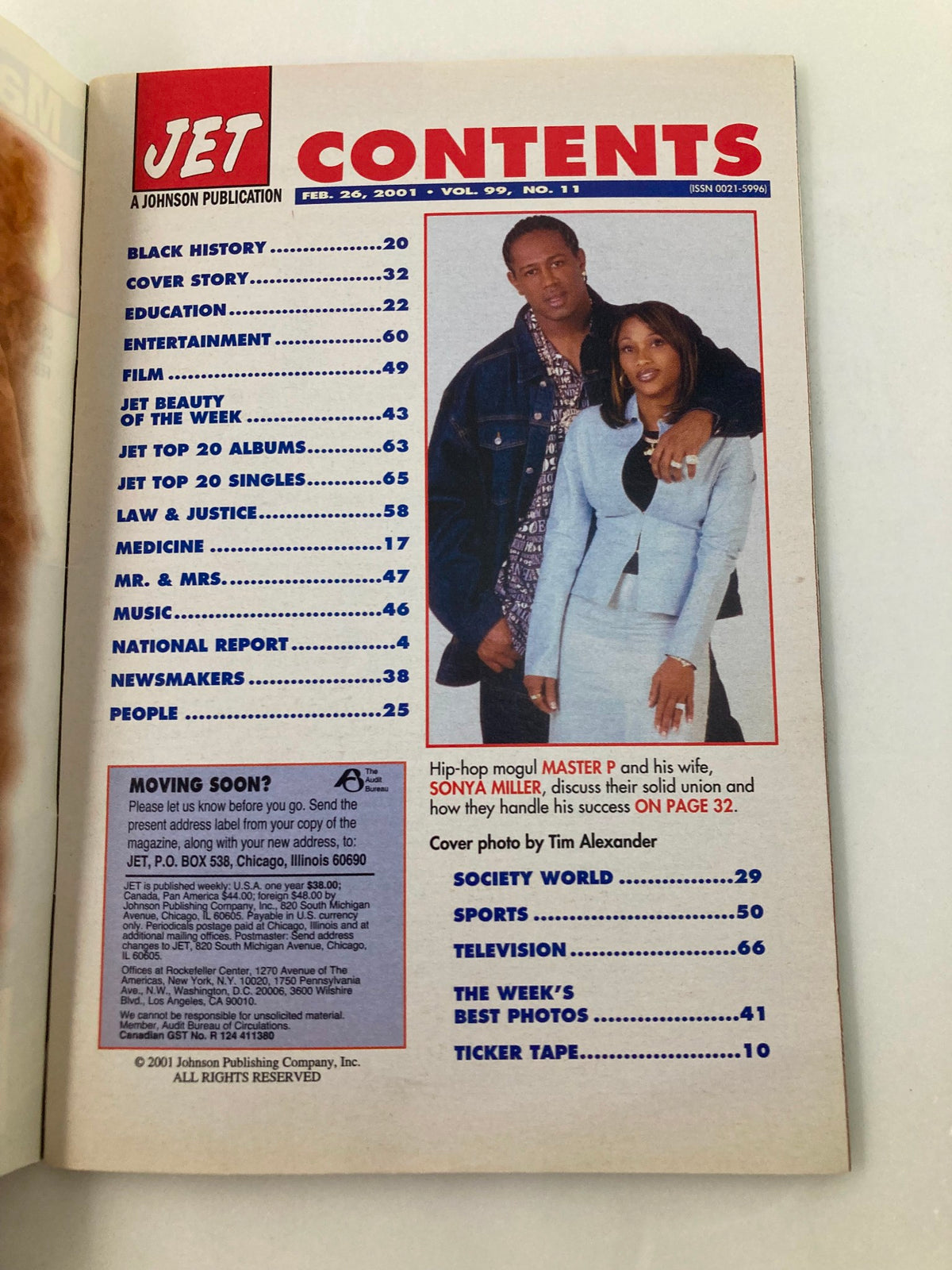


Description
Collector's Note – Why This Issue Matters
The February 26, 2001 issue of Jet Magazine, Volume 99, Issue #11, featuring Master P and Sonya Miller on the cover, documents one of the most commercially successful independent hip-hop entrepreneurs at a specific and significant moment in his personal and professional life. Percy Miller — known professionally as Master P — had built No Limit Records from a small Richmond, California record store into one of the most prolific and financially successful independent rap labels in American music history. By 2001, No Limit had released over a hundred albums and generated hundreds of millions of dollars in revenue, making Master P one of the wealthiest figures in hip-hop and a business model that other artists and labels would study and attempt to replicate for years. A Jet Magazine cover featuring Master P alongside his wife Sonya Miller reflects the publication's consistent approach to covering Black achievement across entertainment, business, and family life simultaneously — the couple's personal relationship as a frame for a profile of professional success. For collectors building an archive of Jet Magazine issues documenting hip-hop culture and Black achievement, a 2001 Master P cover is a primary document of the independent rap business model at its peak commercial moment.
The February 2001 date places this issue at an interesting transitional moment in No Limit Records' trajectory. The label had dominated the rap charts in the late 1990s with an assembly-line release strategy that prioritized volume and loyalty to the No Limit brand over individual album polish — a approach that had made Master P extraordinarily wealthy but was beginning to face commercial saturation. By early 2001, the label was navigating a shift in the rap marketplace that would eventually lead to significant changes in its business model. A Jet cover from this moment captures Master P at the intersection of family visibility and business prominence, before the full effects of that shift had registered. Publications from 2001 document American pop culture at the opening of a new decade, when hip-hop had consolidated its position as the dominant force in American popular music and figures like Master P represented the full commercial maturation of that dominance. Jet's decision to frame the cover as a joint portrait of Master P and Sonya Miller reflects the magazine's long-standing practice of presenting Black success as a family and community achievement rather than purely an individual one.
About the Publication
Jet Magazine, founded by John H. Johnson in 1951 as a compact weekly digest, had by 2001 been the most widely read African American magazine in the United States for five decades. Its pocket-sized format and weekly publication schedule made it a constant presence in Black households across the country, covering entertainment, politics, sports, and social issues with a combination of celebrity coverage and serious journalism that served its broad readership with unusual consistency. Volume 99, Issue #11 places this issue just shy of the publication's fiftieth anniversary — one of the longest continuous publication runs in African American media history. Jet's celebrity covers were among the most eagerly anticipated features of each issue, and a hip-hop figure of Master P's commercial stature warranted the kind of prominent cover placement this issue received.
Key Highlights Inside
- Cover feature on Master P and Sonya Miller — documenting the No Limit Records founder and his wife at the peak of his label's commercial influence, framed as a joint portrait consistent with Jet's practice of presenting Black achievement within family and relationship context.
- Early 2001 cultural and social coverage characteristic of Jet's weekly format — the magazine's combination of entertainment features, social commentary, and community news reflecting the specific moment of February 2001 in Black American public life.
- Subscriber copy with mailing label — the standard distribution configuration for Jet Magazine, whose compact weekly format was primarily delivered through subscription to household readers across the country.
- Note: Specific interior articles, additional features, and departments beyond what is confirmed in the listing are unverified for this issue. The above reflects what is documented and consistent with Jet's well-established editorial format during this period.
Condition & Rarity
Good condition with minor age-consistent wear is an appropriate assessment for a weekly digest magazine now over twenty years old. The presence of a mailing label on the front cover identifies this as a subscriber copy — Jet's primary distribution method was household subscription, and labeled copies are the standard rather than the exception for surviving issues of this era. The plastic protective covering indicates deliberate preservation storage subsequent to the magazine's original receipt, which is a favorable indicator for overall page integrity. For Jet's compact digest format, the primary condition factors to assess in any surviving copy are cover surface clarity, spine integrity — the small digest binding is susceptible to cracking with age — and the absence of moisture or handling damage to the interior pages.
Looking for More Issues Like This?
A Master P and Sonya Miller Jet Magazine cover from 2001 is a specific document of hip-hop's commercial peak era as filtered through the publication that has covered Black American life most consistently for over seven decades. If this issue has already been claimed, the full archive of Jet Magazine issues spans the publication's entire run and surfaces covers across the full range of Black American achievement in entertainment, sports, politics, and culture. The broader 2001 magazine collection offers additional context for this specific year in American popular culture history across multiple publications.