


Description
Collector's Note – Why This Issue Matters
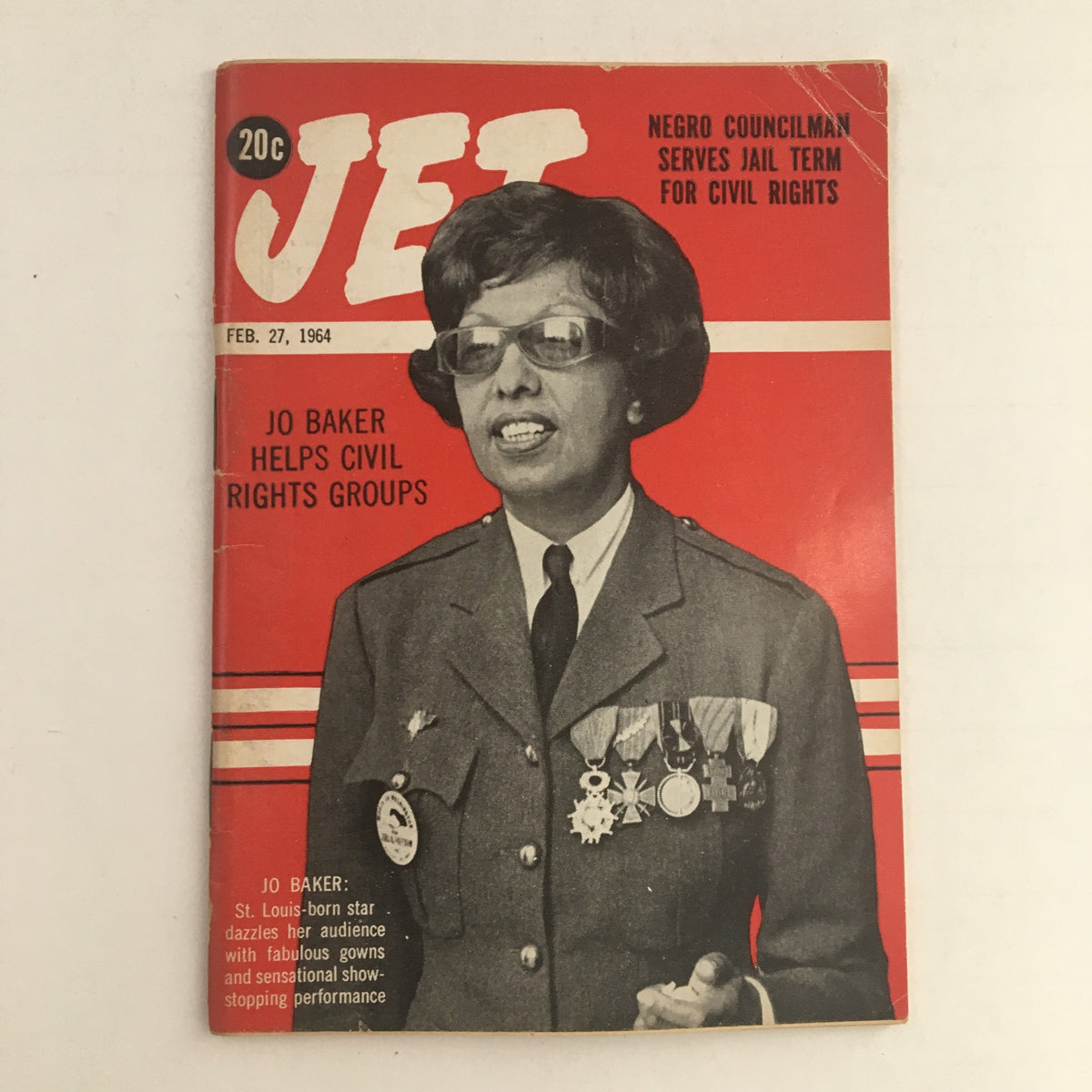
February 27, 1964 places this Jet Magazine issue at one of the most concentrated and consequential moments in the entire history of the American civil rights movement. The Civil Rights Act of 1964 was still months from passage — it would be signed into law on July 2 — and the legislative battle to secure it was at its most intense, with Southern senators preparing the filibuster that would become the longest in Senate history. In this context, a Jet cover story on Josephine Baker's support for civil rights groups was not celebrity journalism but substantive political and cultural reporting on one of the most publicly committed and internationally prominent Black women in the world. Baker had been involved in civil rights advocacy for decades — she had refused to perform for segregated audiences since the 1950s, had spoken at the March on Washington just six months before this issue's publication in August 1963, and her status as a global entertainer whose fame had taken her from St. Louis to Paris gave her advocacy a transatlantic resonance that few American civil rights figures could match. For collectors building an archive of Jet Magazine issues from the civil rights era, this February 1964 edition represents the publication at its most historically central — documenting a major figure's active engagement with the movement at the moment of its greatest legislative crisis.
The listing's identification of the cover subject as "Jo Baker" is the publication's own rendering of Josephine Baker's name, which appeared in various forms across different American publications throughout her career. By February 1964 Baker was fifty-seven years old, had been living primarily in France for nearly four decades, and had transformed herself from a Paris sensation into one of the most publicly committed civil rights advocates of international stature — a figure who used her European fame and her exemption from American segregation's most direct effects not as a reason for detachment but as a platform for more vocal advocacy than American performers could safely adopt. Jet's decision to cover her civil rights work reflects the magazine's consistent editorial commitment to documenting Black achievement and activism across the full range of its forms — not just the Montgomery and Birmingham campaigns but the international dimensions of Black freedom struggle as seen through the lives of figures like Baker who had found in Europe both artistic freedom and the distance from which to criticize American racism most directly. Collectors researching American magazines from 1964 will find this Jet issue a primary source document of how the Black press covered the civil rights movement's multiple dimensions — legislative, cultural, and international — in the pivotal months before the Civil Rights Act's passage.
The newsstand provenance of this issue is itself a historically meaningful detail. Jet was one of the most widely read Black-owned publications in America by 1964, its pocket-sized format and weekly publication schedule making it both affordable and accessible to a broad Black readership that was not always served by the mainstream press. A newsstand copy — purchased by an individual reader rather than delivered to a subscriber — preserves the magazine in the form in which the majority of its readers encountered it: as a timely, accessible weekly document of Black American life, culture, politics, and achievement during the movement's most consequential legislative year. The absence of a label maintains the cover design as it appeared on newsstands, where Josephine Baker's image and the civil rights headline would have been immediately visible to passersby — a small but documentarily meaningful detail about how the publication's editorial judgments reached their intended audience in the specific public spaces of Black American commercial life in February 1964.
About the Publication
Jet Magazine was founded in 1951 by John H. Johnson of Johnson Publishing Company in Chicago, designed as a pocket-sized weekly digest that would document Black American life, culture, politics, and achievement for a broad readership at an accessible price point. By February 1964 it had been publishing for thirteen years and had established itself as one of the most widely read and institutionally significant Black-owned publications in the United States, with a readership that spanned the full socioeconomic range of Black America and a journalistic identity that combined entertainment coverage, celebrity profiles, and the kind of substantive political and civil rights reporting that the mainstream white press rarely provided from a Black perspective. Jet's coverage of the civil rights movement throughout the late fifties and early sixties is now recognized as some of the most important contemporary documentation of that history — the magazine's willingness to cover stories that the white press ignored or minimized, including the graphic documentation of racial violence that helped galvanize national opinion, gave it a role in the movement's history that extended well beyond journalism into advocacy and historical witness.
Key Highlights Inside
- Josephine Baker civil rights cover story — a primary document of one of the most internationally prominent Black women in the world's active engagement with the American civil rights movement in February 1964, published six months after Baker's March on Washington appearance and at the height of the legislative battle for the Civil Rights Act, representing Jet's consistent commitment to covering the movement's full range of participants and dimensions.
- Civil rights movement coverage consistent with Jet's February 1964 editorial scope — the magazine in this period was providing its readership with the most sustained and substantive weekly documentation of the civil rights struggle available in any American periodical, and an issue from this pivotal pre-Civil Rights Act month would have engaged the legislative, organizational, and human dimensions of that struggle with the specificity and perspective that made Jet essential reading for Black Americans following the movement's progress.
- Black entertainment, culture, and community coverage consistent with Jet's established weekly format — the magazine's combination of civil rights reporting, celebrity profiles, entertainment news, and community documentation gave each issue a breadth that reflected the full range of its readership's interests and lives, and the February 1964 issue would have carried all of those elements alongside the Baker civil rights feature.
- Period advertising directed at Jet's Black American readership in February 1964 — a primary documentary record of the commercial culture that Black-owned and Black-targeted businesses were directing at their audiences at a specific moment of political and social transformation, providing research material of considerable value for historians studying the intersection of Black commerce, community, and the civil rights movement.
- Note: Specific secondary article titles, confirmed departmental content details, and additional feature bylines beyond the documented cover story have not been individually verified for this issue. The highlights above reflect Jet's well-documented editorial format, the verified cover subject, and the historical context of February 27, 1964.
Condition & Rarity
Jet Magazine issues from February 1964 are approaching their sixty-second year of existence, and the condition landscape for surviving copies from this period reflects both the general attrition of that age and the specific physical characteristics of Jet's pocket-sized digest format. Printed on paper stock typical of the early-sixties digest magazine market — relatively lightweight and not archivally stable — and read actively by a readership that carried the magazine in pockets and purses in the format for which it was designed, surviving copies from this period in good overall condition represent a more careful provenance than the publication's distribution model might suggest. Good condition with minor wear throughout and a few creases on the front cover is an honest and appropriate assessment for a sixty-two-year-old weekly digest magazine — it describes a copy that retains structural integrity and readable content, while acknowledging the honest physical evidence of six decades of existence that distinguishes authentic surviving copies from more pristine later impressions. The creases noted are consistent with the handling that Jet's pocket format invited and represent authentic age rather than storage damage. The newsstand provenance — confirmed by the absence of a mailing label — preserves the cover design without subscriber label adhesion, which for a publication whose covers were often used as a primary communication of that week's most significant Black news story is both aesthetically and documentarily preferable. The plastic protective sleeve provides ongoing archival protection. Collectors evaluating surviving examples of this issue should prioritize cover readability and the Baker image integrity, the completeness of all interior pages, and the overall structural integrity of the pocket-digest binding as primary condition criteria.
Looking for More Issues Like This?
A label-free newsstand copy of Jet Magazine from February 27, 1964 with the Josephine Baker civil rights cover in good condition is a historically specific and meaningful find — civil rights era Jet issues from the pivotal months of 1964 with confirmed cover documentation surface less frequently than their importance to American history would suggest, and this issue's placement of international Black activism alongside the domestic legislative struggle gives it a particular documentary richness. If this issue is no longer available, the full Jet Magazine collection at OriginalMagazines.com is the most comprehensive place to browse surviving issues from across the publication's history and locate other civil rights era editions, significant cover stories, or specific dates from this extraordinarily important period in the magazine's run. The 1964 magazine collection brings together surviving issues from across that year's major publications for collectors working to document the full breadth of American print journalism during the most legislatively consequential year of the civil rights movement.