
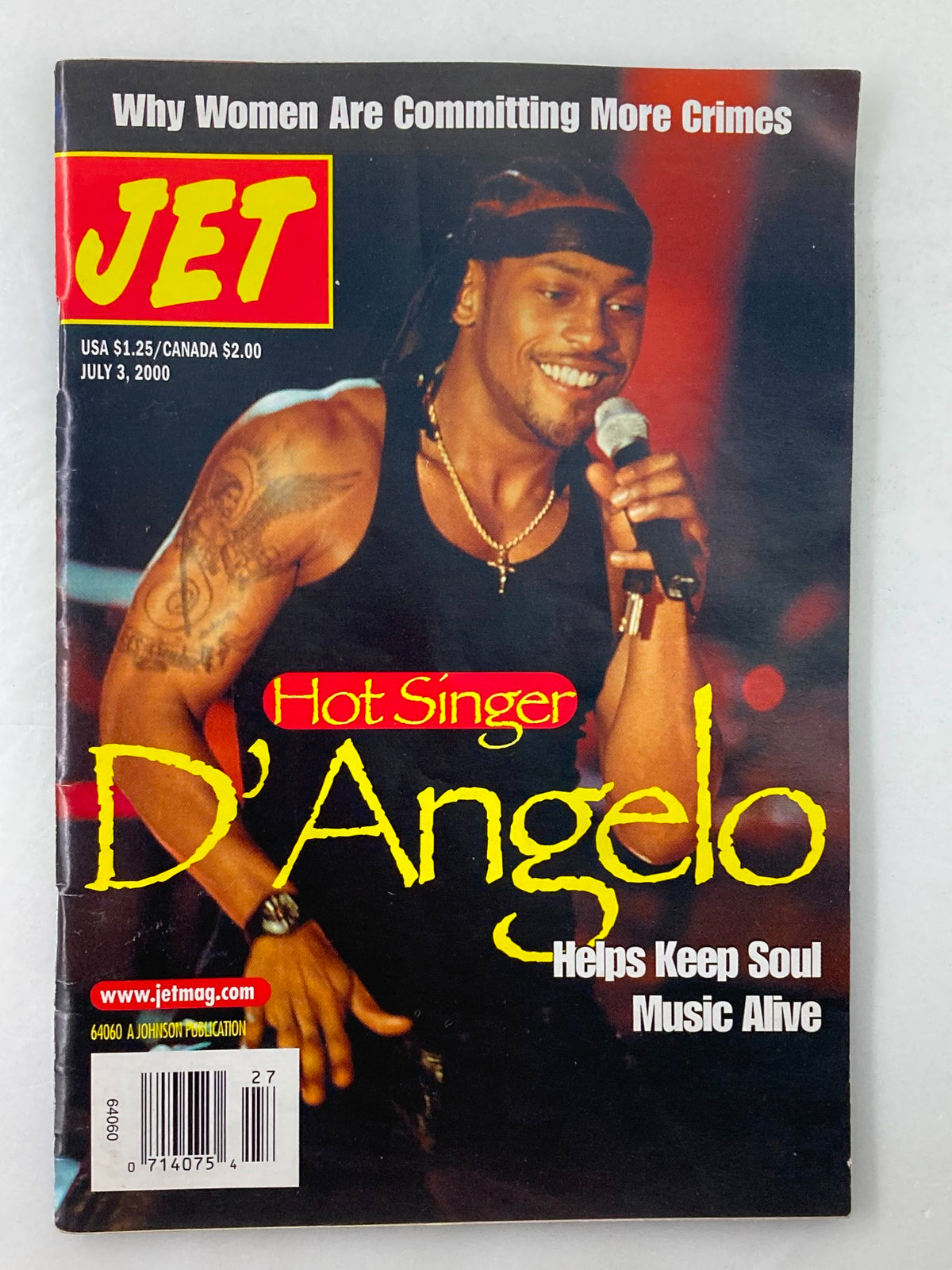


Description
Collector's Note – Why This Issue Matters
The July 3, 2000 issue of Jet — Vol. 98, No. 4 — featuring D'Angelo and Tiger Woods arrives at a moment when both figures were operating at extraordinary peaks of cultural influence. Tiger Woods in the summer of 2000 was in the midst of what is widely regarded as the greatest sustained stretch of professional golf in the sport's history. He had won the US Open at Pebble Beach just weeks before this issue's publication date, finishing twelve strokes ahead of the field in a performance so dominant it remains one of the most discussed rounds in major championship history. He would go on to win the Open Championship and the PGA Championship later that same summer, completing what became known as the "Tiger Slam." A Jet feature on Woods in July 2000 captures him at the precise apex of that historic run, before it was fully complete and before its full magnitude was understood.
D'Angelo in the summer of 2000 was navigating a cultural moment of equal intensity, though of a very different kind. His second album Voodoo had been released in January 2000 to widespread critical acclaim, debuting at number one on the Billboard 200 and instantly establishing itself as one of the defining R&B records of the era. The album's neo-soul aesthetic — deeply rooted in classic funk and soul traditions while remaining thoroughly contemporary — had a profound influence on the direction of Black music in the early 2000s, and D'Angelo's accompanying music video had generated an enormous cultural conversation about Black male beauty and artistic vulnerability. By July 2000 he was one of the most discussed artists in American music. For collectors focused on Jet magazine's documentation of Black cultural achievement, an issue pairing these two figures at this specific moment is a genuinely significant artifact.
The pairing of D'Angelo and Tiger Woods in a single Jet issue is itself editorially meaningful. Both men were, in their respective fields, redefining what excellence looked like and who it belonged to — pushing into spaces that had been historically resistant to Black achievement and doing so with a combination of mastery and personal style that made their success impossible to ignore or minimize. Jet's coverage of both in July 2000 reflects the magazine's consistent role as the primary chronicler of Black excellence across every field of American life. The 2000 magazine archive at OriginalMagazines.com provides broader context for the cultural landscape of this remarkable year.
About the Publication
Jet was founded in 1951 by John H. Johnson of Johnson Publishing Company and quickly became one of the most widely read and culturally significant magazines in African American life. Published weekly in a compact digest format, it covered news, entertainment, sports, politics, and social issues through the lens of the Black American experience, reaching an audience that was consistently underserved and often actively ignored by mainstream white-owned publications. By 2000 it had been a fixture of African American households for nearly five decades, and its covers and feature stories constituted an ongoing visual and editorial record of Black achievement, struggle, and culture across the full breadth of American life. Its combination of accessibility, cultural specificity, and historical continuity makes it one of the most important periodical archives in American publishing history.
Key Highlights Inside
- Coverage of D'Angelo during the peak period of his Voodoo era — capturing him at the height of his cultural influence following the album's January 2000 release and its immediate establishment as a landmark of neo-soul.
- Feature on Tiger Woods during his historic summer of 2000, when he was in the process of completing the most dominant stretch of major championship golf in the sport's recorded history.
- Editorial content reflecting Jet's consistent documentation of Black excellence across music and sports, framing both figures within the broader context of African American cultural achievement at the turn of the millennium.
- Broader news, entertainment, and cultural coverage typical of a Jet weekly issue from this period, spanning the full range of the magazine's editorial scope.
Note: Specific interior articles beyond the cover subjects are unconfirmed for this issue. The above reflects what is verifiable from the listing description, cover subjects, and the well-documented cultural context of the date.
Condition & Rarity
Graded Good with minor wear consistent with age — an honest condition profile for a weekly digest-format magazine now more than twenty years old. The no-label designation identifies this as a newsstand copy rather than a subscriber edition, which is the preferred form for display-oriented collectors and preserves the cover presentation as originally intended. Jet's compact digest format and lightweight paper stock make surviving copies in Good or better condition more meaningful than the grade might suggest for a larger-format publication — the magazine was designed for portability and frequent handling, and copies that have survived with intact covers and readable interiors have generally been treated with care. A protective plastic sleeve provides appropriate ongoing preservation. Issues pairing two figures of this cultural stature — both at documented career peaks — attract collectors across R&B music, golf history, and African American cultural archive collecting simultaneously.
Looking for More Issues Like This?
Jet issues from the summer of 2000 occupy a specific and culturally rich moment in the magazine's long history, and an issue pairing D'Angelo and Tiger Woods at their respective peaks is an unusually concentrated find. The full Jet magazine collection at OriginalMagazines.com is the best place to explore available issues across the magazine's remarkable five-decade run of Black cultural documentation. For collectors building a broader archive of early 2000s American culture, the complete 2000 magazine archive offers a wide range of titles from a year that stands at a genuine cultural threshold.