

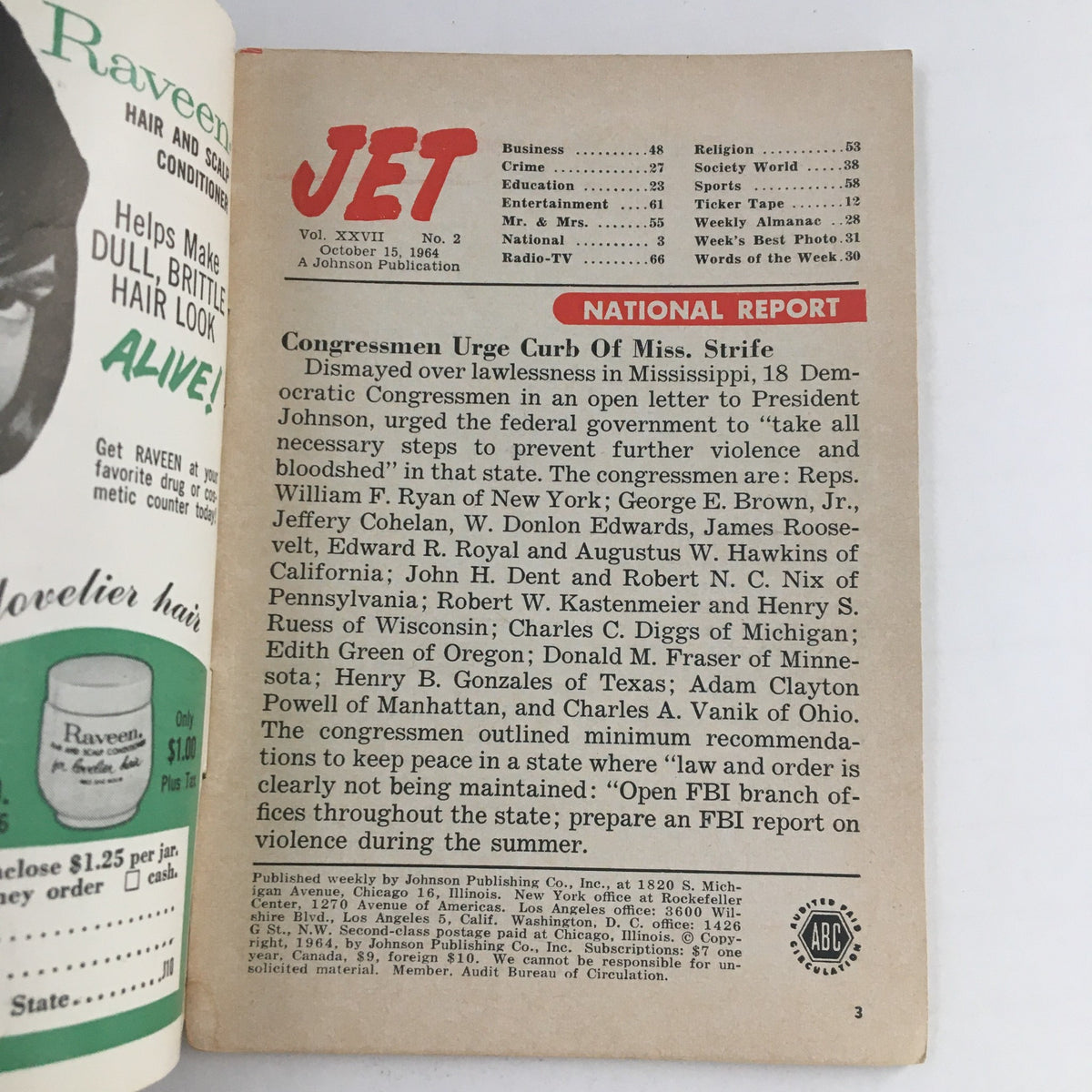


Description
Collector's Note – Why This Issue Matters
This October 15, 1964 issue of Jet arrives during one of the most consequential stretches of the civil rights era, landing roughly three months after the passage of the Civil Rights Act of 1964 and just weeks before that year's presidential election, a period when American society, and Black American life specifically, was undergoing rapid and closely watched transformation. A cover feature on fashion for "the jet set," presenting model Monique Cartright in a styling spread, reflects a side of Jet's editorial identity that existed alongside, rather than separate from, its serious civil rights coverage during this period. Jet had built its readership on a combination of hard news, including detailed and often unflinching photographic coverage of the civil rights movement, alongside entertainment, fashion, and lifestyle content that gave readers a fuller, more complete picture of contemporary Black American life beyond political struggle alone. A glamorous fashion feature in the same publication that covered serious political developments week to week reflects the magazine's broader mission: presenting Black readers with the same range of aspirational lifestyle content, fashion authority, and cultural coverage that mainstream magazines offered their own readers, often without comparable representation.
The "jet set" framing itself reflects a specific cultural moment in early-to-mid 1960s fashion and lifestyle media, a term that had entered popular usage to describe a glamorous, internationally mobile elite whose lifestyle was increasingly accessible through commercial jet travel, which had only become widely available to civilian travelers within the preceding several years. Fashion features built around this concept typically emphasized sophisticated, well-traveled style sensibilities, positioning their featured looks as suited to an international, cosmopolitan lifestyle rather than purely domestic or regional fashion trends. For Jet specifically, presenting this kind of aspirational, globally minded fashion content to its readership carried particular significance, offering visions of glamour and worldly sophistication within a publication explicitly created to ensure Black Americans received the same quality of representation and aspirational content found in mainstream magazines, at a moment when such representation remained far from guaranteed elsewhere in American media.
Specific biographical details about Monique Cartright are not independently confirmed beyond this issue's own description, and readers and collectors should treat her individual story as something best explored within the magazine's own pages rather than assumed from outside sources. For collectors, this issue nonetheless offers a meaningful artifact reflecting Jet's consistent role in providing fashion and lifestyle coverage to Black readers during a pivotal period in American civil rights history, a combination that gives the issue real context within the broader landscape of Jet magazine collecting, where fashion and lifestyle features from this era sit meaningfully alongside the publication's better-known political coverage.
About the Publication
Jet, founded in November 1951 by the Johnson Publishing Company under founder John H. Johnson, was created to address the consistent underrepresentation of Black Americans in mainstream news, entertainment, and lifestyle media. Published weekly in Chicago in a compact digest format, Jet built its identity around timely reporting on news, culture, and entertainment relevant to the African American community, with coverage spanning fashion and beauty tips, entertainment news, dating advice, political reporting, health content, and coverage of events including fashion shows. The magazine's combination of serious civil rights journalism, including detailed photographic documentation of the movement, alongside lighter lifestyle and fashion content reflected its broader mission of providing comprehensive coverage of Black American life in all its dimensions, not solely through the lens of political struggle. By 1964, Jet had already established itself as an essential chronicler of the civil rights movement specifically, while continuing to deliver the kind of fashion, beauty, and entertainment coverage that gave readers a fuller, more complete picture of contemporary Black culture. This combination of hard news and lifestyle content throughout the 1960s makes Jet a valuable and historically layered resource for researchers studying this period from multiple angles simultaneously.
Key Highlights Inside
- A fashion feature presenting model Monique Cartright in styling described as "fashions for the jet set." Specific biographical details about Cartright are not independently confirmed beyond this issue's own description. Readers interested in her individual story are encouraged to view the issue directly for its full context.
- Fashion and styling content reflecting early-to-mid 1960s "jet set" aesthetic sensibilities, a term describing an internationally mobile, glamorous lifestyle made newly accessible through commercial jet travel. This kind of cosmopolitan fashion framing was a notable trend in lifestyle media during this period. Jet's presentation of this content to its readership reflects the magazine's broader commitment to aspirational lifestyle coverage.
- Advertising content characteristic of mid-1960s African American consumer magazines, likely spanning beauty, fashion, and lifestyle products marketed to Jet's readership. Period advertising of this kind offers valuable historical insight into consumer culture targeted specifically at Black American readers during this era. This kind of content is frequently of particular interest to collectors and researchers studying mid-century African American consumer history.
- Broader news and entertainment coverage characteristic of Jet's weekly format during this pivotal period of the civil rights movement. The magazine consistently combined fashion and lifestyle content with serious political and cultural journalism within the same issue. Specific additional articles for this issue beyond the fashion cover feature are not detailed in available listing information.
Condition & Rarity
Surviving copies of this issue are generally evaluated using the same standards collectors apply across vintage digest-sized magazines: cover and spine integrity, completeness of interior pages, and overall condition free of significant tears, foxing, or moisture damage. A copy described as being in good condition, with minor wear throughout, would be considered a reasonable survivor for a weekly digest-format magazine now approaching sixty years old. The absence of a newsstand label reflects the issue's original point-of-sale distribution, a trait generally considered desirable among collectors of vintage Jet issues. A plastic protective sleeve is a standard and effective safeguard for issues of this vintage, helping prevent further handling wear, UV exposure, and humidity damage, though it has no bearing on the underlying grade of the magazine itself. Jet's small, digest-sized format and lightweight paper stock made it especially prone to spine wear and minor tearing over decades of handling, which is part of why well-preserved copies from the 1960s are comparatively difficult to find today. Given this issue's connection to the broader civil rights era, collectors focused on this period of American history may find added value in fashion and lifestyle issues that complement Jet's more widely circulated political coverage from the same months. Pages free of brittleness and excessive yellowing remain the broader benchmark for a well-preserved copy of any Jet issue from this era.
Looking for More Issues Like This?
A Jet issue from October 1964 featuring fashion content alongside the magazine's broader coverage of a pivotal civil rights era offers a layered artifact for collectors interested in this period of American history and culture. If this particular issue isn't available, it's worth browsing the broader Jet magazine collection for other issues spanning this title's long and historically significant run. Collectors focused on the era itself may also want to look through the full range of 1964 magazines for other issues from that pivotal year in American history. Each of these collections offers a different way into the period, whether the interest lies in this specific title's combination of fashion and serious political coverage or the broader cultural and political snapshot of a single consequential year. A single year's worth of magazines often tells a fuller story than any one issue alone, particularly for a year as eventful as 1964 across both civil rights history and American culture more broadly. Browsing by publication can also help collectors trace how Jet balanced lifestyle content with its landmark civil rights coverage throughout the decade. Whichever angle appeals most, these collections are a useful starting point for going deeper into this important period of American mass-circulation magazine history.