


Description
Collector's Note – Why This Issue Matters
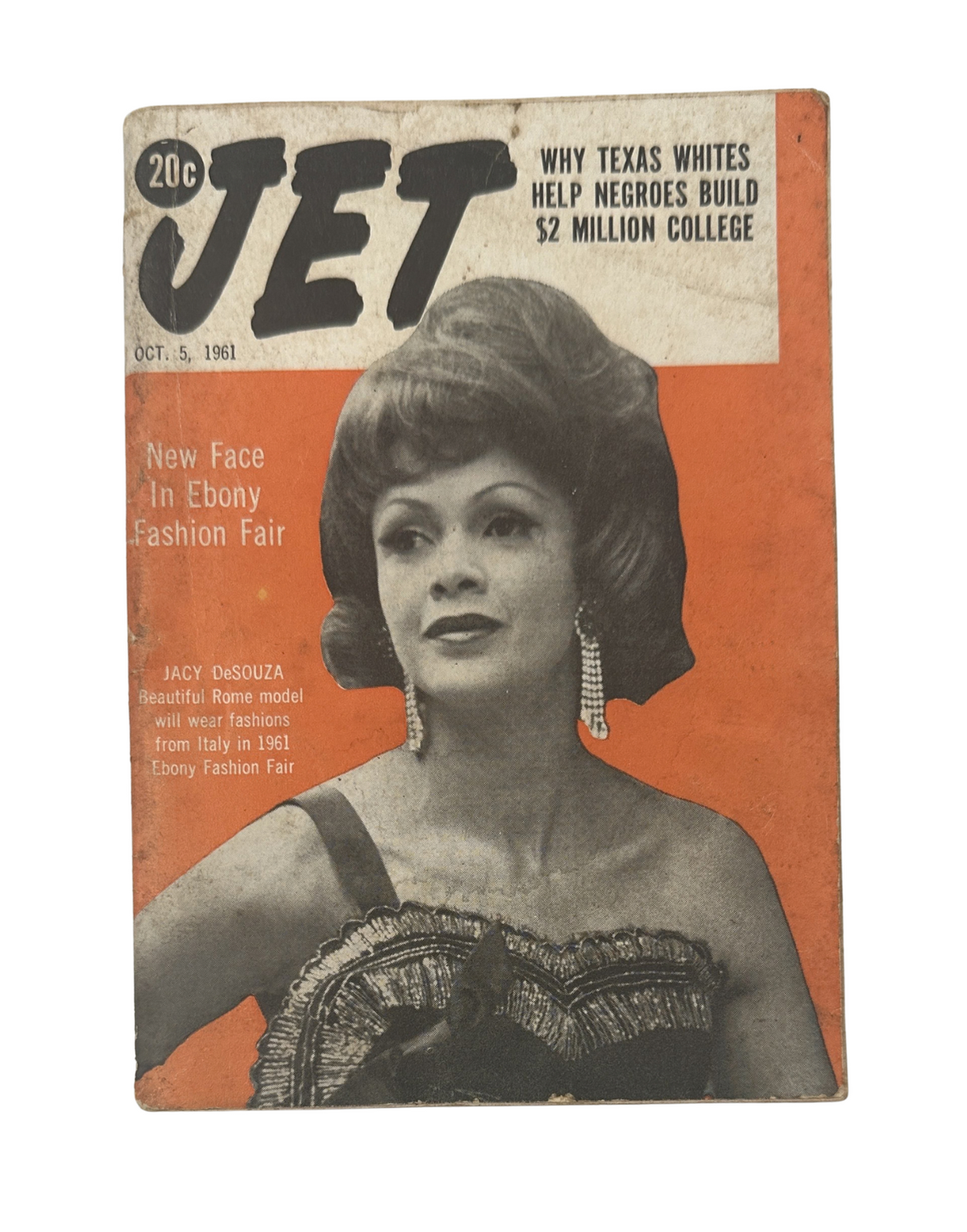
The October 5, 1961 issue of Jet magazine featuring Jacy DeSouza and the Ebony Fashion Fair on the cover documents one of the most significant and most enduring institutions in African American fashion and charitable history at an early and historically specific moment in its development. The Ebony Fashion Fair — the traveling fashion show founded by Eunice W. Johnson, wife of Ebony and Jet publisher John H. Johnson — had been launched in 1958 as a charitable fundraising vehicle that simultaneously celebrated Black fashion, beauty, and elegance at a time when mainstream American fashion culture systematically excluded Black models, designers, and consumers from its aspirational imagery. By October 1961, the Fair was in its fourth year of operation and already establishing itself as one of the most important annual events in African American social and cultural life, with its touring schedule bringing high fashion to Black communities across the United States and Canada and generating scholarship funds for historically Black colleges and universities. A Jet cover featuring the Fair in October 1961 — documenting model Jacy DeSouza in the presentation that embodied the Fair's aesthetic vision — is a primary document of that institution at a formative and historically charged moment. For collectors building a focused archive through the Jet magazine run of the early civil rights era, this October 1961 issue is both a fashion history document and a civil rights history document simultaneously.
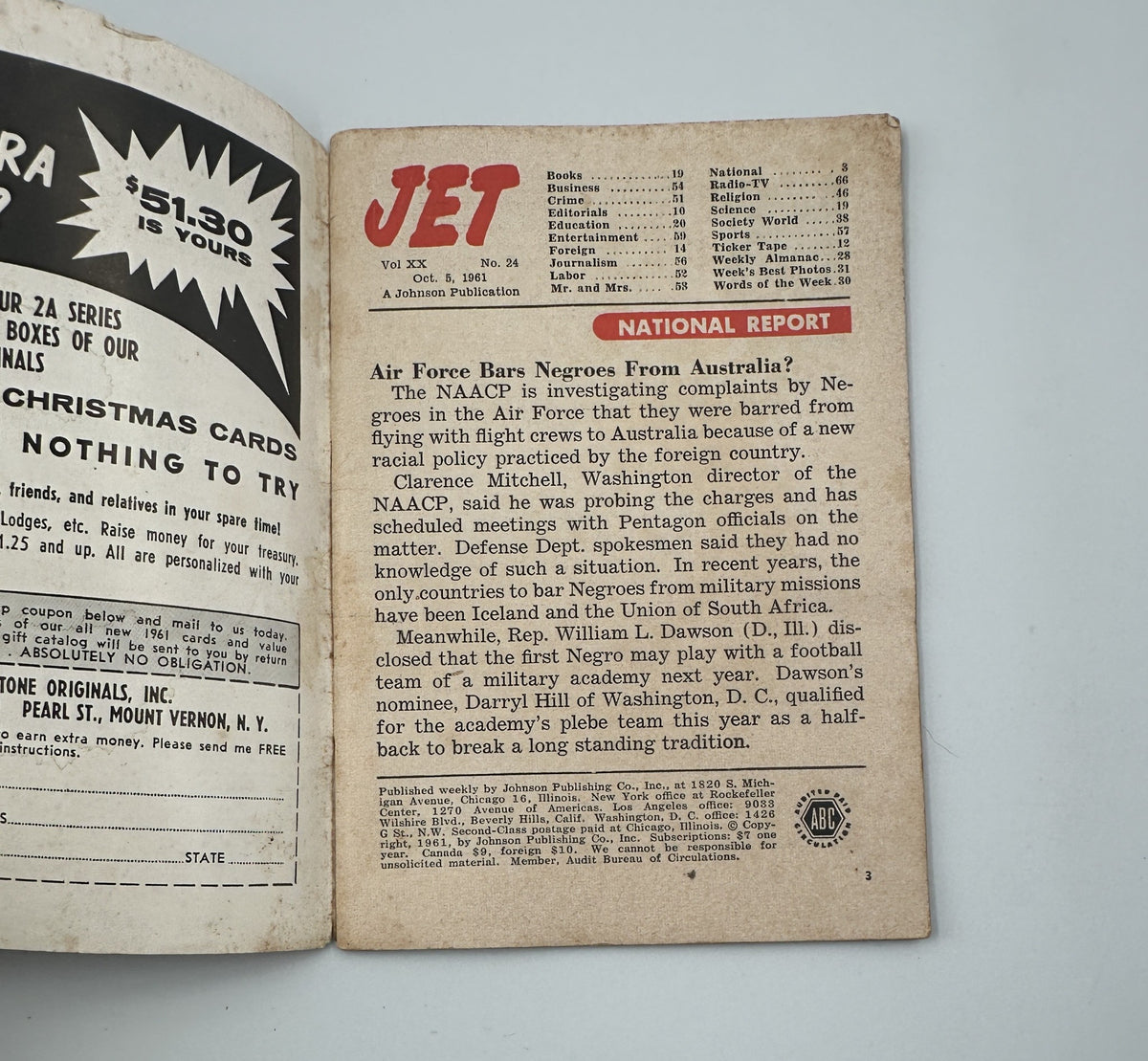
The October 1961 context gives this issue particular historical weight beyond the fashion coverage. The Freedom Rides had occurred earlier that year, in May 1961; the Albany Movement was beginning in Georgia; and the civil rights movement was entering one of its most active legislative and direct-action phases. Jet's national, foreign, education, and religion sections — all present in the table of contents — would have been covering these developments with the specific perspective and analytical depth that made the Johnson Publishing Company's magazines the primary print voice for African American news and culture in this period. The juxtaposition of the Ebony Fashion Fair's celebration of Black beauty and aspiration with Jet's comprehensive coverage of the civil rights struggle was not incidental — it was the magazine's editorial thesis in action: that Black Americans deserved both the political rights that the movement was demanding and the cultural recognition and aspiration that the Fashion Fair was providing. For anyone researching African American print culture and the civil rights era in 1961, this issue is a primary document of that dual commitment at one of the movement's most consequential years.
Jacy DeSouza as the cover model gives this issue a specific biographical dimension for researchers documenting the history of Black modeling. The Ebony Fashion Fair was one of the very few venues in early-1960s America where Black models could work in high fashion contexts, and the women who modeled for the Fair were among the most visible Black fashion figures of the era. A Jet cover featuring one of these models in October 1961 is a document of an alternative fashion world that existed alongside and in resistance to the mainstream American fashion industry's exclusions.
About the Publication
Jet magazine, founded by John H. Johnson in 1951 as a pocket-sized weekly news digest for African American readers, was by October 1961 in its tenth year of publication and firmly established as one of the most widely read and most trusted news publications in Black America. Its compact format combined news coverage across national, international, entertainment, sports, religion, and social categories with the specific perspective and editorial authority that made it essential reading for African American households. As a Johnson Publishing Company publication alongside Ebony, it shared both the institutional commitment to Black pride and progress and the direct institutional relationship with the Ebony Fashion Fair that made this October 1961 cover a natural editorial choice.
Key Highlights Inside
- Jacy DeSouza and Ebony Fashion Fair cover — documentation of the Johnson Publishing Company's traveling fashion show at an early moment in its development, featuring a Black model in high fashion imagery that was systematically excluded from mainstream American fashion publications in October 1961.
- National and Foreign news sections — coverage of civil rights developments and international affairs from the specific perspective of African American journalism in one of the movement's most active years, following the Freedom Rides and the beginning of the Albany Movement.
- Complete weekly news digest format — the full range of Jet's editorial coverage including education, religion, science, sports, entertainment, labor, and society, providing a comprehensive document of African American public life in October 1961.
- Society World and Week's Best Photos sections — social documentation of African American community life and events alongside the civil rights and political coverage, reflecting Jet's editorial commitment to the full range of Black American experience.
- Note: Specific article titles within individual sections, interview subjects, and other editorial details beyond the confirmed Ebony Fashion Fair cover and table of contents have not been independently verified from the listing. Interior details should be confirmed against a physical copy; condition is noted as acceptable/reader grade with significant wear.
Condition & Rarity
Surviving copies of this issue in acceptable/reader condition — with significant wear including possible cover creases, small tears, writing, spine stress, or light marks, but with binding intact and all pages legible — present a condition profile that prioritizes research accessibility over display quality. Acceptable condition for a sixty-four-year-old weekly digest magazine indicates that the issue has been handled extensively over its lifetime, which is characteristic of publications that were actively read rather than archived. The binding's integrity and page legibility are the primary research criteria, and both are confirmed by the listing. A plastic protective sleeve confirms current preservation intent. Early-1960s Jet issues featuring Ebony Fashion Fair covers are sought by African American fashion history researchers, Johnson Publishing Company archivists, civil rights era print culture scholars, and Jet completists simultaneously — the specific intersection of fashion history and civil rights history in this October 1961 issue gives it sustained research and collector interest across multiple communities.
Looking for More Issues Like This?
Early-1960s Jet issues documenting the Ebony Fashion Fair are primary documents of both African American fashion history and civil rights era print culture, and reader-condition copies are valuable research tools even when their display condition is limited. If this October 1961 issue has already found a researcher, the full Jet magazine collection at OriginalMagazines.com spans the publication's long history of African American news coverage from its founding through the civil rights era and beyond. The complete 1961 magazines collection offers broader context for African American print culture and the civil rights movement from one of its most consequential years.