




Description
Collector's Note – Why This Issue Matters
June 1979 sits squarely in the heart of what bodybuilding historians now call the golden era — a period roughly bracketed by the early seventies rise of the Weider empire and the early eighties commercial explosion that followed the mainstream success of Pumping Iron. Arnold Schwarzenegger had already won seven Mr. Olympia titles by this point and was in the process of transitioning from competitive athlete to global icon, his face and physique having become synonymous with the sport itself. An Arnold cover on a Weider publication in 1979 was not a novelty — it was an expectation — but what distinguishes this particular issue is the density of genuine editorial content attached to that cover. This is not a magazine built around a single celebrity feature. It is a document of an entire ecosystem of knowledge, philosophy, and competitive insight at its most concentrated. Collectors focused on this period will find the broader Arnold Schwarzenegger magazine archive an essential resource for tracking how his image and influence evolved across the decade.
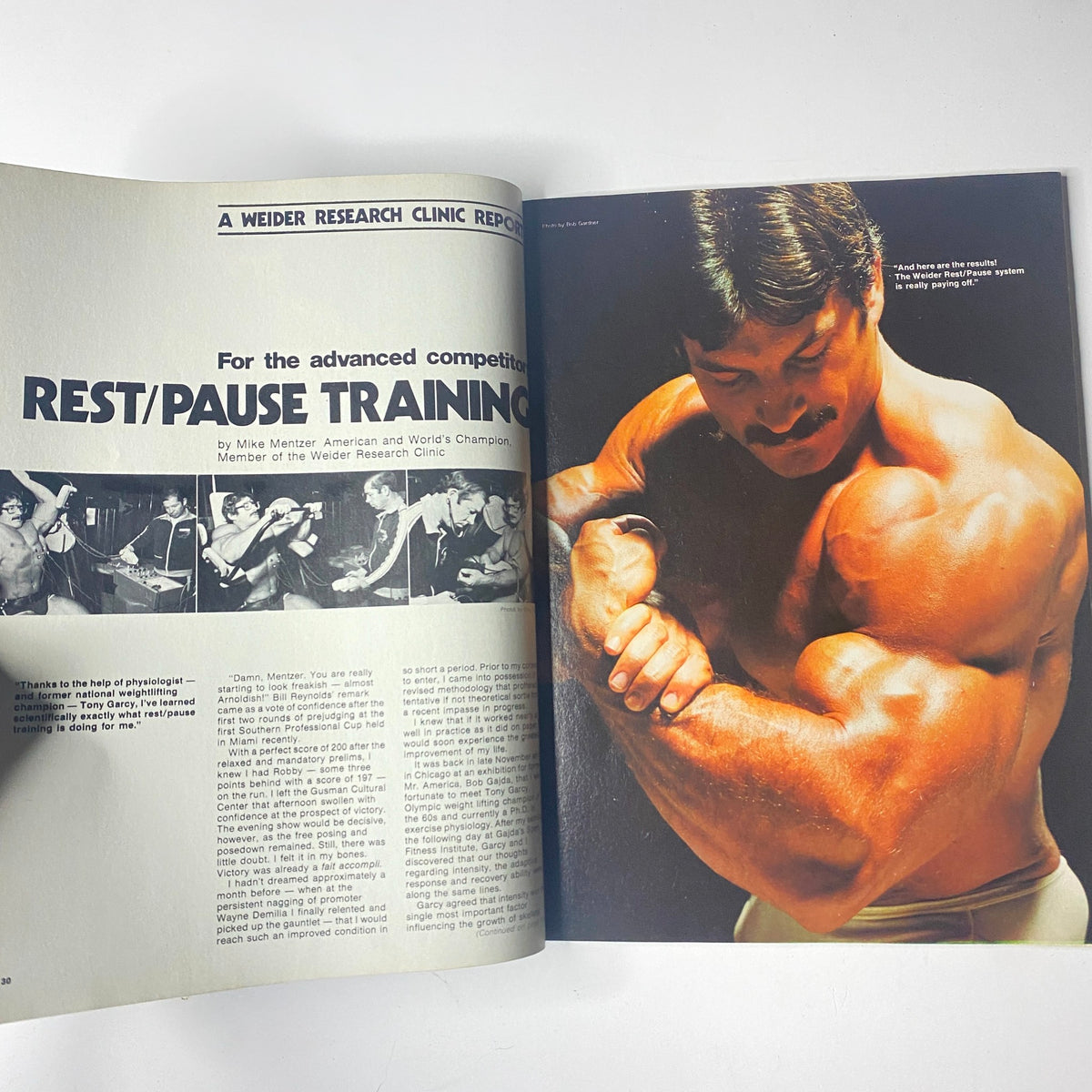
The contributor list in this issue reads like a roll call of golden era bodybuilding's most significant figures, each at or near the height of their influence. Mike Mentzer was in 1979 actively challenging the orthodoxies of high-volume training with his Heavy Duty philosophy, and his presence here — with both a training feature on Rest/Pause Training and his regular "Ask Mike" column — captures that intellectual ferment in real time. Tom Platz, whose leg development remains a benchmark five decades later, contributes on getting ripped. Frank Zane, a three-time Mr. Olympia whose approach to physique aesthetics defined an entire competitive philosophy, addresses the mental dimension of training. Bill Pearl, a legend of an earlier generation, appears twice. Franco and Anita Columbu hold down the medical column. Robby Robinson gets not one but two dedicated features. This is a remarkable concentration of first-generation expertise in a single issue, and it explains why the Joe Weider's Muscle Magazine collection draws serious researchers and collectors rather than casual readers alone.
The women's fitness content — featuring Betty Weider, Laura Mishima, and others — is also historically significant in ways that are easy to undervalue. Women's competitive and recreational bodybuilding was still finding its institutional footing in 1979, and the coverage in Weider publications during this transitional period documents that emergence in ways that later, more polished publications do not. Add the science-forward content on glycogen loading, dietary strategy, and muscle physiology, and this issue functions as a genuine cross-section of where bodybuilding knowledge stood in the summer of 1979 — informed, ambitious, and increasingly systematic. For anyone assembling a serious archive of the era, 1979 magazine issues represent a year when the sport was simultaneously at its most raw and its most intellectually serious.
About the Publication
Joe Weider's Muscle Builder Power was one of the flagship publications in Joe Weider's extensive fitness media empire, which by the late 1970s had become the dominant force in bodybuilding publishing worldwide. Weider's magazines — which also included Flex and Shape — were the primary channels through which training knowledge, competitive results, nutrition science, and the personalities of the sport reached a mass audience. Muscle Builder Power was aimed at serious training enthusiasts: men who were actively competing or aspiring to compete, and who wanted instruction from the best practitioners in the world rather than general fitness content. Its editorial format combined long-form training features, regular columns from named athletes and experts, competition coverage, dietary and scientific content, and Q&A sections — a structure that made each issue function as both a training manual and a cultural record of the sport at a specific moment in time. The Weider publications of this period occupy a unique position in sports media history: they were simultaneously promotional vehicles for the Weider brand and genuinely valuable repositories of practical knowledge that athletes and coaches still reference today.
Key Highlights Inside
- Arnold on Biceps (Bill Reynolds) and Ask the Champ (Arnold Schwarzenegger) — two separate Arnold-driven features offering both instructional content and direct Q&A, representing the kind of access to Schwarzenegger's training philosophy that made Weider publications essential reading in this period.
- Arnold: Lover of Life (Jack Neary) — a profile piece that goes beyond training to address Arnold's broader persona and outlook, documenting the personality that was rapidly making him a crossover cultural figure beyond bodybuilding.
- Rest/Pause Training and Burning Issues (Mike Mentzer), plus his Ask Mike column — three Mentzer contributions in a single issue, capturing his Heavy Duty philosophy at a moment when it was actively disrupting the high-volume consensus that had dominated the sport.
- Mind in Training (Frank Zane) — from a three-time Mr. Olympia whose approach to physique aesthetics and mental discipline represented a distinct and influential school of thought within the golden era.
- Getting Ripped (Tom Platz), Calf Training (Dennis Tinerino), Sector Training (Larry Scott), and Priming the Pump / Wisdom of Pearl / Pearl and Vegetarianism (Bill Pearl) — a concentrated cluster of technique-specific features from some of the most accomplished competitive bodybuilders of the era.
- Doctors' Corner (Drs. Franco and Anita Columbu) alongside features on glycogen loading and dietary strategy — evidence of the increasingly science-literate editorial direction Weider publications were pursuing by the late seventies, treating nutrition and physiology as seriously as training mechanics.
Condition & Rarity
Copies of this issue that survive in genuinely good condition are increasingly uncommon. Weider publications of this period were printed on standard newsprint-grade stock and were handled heavily by readers who used them as active training references rather than collectibles — dog-eared, annotated, and eventually discarded in large numbers. A surviving copy with intact covers, unclipped pages, and good structural integrity represents a meaningful find by the standards of late-seventies bodybuilding periodicals. The protective plastic sleeve present on preserved copies is the correct archival approach for this type of magazine: it prevents further handling wear and environmental damage without requiring any alteration to the original item. Arnold Schwarzenegger cover issues from this period — particularly those with the editorial depth documented here — consistently attract the most collector interest within the Weider catalog, which makes condition all the more consequential when evaluating any surviving copy. Issues with strong cover presence, no significant label damage, and intact interior page blocks are the benchmark to look for.
Looking for More Issues Like This?
An Arnold cover issue from 1979 with this level of editorial content is one of the more sought-after entries in the Weider catalog, and copies in solid condition don't stay available for long. If this particular issue has already moved on, the Arnold Schwarzenegger magazine collection is the best starting point for finding other issues that document his career and influence across the golden era. The full Joe Weider's Muscle Magazine archive covers the broader publication history for collectors working through the complete run, and the 1979 magazine collection provides wider context for anyone building an archive of the sport during one of its most consequential years.