
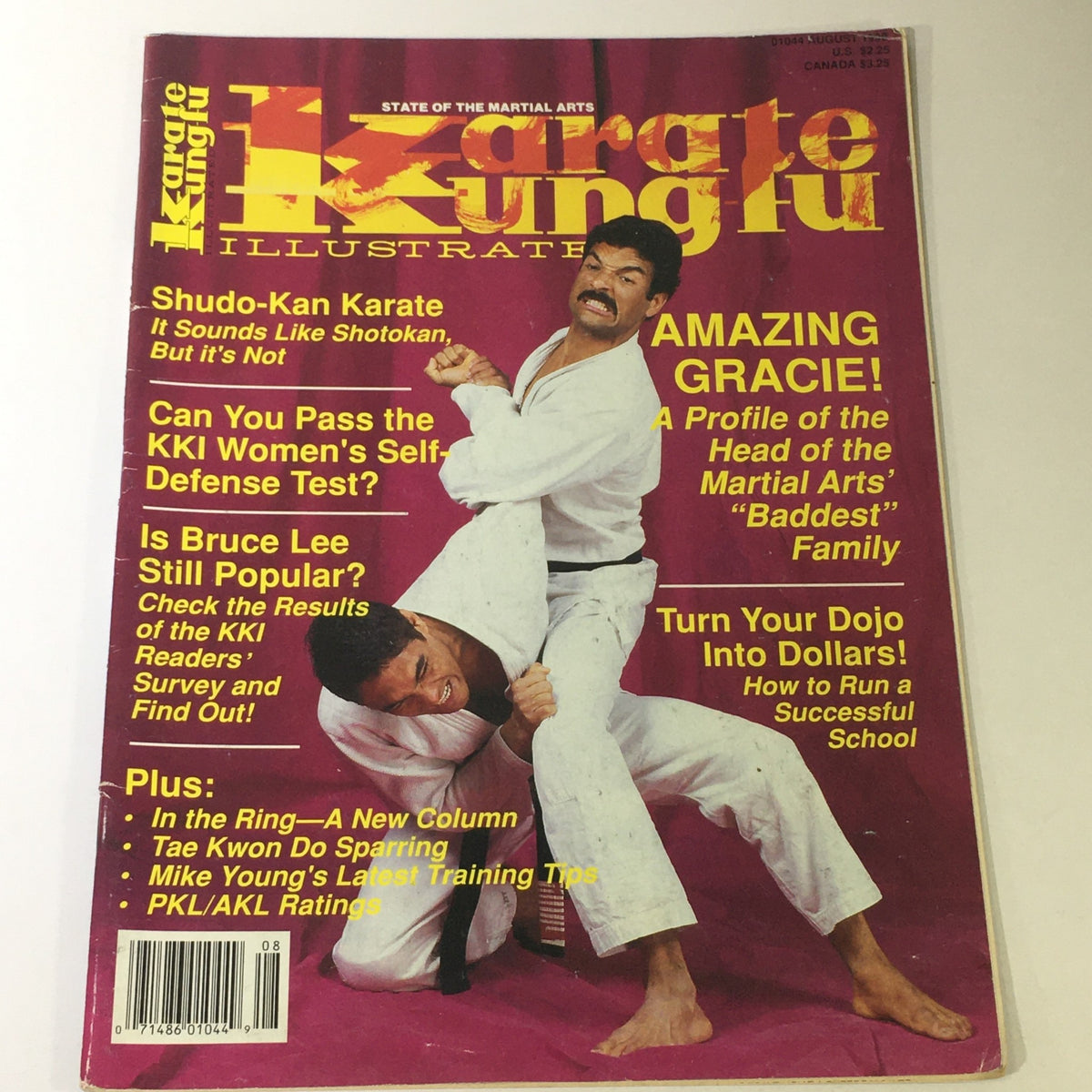


Description
Collector's Note – Why This Issue Matters
Karate Kung Fu Illustrated from August 1990 captures a revealing moment in martial-arts media, when American readers were being introduced to a wider mix of fighting traditions, personalities, and philosophies through specialist print culture. A cover that references both Bruce Lee and Royce Gracie immediately gives the issue unusual historical interest. Bruce Lee's importance was already firmly established by 1990: he had become the defining modern icon of martial arts in popular culture, with influence that extended well beyond film into training philosophy, physical discipline, and cross-style curiosity. A Bruce Lee connection on the cover of a period martial-arts magazine almost always signals a strong collector appeal because it ties the issue to one of the central names in the entire field.
The Royce Gracie reference is equally interesting, though for a different reason. In August 1990, Gracie's name would have carried a more specialized martial-arts resonance than it would a few years later, before he became globally recognized through the early Ultimate Fighting Championship era. That makes this issue especially useful as a period document. It reflects a martial-arts world in which Brazilian jiu-jitsu lineage, technical curiosity, and style comparison were still circulating primarily among serious enthusiasts rather than mainstream audiences. Readers exploring the broader run of Karate Kung Fu Illustrated magazines will recognize this kind of issue as part of the magazine's value: it preserved moments when important names appeared in print before later history made them even more widely recognized.
Placed within the wider context of magazines published in 1990, this issue stands at the edge of a transition. The late 1980s and early 1990s were years when martial-arts publishing still relied heavily on print to define reputations, explain systems, and connect practitioners to a larger community of readers. For collectors, that makes an issue like this more than a themed back number. It is evidence of how martial arts were being interpreted, packaged, and debated just before the 1990s changed the public conversation around combat sports.
About the Publication
Karate Kung Fu Illustrated was a specialist martial-arts magazine aimed at practitioners, hobbyists, instructors, and readers interested in the broader world of karate, kung fu, self-defense, and fighting culture. Its editorial format typically mixed personality features, style-oriented coverage, training material, interviews, and visually driven articles designed to appeal both to serious students and to general martial-arts enthusiasts. In period terms, it belonged to the class of enthusiast magazines that helped shape how American readers encountered different systems and the figures associated with them.
Key Highlights Inside
- Cover-related editorial attention tied to Bruce Lee, one of the central names in modern martial-arts culture.
- A Royce Gracie reference that gives the issue added historical interest for collectors of pre-UFC martial-arts print material.
- A period example of how martial-arts magazines brought together different traditions and personalities within a single issue.
- A useful reference point for readers interested in the state of martial-arts media in 1990, when specialist magazines still played a major role in shaping enthusiast knowledge.
- Newsstand status, which adds collector interest because it indicates a retail-sold copy rather than a subscriber-mailed example.
Condition & Rarity
From a collector's standpoint, surviving copies of this issue are judged on the usual periodical factors: cover quality, spine integrity, page condition, edge wear, and whether the copy originated from the newsstand or subscription channel. The listing describes a good example with minor edge wear, possible small rips or marks, no label, and a plastic protective covering. For magazine collectors, a newsstand copy without an address label is a meaningful advantage because it generally offers a cleaner front-cover presentation and stronger display appeal. Protective plastic storage is also a positive preservation detail, especially for glossy martial-arts magazines from this era, which can easily pick up rubbing, corner wear, and handling marks over time.
Looking for More Issues Like This?
August 1990 is the kind of issue collectors often look for when tracing how martial-arts magazines connected major legacy figures with emerging names and changing styles. Readers who want to continue in that direction can browse the broader Karate Kung Fu Illustrated collection, which gives a fuller sense of the magazine's editorial range across different eras. It is also worth exploring the wider group of 1990 magazines, since the year-by-year context often makes an issue like this even more revealing.