


Description
Collector's Note – Why This Issue Matters
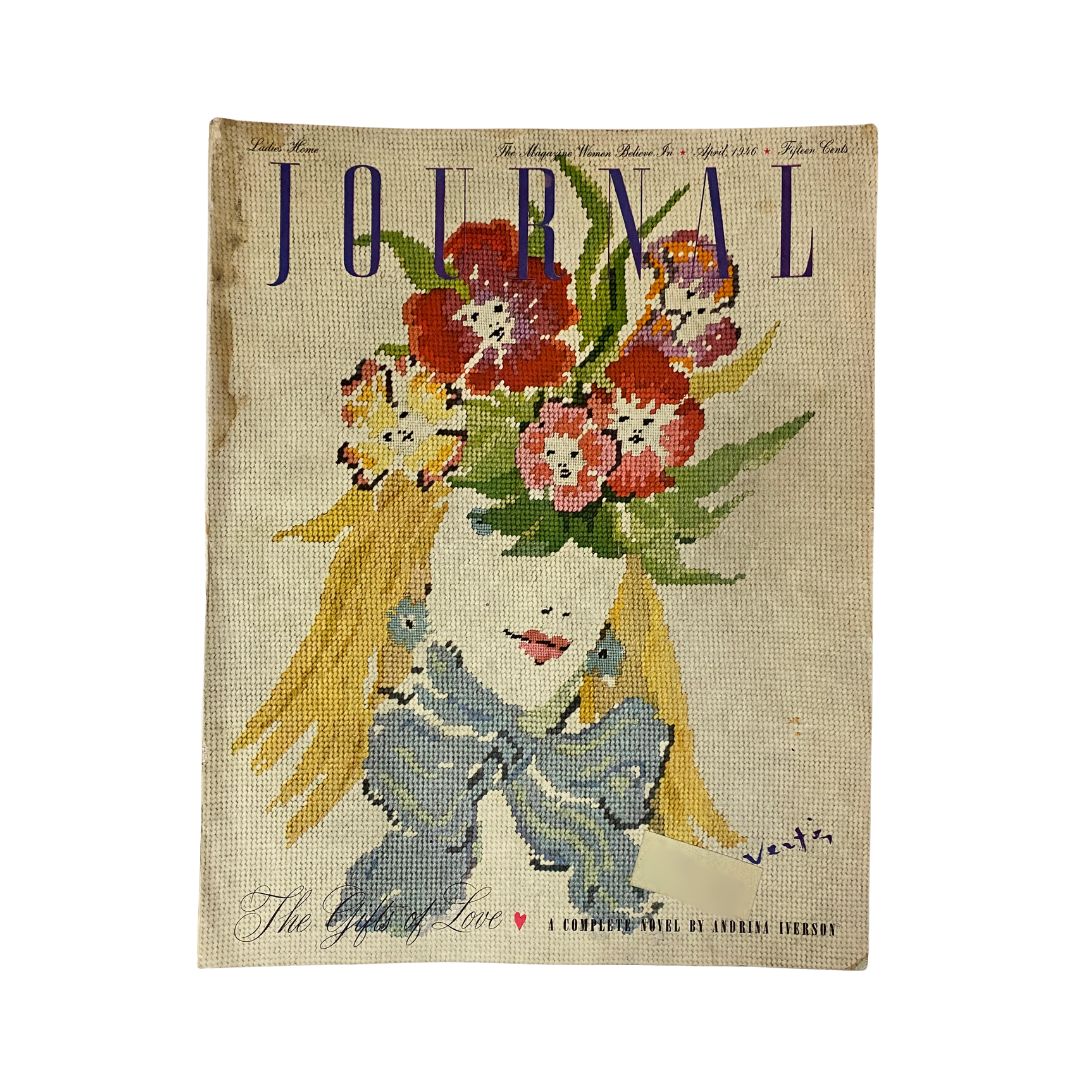
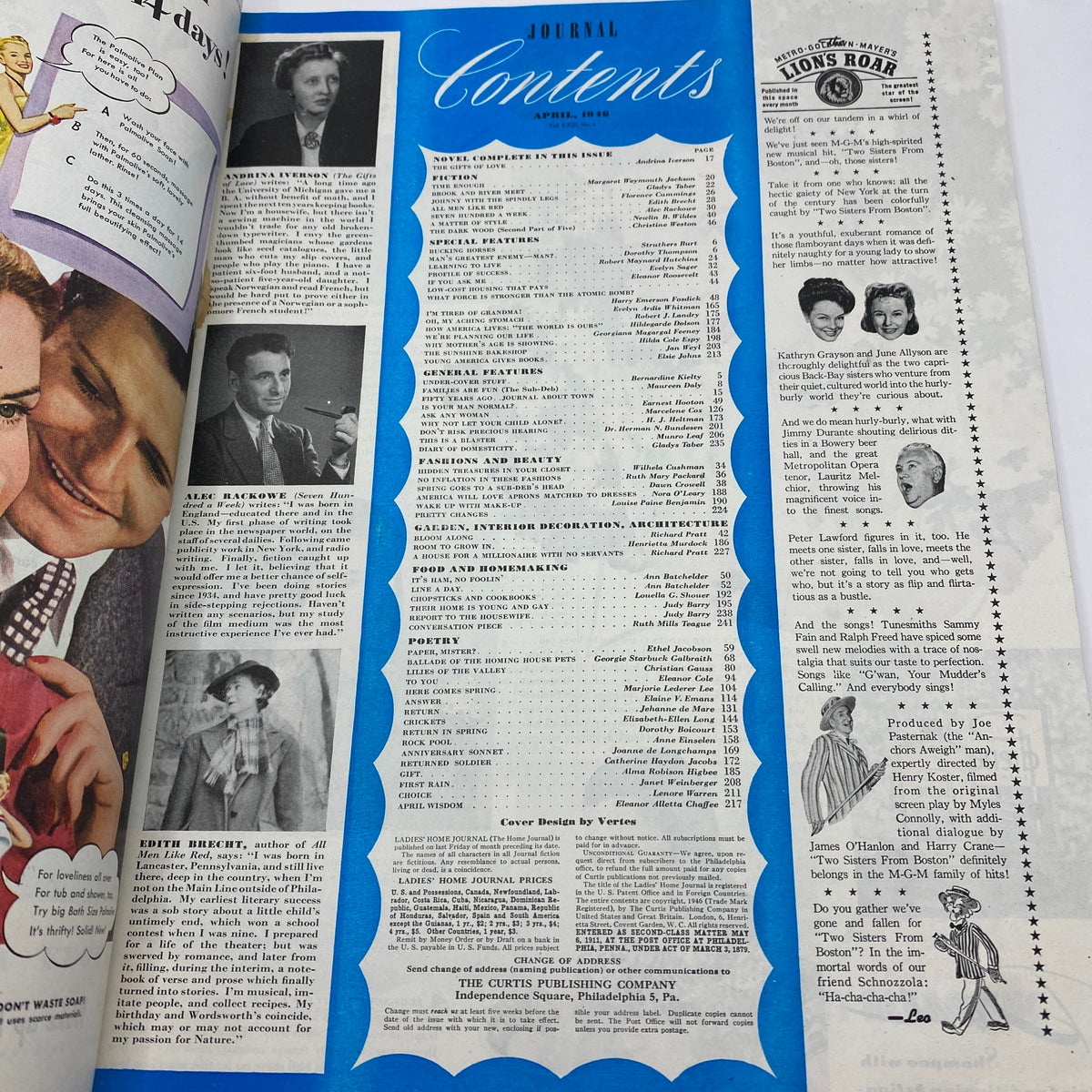
This April 1946 issue of Ladies' Home Journal arrives during one of the most significant transitional periods in twentieth-century American life, situated less than a year after the end of the Second World War and squarely within the early months of postwar domestic reconstruction. The issue's complete novel, "The Gifts of Love" by Andrina Iverson, anchors a remarkably dense and wide-ranging editorial lineup that reflects the magazine's continued commitment to substantial original fiction even as American readers were adjusting to peacetime concerns following years of wartime mobilization. The presence of a poem titled "Returned Soldier," by Catherine Haydon Jacobs, situated among the issue's extensive poetry section, offers a particularly direct and poignant marker of this exact postwar moment, reflecting the lived experience of reintegration that defined American family life throughout 1946.
This issue's roster of contributors includes several genuinely significant figures in American letters and public life. Eleanor Roosevelt appears with her column "If You Ask Me," part of her long-running reader correspondence feature for Ladies' Home Journal, in which the former First Lady fielded questions directly from the magazine's readership on matters of politics, culture, and daily life. Dorothy Thompson, one of the most prominent American journalists and political commentators of the era, contributes "Man's Greatest Enemy," while Robert Maynard Hutchins, the influential president of the University of Chicago and a major figure in American higher education reform, contributes "Learning to Live." The inclusion of a piece titled "What Force Is Stronger Than the Atomic Bomb?" by theologian Henry Emerson Fosdick reflects the genuinely urgent and unprecedented cultural reckoning with nuclear weapons that defined American public discourse in the immediate aftermath of Hiroshima and Nagasaki, less than a year removed from this issue's publication.
The issue's fiction section extends well beyond its featured complete novel, including contributions from established writers such as Gladys Taber, who appears twice in this issue with both a short story and her recurring "Diary of Domesticity" column, reflecting her substantial and ongoing presence within the magazine's regular content during this period. Christine Weston's contribution, "The Dark Wood," appears as the second installment of a five-part serialized story, situating this issue within an ongoing narrative that extended across multiple consecutive editions. This combination of complete fiction, serialized storytelling, and recurring columnists reflects the sophisticated and varied editorial structure Ladies' Home Journal had developed by the mid-1940s.
Taken together, this issue offers an extraordinarily comprehensive cross-section of immediate postwar American domestic culture, anchored by Iverson's complete novel and extended by substantive contributions from figures as significant as Eleanor Roosevelt, Dorothy Thompson, and Robert Maynard Hutchins. It sits within the broader context of 1946 magazines and the long editorial history of Ladies' Home Journal itself, capturing a specific, exceptionally well-documented moment in American postwar domestic life. Few single issues combine this many notable bylines across fiction, political commentary, and cultural analysis within the same set of pages.
About the Publication
Ladies' Home Journal was founded in the late nineteenth century and grew into one of the most widely read and culturally influential women's magazines in the United States, particularly under the editorial leadership of Edward Bok in earlier decades, which significantly expanded both its circulation and editorial ambition. By the mid-1940s, the magazine's format combined complete novels and substantial short fiction with serious political and cultural commentary, recurring columns on domestic and homemaking topics, fashion and beauty content, and an extensive poetry section, reflecting an editorial scope considerably broader than purely domestic or decorative content. This April 1946 issue, with contributions from figures including Eleanor Roosevelt, Dorothy Thompson, and Robert Maynard Hutchins, reflects the magazine's continued willingness to engage substantively with political and cultural subjects well beyond conventional homemaking content. The magazine's audience by this period spanned women across the country seeking both practical domestic guidance and serious cultural and political engagement within a single publication. Ladies' Home Journal maintained a highly consistent structural format across its issues during this era, organizing content into clearly defined fiction, special features, fashion and beauty, home and garden, food, and poetry sections. That consistent format is part of what allows an issue like this one to be so precisely dated and contextualized within the magazine's broader mid-1940s output, capturing the publication at a particularly significant moment of immediate postwar transition.
Key Highlights Inside
- "The Gifts of Love," the issue's complete novel, written by Andrina Iverson and presented as the issue's primary fiction offering. This format, a full novel published complete within a single issue, reflects Ladies' Home Journal's substantial commitment to original long-form fiction during this period. The novel anchors the issue's cover feature and overall editorial identity.
- "If You Ask Me," a column by Eleanor Roosevelt, part of her long-running reader correspondence feature for the magazine. This column reflects the former First Lady's sustained and direct engagement with Ladies' Home Journal's readership during this period. Her contribution adds significant historical and political weight to the issue's broader content.
- "Man's Greatest Enemy," a feature by Dorothy Thompson, one of the most prominent American journalists and political commentators of the era. This piece reflects the issue's substantive engagement with serious political and cultural commentary. Thompson's involvement underscores the level of journalistic significance the magazine attracted during this period.
- "What Force Is Stronger Than the Atomic Bomb?", a feature by theologian Henry Emerson Fosdick, engaging directly with the unprecedented cultural reckoning surrounding nuclear weapons in the immediate aftermath of their first use in 1945. This piece situates the issue within a genuinely urgent and historically significant public conversation. Its presence reflects the magazine's willingness to address weighty contemporary subjects alongside its domestic content.
- "Returned Soldier," a poem by Catherine Haydon Jacobs, appearing within the issue's extensive poetry section. This piece offers a direct and poignant literary reflection of the postwar reintegration experience defining American family life in 1946. Its inclusion adds genuine emotional and historical texture to the issue's broader content.
- "The Dark Wood," the second installment of a five-part serialized story by Christine Weston, reflecting the magazine's use of ongoing serialized fiction alongside its complete novels and short stories. This format encouraged sustained reader engagement across multiple consecutive issues. Its presence adds further fiction depth to an already substantial literary lineup.
- "Learning to Live," a feature by Robert Maynard Hutchins, the influential president of the University of Chicago and a significant figure in American higher education reform. This piece reflects the issue's engagement with serious educational and intellectual subject matter. Hutchins's contribution adds further intellectual weight to the issue's broader nonfiction content.
Condition & Rarity
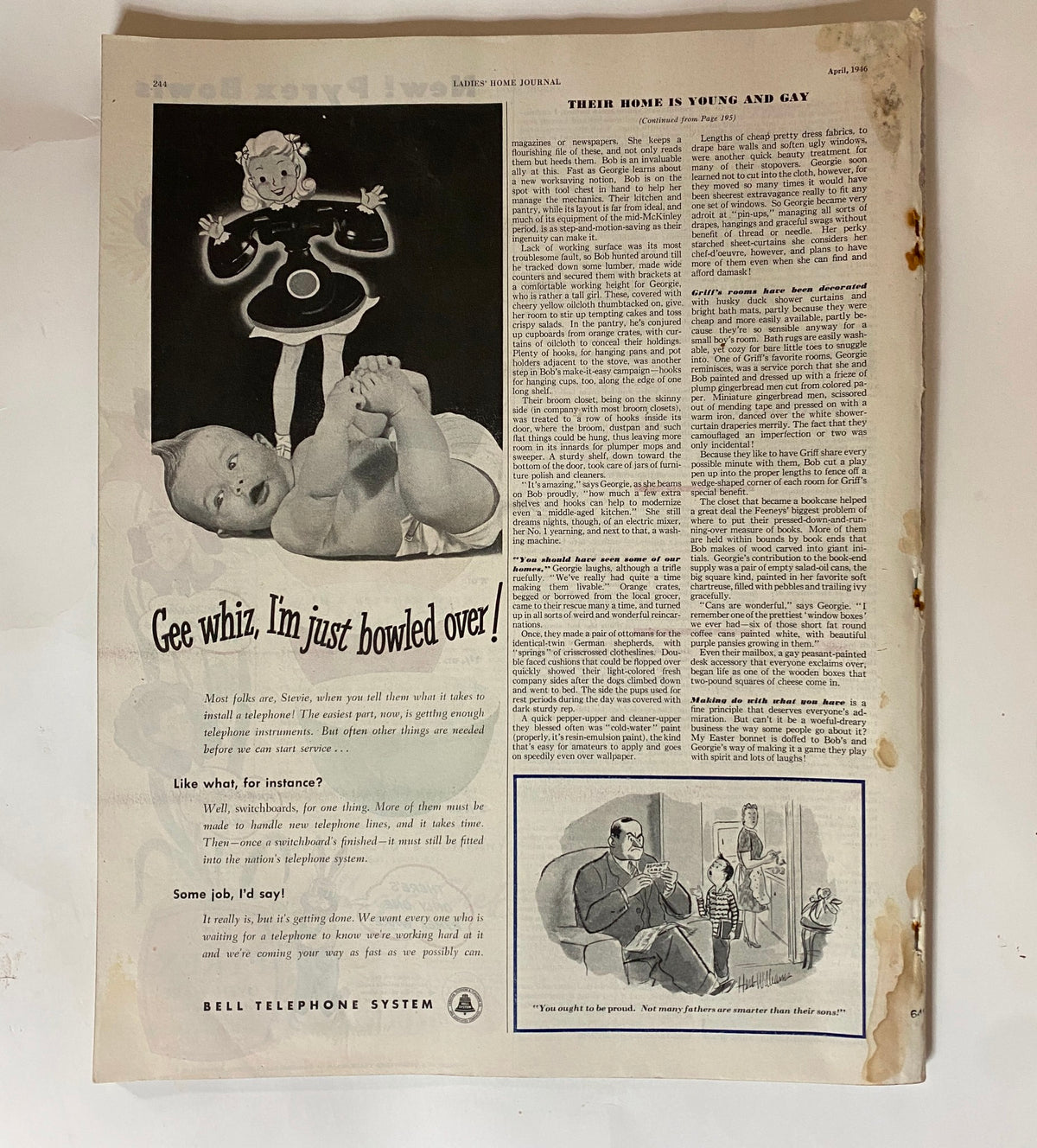
Condition for women's magazines of this type and era is generally assessed through cover and binding integrity, page completeness, and the overall legibility of printed text and illustration. A copy described as having well-preserved interior pages with minimal signs of aging and clear, legible print, despite cover wear typical for a magazine of this decade, reflects a meaningfully strong outcome for the issue's primary reading and reference value, even when the cover itself shows more pronounced age-related wear. The reported absence of some back pages represents a genuine completeness consideration that collectors should weigh carefully, since this affects the issue's overall structural integrity even though the core content, including the featured novel and primary feature articles, reportedly remains intact. Given the density and significance of this issue's content, spanning a complete novel, substantial nonfiction from notable contributors, and an extensive poetry section, the completeness of the core material is a particularly important factor for collectors prioritizing reference value over absolute physical completeness. A protective covering plays a meaningful role in halting further deterioration of the remaining pages, guarding against additional humidity exposure and handling wear going forward. Given the issue's substantial and historically significant content, a copy with strong interior legibility despite cover wear and some missing back pages is generally considered a worthwhile example for collectors and researchers focused on the issue's core editorial content. Collectors evaluating any surviving copy of this issue should weigh interior page completeness and legibility, particularly around the featured novel and major feature articles, as the primary indicators of long-term collectible and reference value.
Looking for More Issues Like This?
An issue combining a complete novel with contributions from figures as significant as Eleanor Roosevelt, Dorothy Thompson, and Robert Maynard Hutchins represents an exceptionally well-documented piece of immediate postwar American magazine publishing, making it a particularly interesting target for collectors focused on this specific period. If this exact April 1946 issue isn't what you're looking for, particularly given its noted missing back pages, the broader Ladies' Home Journal collection spans material from across the magazine's long publishing history, offering a wider range of issues and contributors for collectors interested in the title's overall legacy. For those more focused on this specific year, the full range of 1946 magazines brings together material from across that year, spanning multiple publications beyond Ladies' Home Journal alone, including other periodicals documenting this pivotal postwar transition. Browsing the Ladies' Home Journal collection can be especially useful for collectors building a set around specific contributors, such as Eleanor Roosevelt's columns, or specific decades of the magazine's editorial history, potentially in more complete condition than this particular copy. Browsing by year, on the other hand, suits collectors more interested in capturing a broader cultural and historical snapshot of 1946 across different types of periodicals. Either approach offers a practical way to continue exploring material connected to this issue's particular combination of fiction and feature content. Both collections represent solid starting points for finding comparable issues from this historically significant period in American women's magazine publishing.