
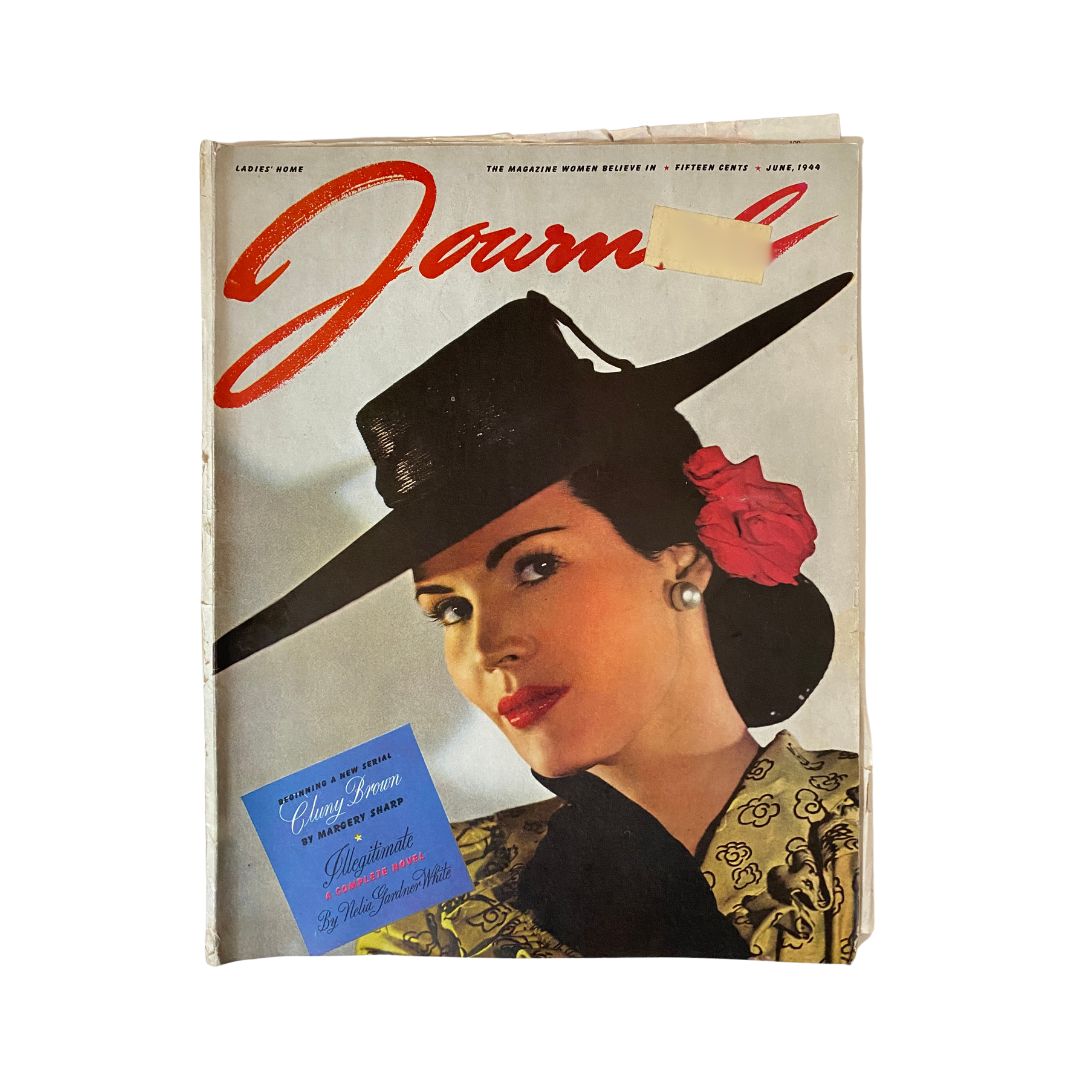
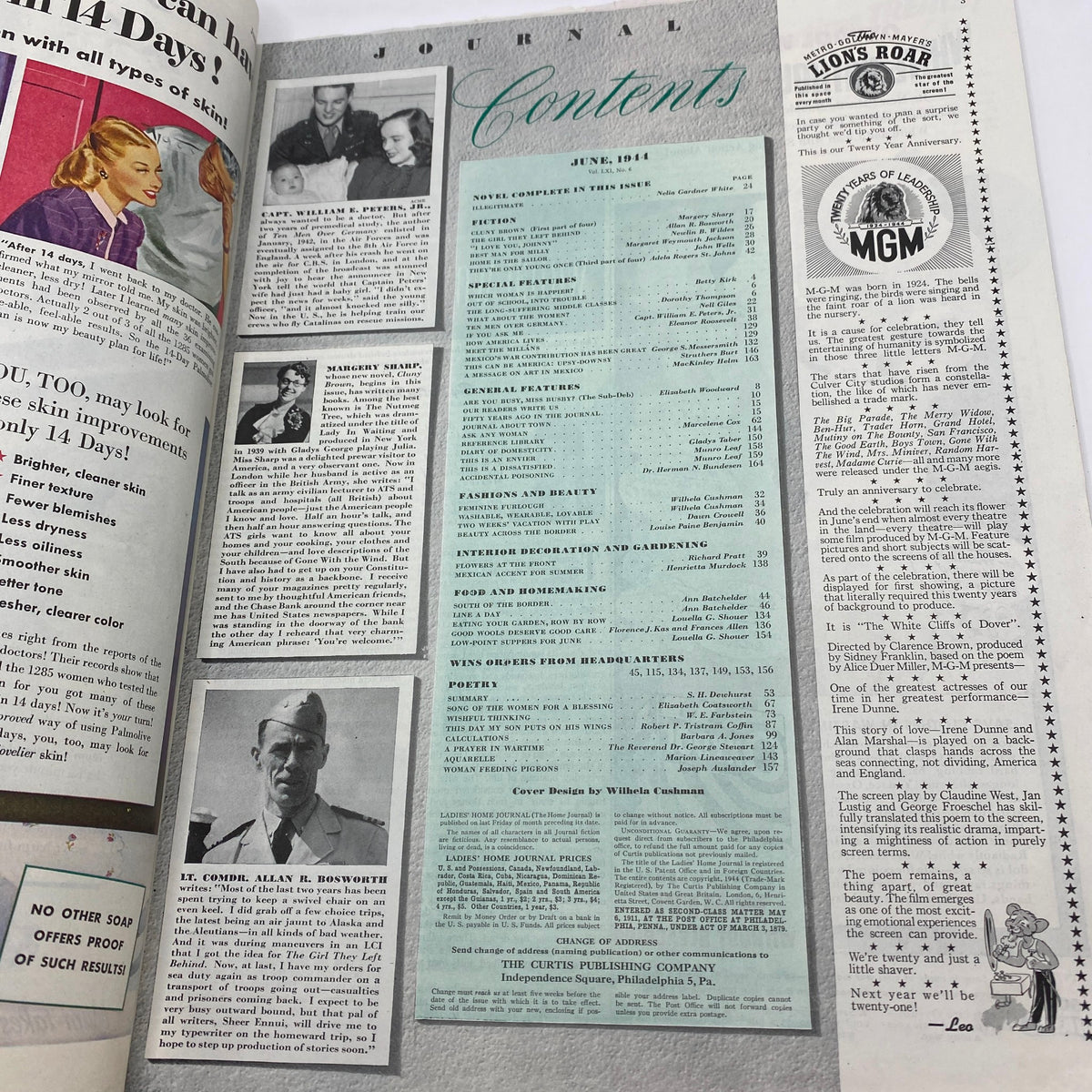
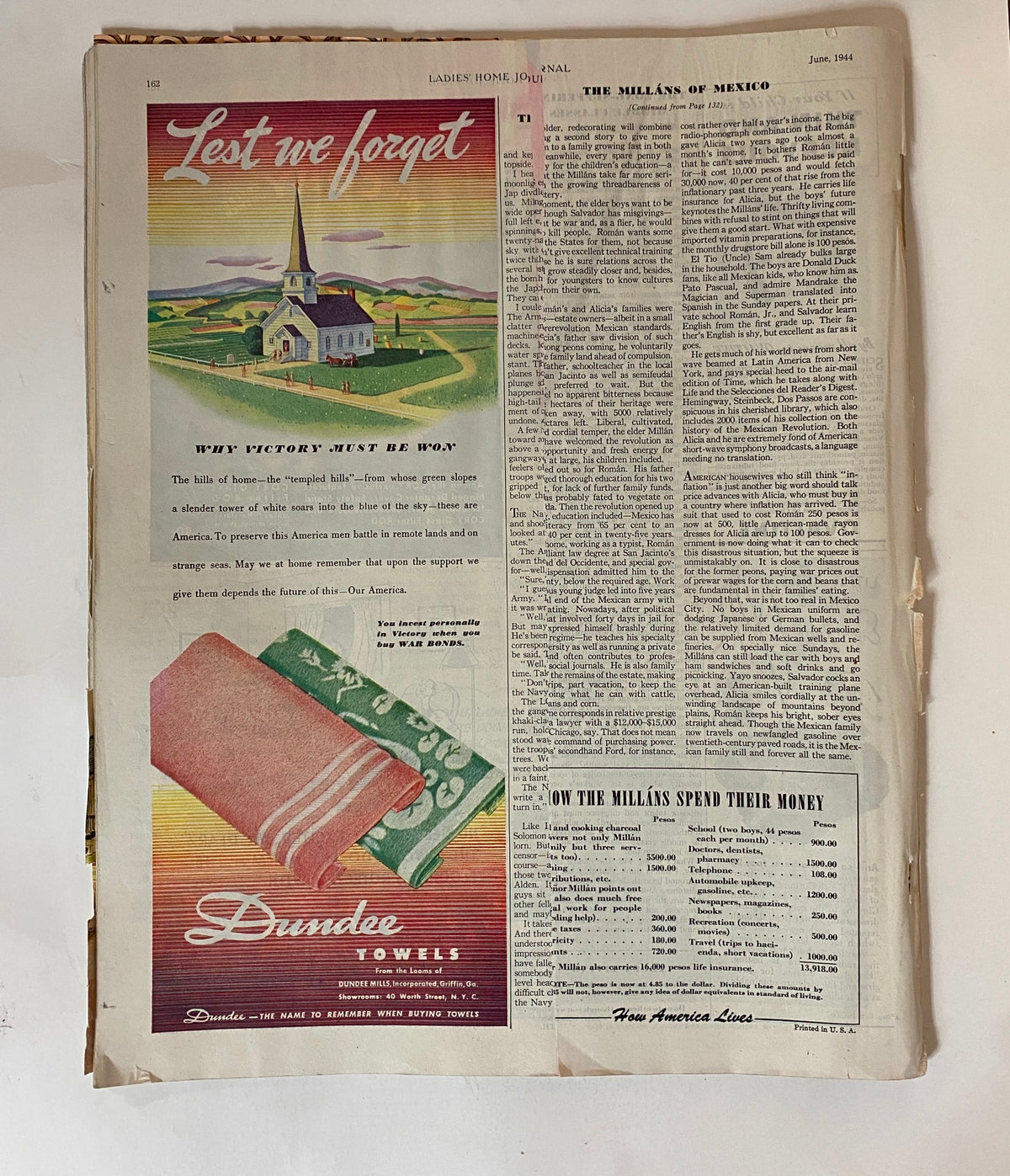


Description
Collector's Note – Why This Issue Matters
The June 1944 issue of Ladies' Home Journal is a primary document of American women's domestic and public life at one of the most consequential moments of the Second World War. June 1944 was the month of D-Day — the Allied landings in Normandy on June 6 — and this issue was assembled and distributed during the weeks surrounding that operation, the largest amphibious military assault in history and the turning point of the European war. The magazine's content reflects the particular tension of that moment with unusual directness. Eleanor Roosevelt's contribution, "Ten Men Over Germany," places the former First Lady's wartime journalism within these pages as a primary document of engaged American public life during the conflict. Dorothy Thompson's "Out of School, Into Trouble" reflects the social and educational disruptions of wartime, and Nell Giles's "The Long-Furrowed Middle Classes" engages directly with the class and economic transformations that the war was accelerating in American society. For collectors building archives of vintage Ladies' Home Journal issues, wartime numbers with this density of named, verifiable content represent some of the most historically substantive material in the publication's long run.
The literary content of this issue is exceptional even by the Journal's high standards for fiction. The first installment of Margery Sharp's serial "The Circus" — confirmed in the table of contents — is a significant literary find. Sharp was a British novelist of considerable reputation whose work combined wit, psychological acuity, and narrative elegance; she is perhaps best remembered today for the "Miss Bianca" series that inspired Disney's The Rescuers, but in 1944 she was a widely read and critically respected fiction writer whose serial appearances in major American magazines were editorial events. The issue also contains a complete novel — "Illegitimate" by Nadia Gardner White — plus five additional short stories by named authors, including a contribution by Adela Rogers St. Johns, one of the most prominent American journalists and fiction writers of the era. Collectors of 1944 magazines focused on wartime American literary culture will find this issue unusually rich in verifiable fiction content. The cover design credited to Wilhela Cushman — who also contributes fashion content under her own byline — reflects the integrated editorial production approach that distinguished the Journal's visual identity during this period.
The broader content of this issue documents wartime American domestic life with the specificity that makes Ladies' Home Journal from this period so valuable to social historians. "Low-Point Suppers for June" reflects wartime rationing's daily impact on American household cooking. "Feminine Furlough" addresses the fashion needs of women in a wartime economy. The gardening and food sections document Victory Garden culture at its height. Poetry by Robert P. Tristram Coffin, Elizabeth Coatsworth, and others addresses the war's emotional dimensions from the domestic perspective. Taken together, this June 1944 issue is a remarkably complete portrait of how American women's culture was processing the war — practically, emotionally, and creatively — in the month of the Normandy invasion.
About the Publication
Ladies' Home Journal, founded in 1883 and published by Curtis Publishing Company through the mid-twentieth century, was one of the most widely circulated women's magazines in the United States, with a readership in the millions throughout the 1940s. Its editorial formula addressed the full range of its middle-class female readership's concerns: fiction and poetry of genuine literary quality, practical content on homemaking, fashion, beauty, and food, and features on public affairs and cultural life that treated women as engaged citizens as well as household managers. The June 1944 issue exemplifies this editorial range at its most fully developed, combining wartime public affairs journalism by Eleanor Roosevelt and Dorothy Thompson with major fiction, domestic guidance calibrated to wartime conditions, and the cultural and social commentary that made the Journal genuinely indispensable to its readership.
Key Highlights Inside
- "Ten Men Over Germany" — Eleanor Roosevelt — A wartime journalism piece by the former First Lady, published in the month of D-Day, representing her sustained engagement with the war effort as a writer and public figure and providing a primary source document of American wartime public discourse at its most consequential moment.
- "The Circus" — Margery Sharp (First of four parts) — The opening installment of a serial by the British novelist whose critically respected fiction appeared regularly in major American magazines, providing a significant literary document alongside the issue's wartime public affairs content.
- "Illegitimate" — Nadia Gardner White (Complete novel) — A full novel serialized within a single issue, consistent with the Journal's tradition of providing substantial fiction content to its readership.
- "Out of School, Into Trouble" — Dorothy Thompson — A feature by one of America's most prominent journalists and political commentators, reflecting the magazine's consistent engagement with serious public affairs journalism directed at women readers.
- Wartime domestic content throughout — "Low-Point Suppers for June," "Eating Your Garden, Row by Row," and other features document daily wartime household management under rationing and material constraints, providing a primary source record of American domestic life in June 1944.
- Missing back pages — noted completeness factor — The listing confirms some missing back pages, a condition factor collectors should weigh against the confirmed excellent interior condition of the primary editorial content sections.
Condition & Rarity
Good vintage condition overall with well-preserved interior pages, cover wear typical of age, and missing back pages represents a condition profile with both positive and negative factors that collectors should weigh carefully. The well-preserved interior with minimal aging is the strongest positive attribute — for a magazine whose primary collector and research value lies in its editorial content, interior integrity matters more than cover presentation or completeness of peripheral back-matter. The cover wear is standard and expected for an eighty-plus-year-old monthly periodical. The missing back pages are the most significant completeness factor: collectors should confirm which pages are absent and whether they fall within the primary editorial content — if the missing pages contain advertising or the final pages of less significant features, the impact on research value is limited; if they contain the conclusion of major fiction or feature content, that is a more meaningful deficit. The listing notes good interior quality, which suggests the core editorial sections are likely intact. No mention of a label or protective covering is made in the listing's condition notes — collectors evaluating any surviving copy should assess these attributes directly.
Looking for More Issues Like This?
A June 1944 Ladies' Home Journal with Eleanor Roosevelt's wartime journalism, a Margery Sharp serial debut, and the full texture of American domestic life in the month of D-Day is a historically specific and substantive find. The broader Ladies' Home Journal archive at OriginalMagazines.com spans many decades of the publication's run and regularly surfaces wartime issues with comparable editorial depth. For collectors focused on the extraordinary historical density of 1944, the complete 1944 magazine collection documents the war's decisive year across a range of titles and perspectives.