




Description
Collector’s Note – Why This Issue Matters
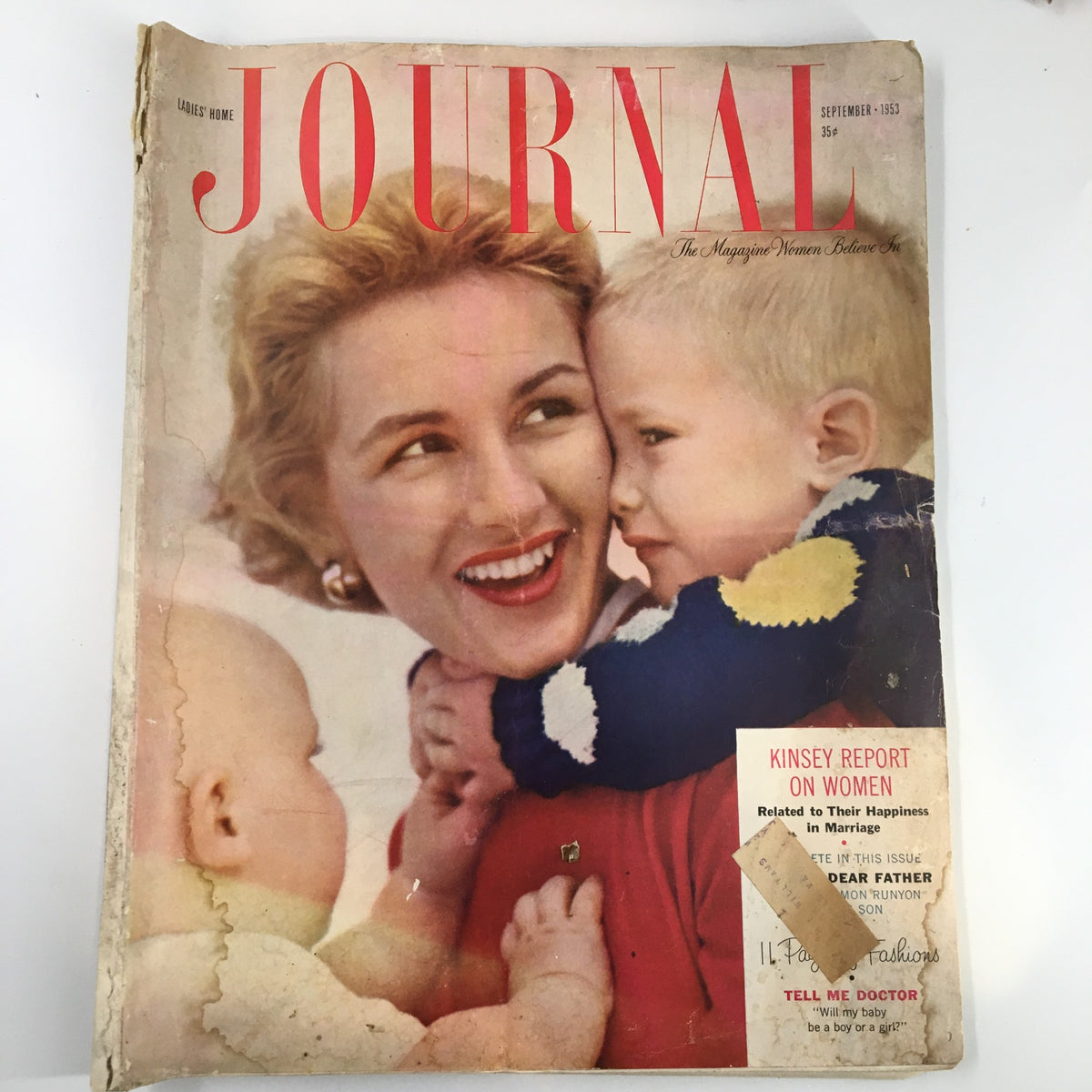
The September 1953 issue of Ladies’ Home Journal presents family life through a warm cover photograph credited to Virginia Thoren. A smiling woman holds a young boy close to her shoulder while an infant reaches upward from the foreground. The arrangement creates an intimate image of affection, childcare, and domestic happiness suited to the magazine’s long-established family readership. At the same time, the surrounding cover lines introduce subjects far more complicated than the gentle photograph initially suggests. One headline connects the newly published Kinsey report on women with questions about happiness in marriage. Another announces “Father, Dear Father,” a complete condensed account of the life of Damon Runyon written by his son. A third promotes the recurring “Tell Me Doctor” department through a question about whether an expectant mother could know if her baby would be a boy or a girl. The cover therefore brings sexuality, marriage, pregnancy, parenthood, literary biography, and idealized family imagery together within one carefully constructed presentation.
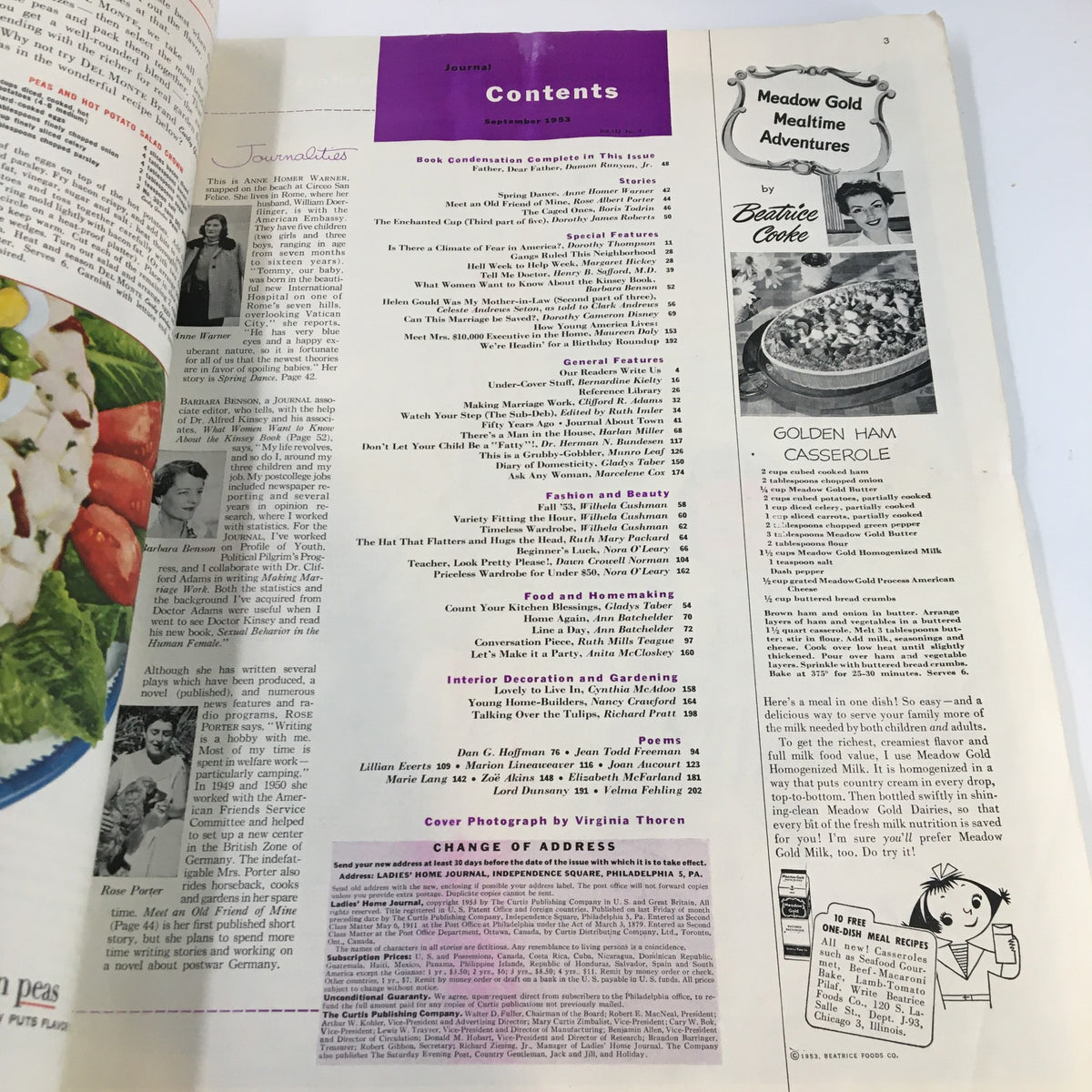
Dorothy James Roberts’s “The Enchanted Cup,” appearing here in the third of five parts, gives the issue particular interest for readers of historical and Arthurian fiction. The novel reinterprets the medieval story traditionally associated with Tristan and Isolde, a tale of loyalty, forbidden love, political obligation, and tragic consequence. Serialization allowed Journal readers to encounter the narrative over several consecutive monthly issues rather than through a single complete volume. This September installment occupies the central position in the five-part sequence and therefore depends upon both the preceding chapters and the later October and November installments. Roberts’s treatment belongs to a long history of modern writers reshaping medieval legends for contemporary audiences. The supplied contents identify several additional stories, including “Spring Dance,” “Meet an Old Friend of Mine,” and “The Caged Ones.” Their titles and credited authors are preserved, but their plots should not be reconstructed without examining the original pages. Together, the literary contents demonstrate that substantial fiction remained an important element within a magazine also associated with household guidance and family advice.
The nonfiction contents provide a wide survey of American concerns during the early Cold War. Dorothy Thompson asks “Is There a Climate of Fear in America?,” a title that evokes contemporary anxiety about political accusation, conformity, loyalty, and freedom of expression. Other special features address neighborhood disorder, fraternity traditions, infant care, marriage counseling, domestic management, and the lives of young Americans. Benjamin Spock contributes advice concerning babies, while Henry B. Safford continues the magazine’s medical question-and-answer series. Fashion pages introduce autumn wardrobes, hats, affordable clothing, and guidance intended for teachers and beginning dressmakers. Food and homemaking departments cover kitchens, entertaining, household routines, and seasonal planning. Interior and garden articles consider livable rooms, young home builders, and the cultivation of tulips. Viewed alongside other magazines published in 1953, the issue records how fiction, sexuality, politics, medicine, fashion, consumer culture, and domestic responsibility were presented to a mass audience of women and families.
About the Publication
Ladies’ Home Journal began publication in 1883 after developing from a women’s supplement created for the newspaper Tribune and Farmer. Louisa Knapp Curtis served as its first editor and helped establish its early emphasis on household, family, and women’s subjects. The magazine later became one of the Curtis Publishing Company’s most influential national publications. Under editor Edward Bok, it expanded dramatically and became the first American magazine to exceed one million subscribers. By the middle of the twentieth century, the Journal ranked among the country’s most widely circulated women’s magazines. Its large monthly issues combined fiction, serialized novels, essays, public affairs, marriage guidance, medicine, parenting, fashion, beauty, food, home design, gardening, crafts, poetry, and consumer advertising. Bruce and Beatrice Gould jointly guided the publication during much of this period and encouraged an editorial mixture broader than conventional household instruction alone. Serious discussions of politics, sexuality, disability, education, and social welfare could appear beside recipes, clothing patterns, decorating suggestions, and family stories. The publication also relied on recurring authorities and columnists whose names became familiar to monthly readers. Extensive advertising documented the products, appliances, clothing, cosmetics, foods, medicines, and services marketed to postwar households. Cover photographs and illustrations helped define idealized images of womanhood, marriage, motherhood, childhood, and domestic prosperity. Surviving issues now function as primary sources for studying literature, journalism, consumer culture, gender expectations, family life, visual design, and changing public conversations about women’s experiences.
Key Highlights Inside
- The Virginia Thoren cover photograph depicts a smiling woman interacting closely with a toddler and an infant. Its affectionate family imagery is paired with cover lines concerning sexuality, marriage, pregnancy, and parenthood. The names of the pictured woman and children have not been confirmed from the supplied documentation.
- The cover promotes a discussion of the Kinsey report on women as it related to marital happiness. The report entered public debate in 1953 and challenged many assumptions about female sexuality, although its methods and sampling later received substantial criticism. The exact title, author, page number, and conclusions of the Journal’s treatment are not included in the supplied contents transcription.
- “Father, Dear Father” is presented as a complete book condensation concerning the life of writer and journalist Damon Runyon. The cover states that the account was written by Runyon’s son, while the supplied contents renders the byline as “Danieue Runyon.” Because that spelling has not been independently verified, the exact printed author name should be checked directly against the photographed contents page.
- Dorothy James Roberts’s “The Enchanted Cup” appears in the third of five serialized installments. The novel reworks the medieval Tristan and Isolde tradition through a modern historical-romance form. Readers seeking the full narrative would require the two preceding installments and the concluding portions published in the following months.
- The other listed stories are “Spring Dance” by Homer Foster, “Meet an Old Friend of Mine” by Rose Albert Porter, and “The Caged Ones” by Boris Todrin. These works broaden the issue’s literary section beyond the historical setting of Roberts’s continuing novel. Their characters, settings, and conclusions remain unconfirmed because the supplied contents provides titles and authors but not summaries.
- Dorothy Thompson’s “Is There a Climate of Fear in America?” introduces a major political and cultural question. Its wording reflects a period marked by Cold War suspicion, loyalty investigations, anti-Communist accusation, and concern about the consequences of public dissent. Thompson’s precise examples, argument, and conclusions should be drawn from the complete article rather than inferred solely from its title.
- “Gang Rule This Neighborhood” and Margaret Hickey’s “Hell Week to Help Week” address organized community behavior and institutional reform. The second title suggests an effort to redirect a tradition associated with initiation or hazing toward constructive service. The locations, participants, and results described in both articles require confirmation from the original features.
- Medical and childcare coverage includes Henry B. Safford’s “Tell Me Doctor” and Benjamin Spock’s “What Women Want to Know About Babies.” Dr. Herman N. Bundesen also contributes an article whose original title uses the period expression “Don’t Let Your Child Become a ‘Fatty.’” That wording should be preserved as historical evidence while recognizing that its language and approach to children’s bodies may now be considered stigmatizing.
- Marriage and household management receive attention through “Can This Marriage Be Saved?,” Clifford R. Adams’s “Making Marriage Work,” and Maureen Daly’s “Meet Mrs. $10,000 Executive in the Home.” These features present marriage and domestic labor as subjects requiring analysis, planning, expertise, and continuing adjustment. Their advice also reflects the gender roles and economic assumptions promoted to American families during the early 1950s.
- The fashion and beauty section presents “Fall ’53,” “Variety Fitting the Hour,” and “Timeless Wardrobe” by Wilhela Cushman. Ruth Mary Packard examines close-fitting hats, while Nora O’Leary contributes material on beginning sewing and an inexpensive wardrobe. Dawn Crowell Norman’s “Teacher, Look Pretty Please!” adds a profession-specific approach to appearance and clothing.
- Food and homemaking material includes Gladys Taber’s “Count Your Kitchen Blessings,” Ann Batchelder’s “Home Again” and “Line a Day,” and Ruth Mills Teague’s “Conversation Piece.” Anita McCloskey contributes “Let’s Make It a Party,” extending the section from daily domestic organization into entertaining. Exact menus, recipes, equipment, and decorating suggestions should be taken from the printed pages.
- Interior design and gardening appear through Cynthia McAdoo’s “Lovely to Live In,” Nancy Crawford’s “Young Home-Builders,” and Richard Pratt’s “Talking Over the Tulips.” The poetry section includes work by Dan G. Hoffman, Jean Todd Freeman, Lillian Everts, Marion Lineaweaver, Joan Aucourt, Marie Lang, Zoë Akins, Elizabeth McFarland, Lord Dunsany, and Velma Fehling. Regular departments such as Our Readers Write Us, Under-Cover Stuff, Diary of Domesticity, Ask Any Woman, and The Sub-Deb complete the issue’s recurring editorial structure.
Condition & Rarity
The supplied description classifies this September 1953 issue as being in Good overall condition. Minor wear is reported and should be understood as evidence of earlier mailing, reading, handling, and storage. A subscriber address label is attached to the front cover and interrupts part of the original photographic and typographic presentation. The label also documents the magazine’s history as a mailed subscription copy rather than an unaddressed example. Light marks are reported throughout the magazine, although their precise locations and severity should be assessed from the accompanying photographs. Wear to the binding is also specifically noted and should be examined for rubbing, looseness, splitting, stress, or partial separation. No complete statement has been supplied concerning tears, detached pages, clipping, missing patterns, handwriting, staining, tape repairs, or restoration. Those characteristics should remain unconfirmed unless they can be established from the listing photographs or direct physical inspection. A plastic protective covering is reported to accompany the magazine and may reduce future exposure to dust and unnecessary handling. That covering is a later storage accessory rather than an original component of the September 1953 publication. Completeness is especially important because “The Enchanted Cup” forms only one installment of a continuing narrative and the issue contains numerous literary, medical, fashion, food, and home departments. Historical and collector interest should be connected with the Virginia Thoren cover, Kinsey-report promotion, Runyon biography, Roberts serialization, documented contents, and actual physical condition rather than with an unsupported claim of exceptional rarity.
Looking for More Issues Like This?
Additional fiction, family journalism, fashion, and household history can be examined through the Ladies’ Home Journal magazine archive. The July and August 1953 issues are particularly relevant because they should contain the opening installments of “The Enchanted Cup.” The October issue continues the novel, while the November edition contains its documented conclusion. Examining all five parts together would preserve the serialization as Journal readers originally encountered it. Neighboring issues may also clarify whether the Runyon condensation, Kinsey discussion, and medical departments generated reader letters or follow-up commentary. Researchers interested in women’s history can compare the magazine’s treatment of sexuality and marital happiness with discussions appearing in newsmagazines, medical publications, and other women’s titles during 1953. Parenting historians may follow Benjamin Spock, Henry B. Safford, and Herman Bundesen across later editions to observe changes in advice concerning infants, nutrition, discipline, and child development. Fashion researchers can compare the September autumn preview with the summer and holiday wardrobes surrounding it. The poetry, fiction, serialized biography, and regular columns provide additional evidence that the Journal operated as a literary publication as well as a domestic guide. The larger 1953 magazine archive places these subjects beside contemporary news, entertainment, business, television, and general-interest journalism. The September Journal remains especially useful because it combines a reassuring family image with difficult public questions involving sexuality, political fear, marriage, child health, domestic labor, and changing expectations for American women.