

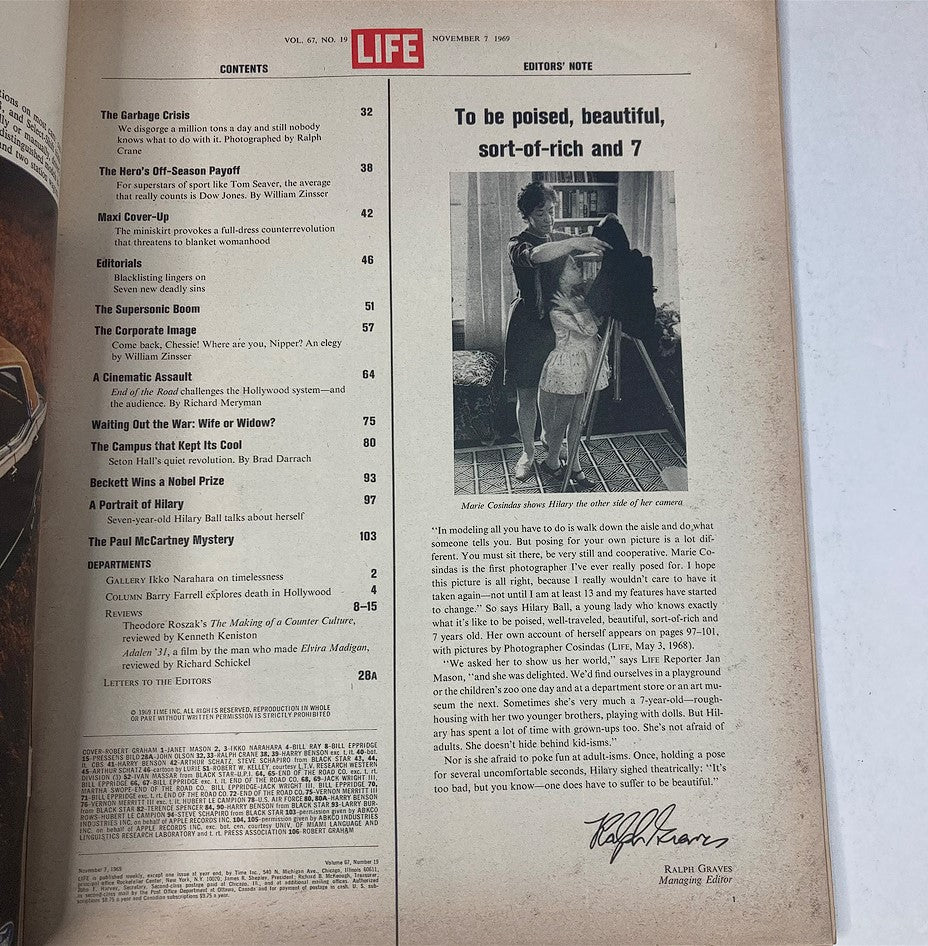


Description
Collector's Note – Why This Issue Matters
The November 7, 1969 issue of Life Magazine, headlined "Paul McCartney Is Still with Us," is one of the most culturally specific and historically fascinating magazine covers of the entire decade — a major American publication directly addressing and debunking one of the most extraordinary conspiracy theories in popular music history. The "Paul is dead" rumor had exploded across American college campuses and popular media in October 1969, following an October 12 call to radio station WKNR-FM in Detroit by a listener claiming to have found clues in Beatles recordings that McCartney had died in a car accident in 1966 and been replaced by a look-alike. The rumor spread with extraordinary speed — this was still years before the internet, but the story traveled through word of mouth, college radio, and mainstream press coverage with a velocity that demonstrated both the Beatles' extraordinary cultural centrality and the specific conspiratorial anxieties of a population that had lived through the Kennedy assassination six years earlier and had reason to believe that significant truths were being concealed from them. Life Magazine's decision to investigate, photograph McCartney at his Scottish farm, and publish the November 7 debunking cover story was a significant editorial act — one of America's most authoritative and widely read publications intervening directly in a popular culture crisis to provide what it presented as definitive visual and journalistic evidence that McCartney was alive. For collectors building archives around Paul McCartney's magazine history, this November 7, 1969 Life cover is among the most historically significant and culturally specific entries in the entire archive — a document of an extraordinary media moment that has no precise equivalent in American popular culture.
The specific timing of this issue — November 7, 1969 — places it within one of the most tumultuous periods in Beatles history. The band had essentially dissolved as a functional unit by the fall of 1969: Abbey Road had been released on September 26 and was in the process of becoming one of the most commercially successful albums in the band's history, but the internal tensions that would lead to the formal announcement of the Beatles' breakup in April 1970 were already publicly visible through various legal disputes and conflicting statements from band members. McCartney himself had withdrawn from public life somewhat — he had married Linda Eastman in March 1969 and was spending significant time on his Scottish farm away from London and the music industry's center of gravity — which had ironically contributed to the credibility of the "Paul is dead" rumor by making him less visibly present in the media than fans expected. The Life cover story that emerged from a photographer's visit to that Scottish farm — images of McCartney, Linda, and their family in pastoral surroundings — was itself a document of a significant moment in his post-Beatles-era identity formation, as he was beginning to construct the private, family-oriented life that would define his public image through the 1970s. Collectors researching Life Magazine's history of documenting American popular culture will find this issue one of the most instantly recognizable and historically weighted covers in the publication's late-1960s archive, and those building a comprehensive picture of American media from 1969 will recognize it as one of the year's most extraordinary editorial responses to a popular culture phenomenon.
The "Paul is dead" story's cultural significance extends well beyond its immediate absurdity as a hoax. It was a genuine mass media phenomenon that preceded and in some ways anticipated the era of viral misinformation — a false narrative that spread faster than authoritative corrections because it engaged deep anxieties about authenticity, concealment, and the trustworthiness of cultural institutions. Life's intervention was an attempt by a major institutional journalism venue to exercise the authoritative corrective function that such institutions had traditionally claimed, and the specific cover line "Paul McCartney Is Still with Us" — delivered with the measured confidence of a publication that expected its word to settle the matter — is itself a historical document of what mainstream American media believed its cultural function and authority to be in November 1969.
About the Publication
Life Magazine was founded by Henry Luce in 1936 as a weekly photojournalism publication and grew over the following three decades into one of the most widely read and culturally influential magazines in American history, reaching a peak weekly circulation of approximately eight million copies in the late 1960s. Its photographic essays, landmark documentary images, and celebrity coverage defined American visual culture for a generation, and its editorial interventions in major cultural and political stories — including this November 7, 1969 McCartney cover — carried genuine authoritative weight with a mainstream American readership that had grown up trusting Life as a primary visual record of contemporary life. By November 1969, Life was publishing in the specific late-decade context of its greatest commercial circulation but also facing the accelerating competition from television news that would eventually lead to the magazine's discontinuation of weekly publication in December 1972. The November 7, 1969 "Paul McCartney Is Still with Us" cover is therefore one of the final major cultural interventions by Life Magazine in its weekly format, produced at the peak of both the magazine's circulation and the cultural authority it was exercising.
Key Highlights Inside
- The cover headline "Paul McCartney Is Still with Us" directly addresses and debunks the "Paul is dead" hoax that had swept American popular culture in October 1969, making this one of the most historically specific and culturally resonant cover stories Life Magazine produced in its final years of weekly publication — a major American institution exercising its authoritative corrective function at a moment of genuine popular culture crisis.
- The photographic documentation of McCartney at his Scottish farm — the visual evidence that constituted Life's debunking of the hoax — provides primary photographic documentation of McCartney in the specific setting and domestic context of late 1969, at the moment he was beginning to construct the private, family-oriented post-Beatles identity that would define his public image through the following decade.
- The November 7, 1969 publication date places this issue within the specific context of Abbey Road's active commercial period — the album had been released on September 26, 1969, and was in the process of becoming one of the most commercially successful albums in Beatles history while the band itself was in the final months before its formal dissolution.
- The confirmed excellent condition with all pages intact is a meaningful preservation attribute for a fifty-six-year-old weekly photojournalism magazine — Life's combination of coated photographic stock and newsprint pages ages unevenly, and complete page integrity in any surviving copy from this period is a significant archival positive.
- Note: Specific article titles, named contributors, and detailed interior content beyond the confirmed McCartney cover story are unconfirmed for this issue. The highlights above are drawn from listing details and well-documented public knowledge about the "Paul is dead" phenomenon and Life Magazine's November 7, 1969 editorial response.
Condition & Rarity
Surviving copies of this issue are graded at the Excellent level with only light wear — a strong condition designation for a fifty-six-year-old weekly photojournalism magazine that indicates careful preservation and minimal aging. For a Life Magazine from November 7, 1969, excellent condition with light wear means a copy that retains cover gloss, spine integrity, and interior page quality without the significant tanning, surface scuffing, or structural damage that affects lower-grade copies from the same era. Life's production format — combining coated photographic pages with standard newsprint sections — ages unevenly, with coated pages generally retaining color and surface quality better than newsprint sections, and excellent-grade survival across all sections represents a meaningful preservation achievement for a publication of this age and paper composition. The confirmed complete page count establishes the issue's full archival integrity, preserving the complete McCartney cover story documentation alongside all accompanying editorial content. The plastic protective covering provides appropriate stabilization for a publication of this age, helping to maintain cover surface quality and prevent further deterioration during handling and storage. The cultural significance of this specific cover — its direct engagement with the "Paul is dead" phenomenon at the precise moment of the story's maximum cultural circulation — gives surviving copies a collector and research interest that extends well beyond the general Life Magazine back-issue market, drawing Beatles historians, pop culture researchers, and media history scholars whose interest centers on the documentary significance of Life's editorial intervention.
Looking for More Issues Like This?
Life Magazine issues that directly document major popular culture crises — and particularly the November 7, 1969 "Paul McCartney Is Still with Us" cover, which remains one of the most culturally specific and historically resonant covers in the publication's complete archive — are among the most consistently sought-after entries in the Life back-issue collector market. The Paul McCartney magazine collection at OriginalMagazines.com is the most focused place to explore his cover history across multiple titles and decades. The Life Magazine collection offers the broadest view of the publication's extraordinary photojournalism archive, and the 1969 magazines collection provides a wide cross-section of American publishing from one of the most historically dense years of the twentieth century.