




Description
Collector's Note – Why This Issue Matters
The July 4, 1939 issue of Look magazine — Volume 3, Number 14 — featuring Hedy Lamarr and Robert Taylor on the cover is a primary document of extraordinary historical density, combining Hollywood glamour at its most classically defined with some of the most politically charged editorial content published in any mainstream American magazine of 1939. The cover subjects themselves represent a specific and well-documented moment: Lamarr had arrived at MGM from Europe in 1937 and was still in the early phase of her American career, being introduced to mass audiences through exactly these kinds of promotional cover placements, while Taylor was already one of the most commercially bankable leading men in Hollywood. The confirmed Lady of the Tropics preview inside is a primary document of the film at the exact pre-release moment — the film would open in August 1939 — making this a dated primary promotional document of one of Lamarr's most significant early American roles. The July 4 cover date — American Independence Day — gives this issue a specific patriotic framing whose irony the confirmed content makes immediately apparent: the most politically significant article in the issue was written by Adolf Hitler's estranged nephew. For collectors building archives of vintage Look magazine issues, this July 4, 1939 number is among the most historically layered in the publication's prewar run.
The confirmed "Why I Hate My Uncle" piece by William Patrick Hitler is the editorial item that gives this issue its most extraordinary historical distinction. William Patrick Hitler — born in Liverpool to Adolf Hitler's half-brother Alois — had a documented history of attempts to trade on and distance himself from his uncle's name, and by 1939 his public statements about the Nazi leader carried specific biographical authority that no other American commentator could claim. A mainstream American photographic magazine publishing a personal anti-Hitler piece by Hitler's own nephew in July 1939 — ten weeks before Germany's invasion of Poland — is a primary document of how the American press was engaging the European crisis through the most intimate possible lens at the specific moment when that crisis was building toward its decisive climax. The confirmed Harold Ickes piece ("Why I Want Roosevelt to Run Again") and Drew Pearson and Robert S. Allen's "Roosevelt After 1940" together document the American domestic political anxiety of July 1939 from two perspectives: the Cabinet-level advocacy for a third term and the journalistic assessment of Roosevelt's political future, both published in the same issue as J. Edgar Hoover's G-Man piece and the Hitler nephew article. Collectors of 1939 magazines will find no other issue from this year that concentrates this range of named political primary sources into a single number.
The confirmed fashion content — "Hattie Carnegie vs. Elizabeth Hawes" — documents a specific and historically interesting fashion culture confrontation between two of the most significant American fashion figures of the interwar period: Carnegie, the Austrian-born retailer and designer who had built one of the most influential fashion businesses in American history, and Hawes, the iconoclastic designer and writer whose Fashion Is Spinach (1938) had been one of the most provocative challenges to American fashion culture ever published. A July 1939 Look feature pitting them against each other is a primary document of that specific fashion culture tension at its most publicly articulated.
About the Publication
Look magazine, founded in 1937 by Gardner Cowles Jr. and published biweekly through 1971, was the primary competitor to Life magazine in the American photographic general-interest magazine market. By July 1939 it was in only its third year of publication and was actively establishing its editorial identity as a publication willing to engage both Hollywood glamour and serious political journalism with equal ambition — a combination fully visible in this issue's mix of Hedy Lamarr cover promotion and William Patrick Hitler political commentary. Its audience was broad, middle-class, and nationally representative, and its editorial decisions reflected a consistent effort to inform and entertain its readership in equal measure.
Key Highlights Inside
- Hedy Lamarr and Robert Taylor cover — Lady of the Tropics promotion — A confirmed promotional cover for the August 1939 MGM film, documenting Lamarr's early American career positioning and Taylor's established leading man status at a specific pre-release moment.
- "Why I Hate My Uncle" — William Patrick Hitler (page 16) — A confirmed personal-political piece by Adolf Hitler's estranged Liverpool-born nephew, published ten weeks before Germany's invasion of Poland — one of the most extraordinary primary sources published in any American mainstream magazine of 1939.
- "Why I Want Roosevelt to Run Again" — Harold L. Ickes (page 2) — A confirmed Cabinet-level advocacy piece by Roosevelt's Secretary of the Interior, providing a primary document of the internal Democratic politics of the third-term question in July 1939.
- "Roosevelt After 1940" — Drew Pearson and Robert S. Allen (page 30) — A confirmed political journalism assessment by two of America's most prominent political columnists, providing a second named primary source on the Roosevelt succession question in the same issue as the Ickes piece.
- "The G-Men Want These Criminals" — J. Edgar Hoover (page 6) — A confirmed bylined piece by the FBI Director, providing a primary document of Hoover's personal engagement with the popular press at the specific moment of his most sustained public authority.
- "Hattie Carnegie vs. Elizabeth Hawes" — fashion feature (page 36) — A confirmed feature documenting the specific tension between two of the most significant figures in interwar American fashion culture, published the year after Hawes's landmark Fashion Is Spinach.
Condition & Rarity
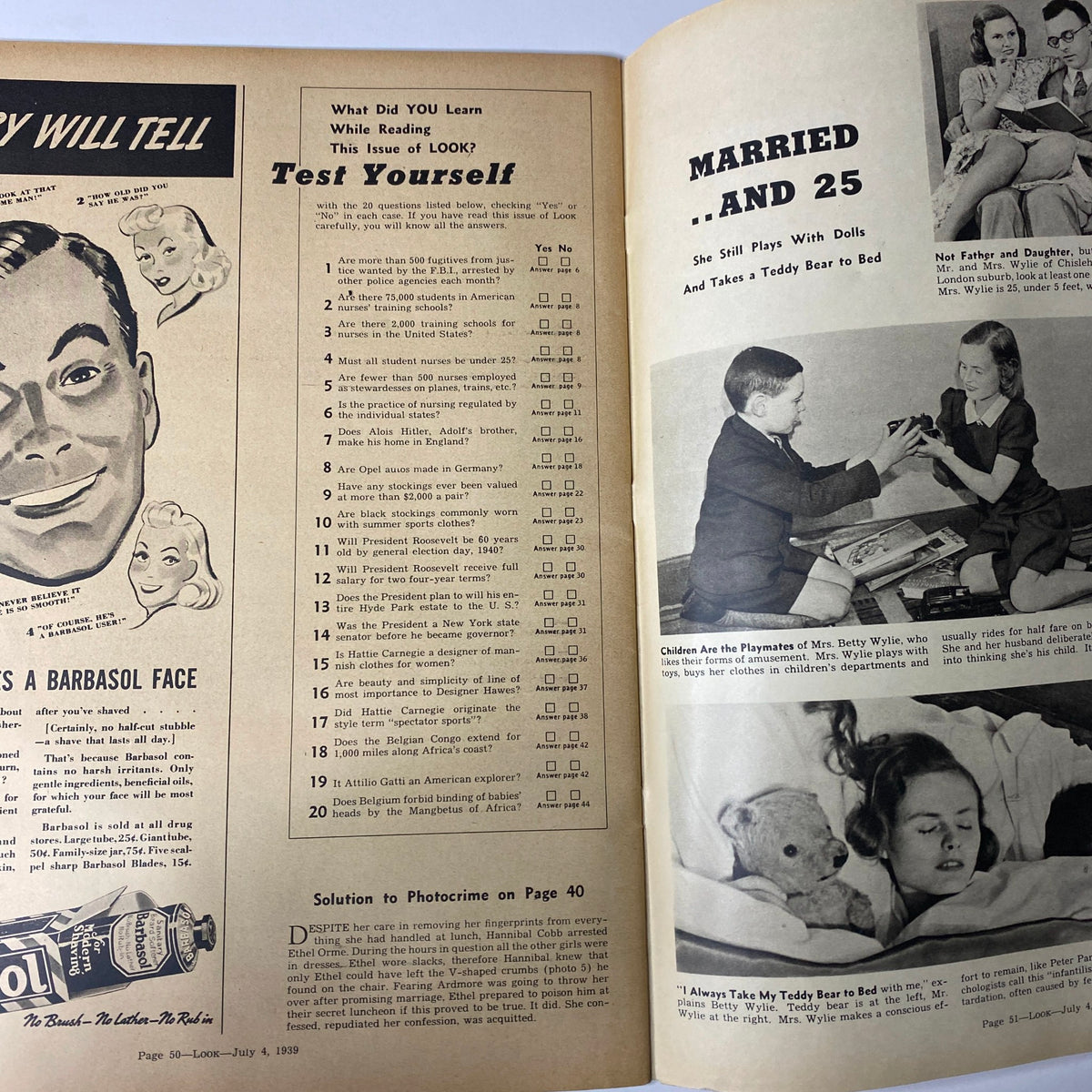
Very good condition with minor edge wear, no mailing label, and plastic protective sleeve represents a strong collector-grade example of an eighty-five-year-old biweekly general-interest photographic magazine. The no-label status confirms the full Lamarr-Taylor cover image is completely visible without address obstruction — particularly significant for a cover whose Hollywood promotional context makes its visual integrity a primary display attribute. Minor edge wear is standard and expected at the very good grade for a publication of this age. The plastic protective sleeve confirms deliberate preservation. The confirmed full table of contents indicates complete interior integrity across all editorial sections, including the William Patrick Hitler piece and the three named political articles, which collectively constitute the issue's primary historical research value. For a publication of this historical density — with this specific combination of Hollywood, domestic politics, international crisis journalism, and fashion culture — the very good condition grade represents a favorable survival state that makes this issue accessible for both display and research purposes.
Looking for More Issues Like This?
A July 4, 1939 Look with William Patrick Hitler's anti-uncle piece, Harold Ickes's third-term advocacy, and the Hedy Lamarr Lady of the Tropics preview is a specific and historically extraordinary find — the combination of named political primary sources in a single pre-war issue is virtually unmatched in the publication's run. The broader Look magazine archive at OriginalMagazines.com spans many years of the publication's run and is worth exploring carefully for other issues from its historically dense prewar period. For collectors focused on the extraordinary political and cultural intensity of 1939 — the last full year before the world changed — the complete 1939 magazine collection documents the most consequential year of the entire twentieth century across a range of titles and perspectives.