




Description
Collector's Note – Why This Issue Matters
November 8, 1938 was a date of considerable historical weight. The American midterm elections had just concluded the previous day, with Democrats retaining Congressional majorities despite significant Republican gains — the first meaningful check on Franklin Roosevelt's New Deal coalition. In Europe, the situation was deteriorating rapidly: Kristallnacht, the coordinated Nazi pogrom against Jewish businesses, synagogues, and homes across Germany and Austria, occurred just two days after this issue's cover date, on the night of November 9th. The United States was navigating a world in which the Depression had not fully lifted, European fascism was accelerating toward catastrophe, and American domestic politics were in active flux. A Look magazine from this precise week is a document of American popular culture at one of its most historically charged moments — the last autumn before the world changed irreversibly.
The two major features named in this issue represent strikingly different dimensions of that cultural moment. "Birth Control — A Debate" featuring Margaret Sanger was genuinely bold editorial territory for a mainstream American pictorial magazine in 1938. Sanger had founded the American Birth Control League — the organization that would become Planned Parenthood — in 1921, and remained one of the most controversial and consequential public figures in American life, a woman whose advocacy for reproductive rights intersected with the era's complex conversations about women's autonomy, public health, and social policy. Publishing a debate around her work in a mass-circulation magazine was a meaningful editorial statement. "Bette Davis Grows Up," meanwhile, profiled an actress at the peak of her early career power — Davis had won her second Academy Award for Jezebel in 1938, the same year she appeared in Dark Victory and The Private Lives of Elizabeth and Essex. For collectors focused on Bette Davis's documented presence in American print media, a 1938 profile from this period of her career is among the most historically significant available.
The breadth of the table of contents here is remarkable even by the generous standards of a general pictorial magazine. A single issue covers birth control advocacy, electoral politics, Mickey Rooney and Clark Gable's box office rivalry, Thomas Dewey's political future, the Dionne Quintuplets, Anne Morrow Lindbergh's new book, and a feature on wrestling — a cross-section of American popular culture in late 1938 that no single-subject publication could replicate. The presence of a feature on Thomas Dewey, framed as a potential GOP future, is particularly resonant in retrospect: Dewey would go on to win the Republican presidential nomination in 1944 and 1948, losing narrowly to Roosevelt and then, famously, to Truman. For collectors assembling a record of American print culture from 1938, this issue offers an unusually rich cross-section of the era's concerns and personalities in a single, well-preserved artifact.
About the Publication
Look magazine, founded by Gardner Cowles Jr. in 1937, was a biweekly American pictorial magazine that competed directly with Life for the mass-market photojournalism audience throughout its run from 1937 to 1971. Where Life emphasized hard news and photographic documentation of current events, Look leaned toward human interest, celebrity, social issues, and the kind of accessible feature journalism that appealed to a broad general readership. Its large-format pages and heavy investment in photography made it visually distinctive, and its editorial willingness to engage with controversial social topics — as demonstrated by the Sanger birth control feature in this very issue — gave it a reputation for tackling subjects that more conservative publications avoided. By November 1938, just over a year into its publication history, Look had already established the format and editorial voice it would maintain for decades.
Key Highlights Inside
- "Birth Control — A Debate" (p. 14) — a feature spotlighting Margaret Sanger, founder of what would become Planned Parenthood and the most prominent advocate for reproductive rights in American public life, published in a mass-circulation magazine at a moment when the topic remained genuinely controversial in mainstream media.
- "Bette Davis Grows Up" (p. 34) — a profile of the two-time Academy Award-winning actress during the most critically acclaimed stretch of her early career, the same year she appeared in Jezebel, Dark Victory, and The Private Lives of Elizabeth and Essex.
- "Mickey Rooney — Gable's Rival" (p. 33) — a feature on the box office competition between two of Hollywood's biggest male stars of the late 1930s, documenting the studio era's celebrity culture at its height.
- "Dewey: G.O.P. Man of Destiny?" (p. 42) — a profile of Thomas Dewey, the future two-time Republican presidential nominee, published the day after midterm elections that signaled the first significant shift in New Deal political dynamics.
- "Dionne Quintuplets Have Pets" (p. 50) and "Anne Lindbergh's New Book" (p. 52) — features reflecting the era's distinctive celebrity culture, in which the Dionne quintuplets were among the most photographed children in the world and Anne Morrow Lindbergh one of its most closely followed authors.
- Additional content spanning electoral politics, Hollywood previews, health and beauty, humor, and photocrime — a comprehensive cross-section of American popular culture in the final weeks of 1938.
Condition & Rarity
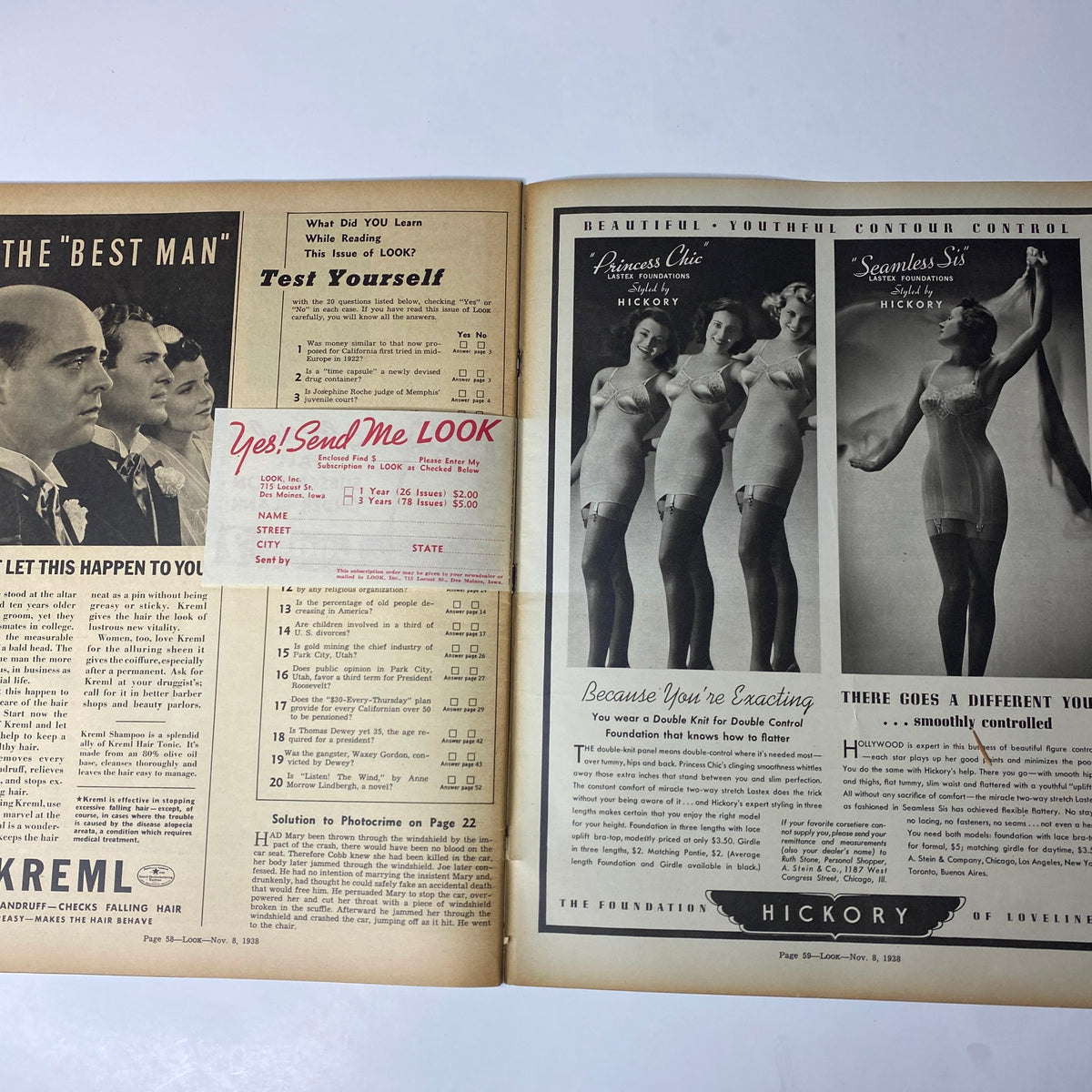
Surviving copies of this issue are graded Very Good, with minor edge wear consistent with nearly ninety years of age — a strong result for a large-format pictorial magazine from 1938. The absence of a mailing label is a meaningful positive attribute: Look's large covers were frequently obscured by subscriber labels affixed directly over the cover image, and label-free copies preserve the full visual integrity of the cover design. Very Good condition for a publication of this type and vintage indicates that the cover, spine, and interior pages are intact and legible without significant brittleness, toning, or structural compromise. The plastic protective covering indicates deliberate preservation. For any surviving copy of this issue, the critical collector condition factors are the integrity of the cover art and the completeness of the key editorial features — particularly the Sanger and Davis pieces, which represent the primary points of historical and collector interest — along with the overall stability of the paper stock, which in large-format pictorial magazines from this era can vary considerably depending on storage history.
Looking for More Issues Like This?
A label-free Look from November 1938 in Very Good condition — featuring both a Bette Davis profile and a Margaret Sanger birth control debate in a single issue — is a genuinely specific find, and copies combining that editorial content with clean condition don't appear often. The Bette Davis magazine collection at OriginalMagazines.com is the most focused resource for tracking down her appearances across the American press throughout her career, and it's the right starting point for collectors building around her late-1930s peak. The full Look magazine archive covers the publication across its entire run and regularly surfaces significant issues from its prewar years, while the 1938 magazine collection brings together the full print landscape of that historically charged year for collectors working across publications and subjects.