
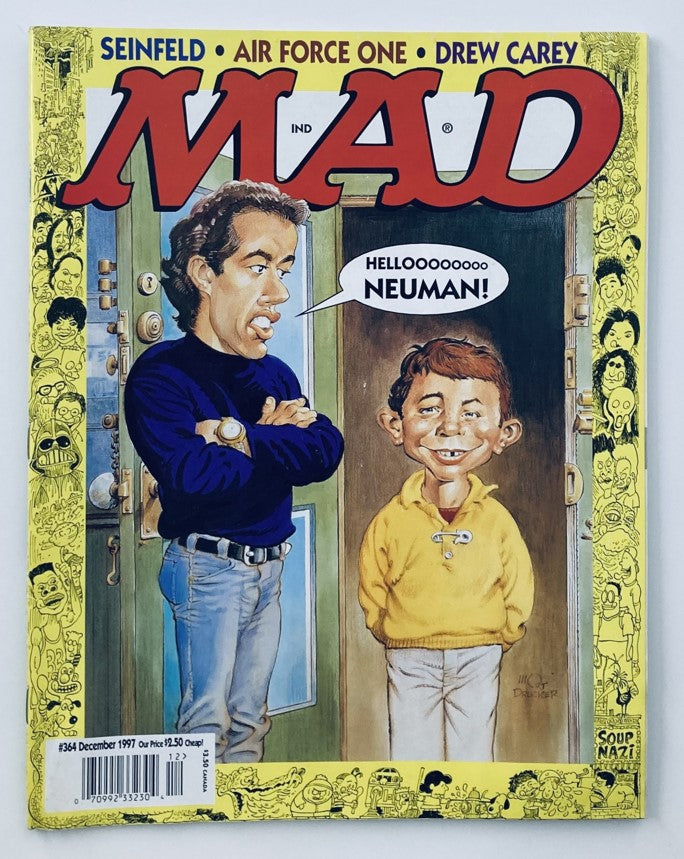


Description
Collector's Note – Why This Issue Matters
December 1997 is one of the most precisely timed and culturally resonant cover choices in Mad Magazine's long history of celebrity satire. Seinfeld, the NBC sitcom that had premiered in 1989 and built slowly to cultural dominance through the early nineties, was in the final stretch of its run by December 1997 — the ninth and final season was airing, and the show's impending conclusion, announced in December 1997, was generating the kind of sustained national conversation that only a very small number of television programs have ever commanded. Jerry Seinfeld was at the absolute peak of his mainstream cultural visibility, simultaneously the star of the most-watched comedy on American television and a performer whose decision to end the show on his own terms — declining a reported $5 million per episode renewal offer — had itself become a major news story. Mad's decision to put him on the December 1997 cover was editorially precise: the magazine's satirical apparatus was being aimed at a target who was, at that exact moment, the most discussed comedian in America and whose show's approaching finale was filling more column inches in the entertainment press than virtually any other television story of the year. For collectors building an archive of Mad Magazine issues from across the publication's history, the December 1997 edition is a primary document of the magazine's satirical engagement with one of the most culturally dominant comedy properties of the decade.
The Seinfeld phenomenon of the mid-to-late nineties was itself a cultural event that rewards careful historical attention, and Mad's engagement with it carries the specific weight of satire meeting a subject that was already self-consciously comedic. Seinfeld had been praised throughout its run for its meta-awareness, its refusal of conventional sitcom sentimentality, and its treatment of petty social anxieties as legitimate subjects for sustained comedic attention. The show's critics sometimes pointed to exactly these qualities as evidence of a certain moral emptiness — the "show about nothing" characterization that its creators had enthusiastically adopted was also, for some observers, a critique. Mad's satirical treatment of Seinfeld in December 1997 was therefore operating in an unusually complex register: a satirical magazine taking aim at a television comedy that was itself already a sophisticated satirical enterprise, at the precise moment when that comedy was preparing its exit. The result — whatever specific approach the cover and interior content took — was a document of one comedic tradition engaging with another at a moment of mutual cultural prominence that neither could have fully anticipated when both began their respective runs in the late eighties. Collectors researching pop culture and entertainment magazines from 1997 will find this issue a precisely dated primary artifact of the Seinfeld cultural moment at its most acute.
Issue #364 places this December 1997 edition in Mad's own long institutional history. The magazine had been publishing since 1952 — forty-five years by the time this issue appeared — and had survived the transition from comic book to magazine format, the loss of its founding editor Harvey Kurtzman, the deaths of beloved original contributors, and the full arc of American cultural change from the Eisenhower era to the Clinton years. A 364th issue reaching newsstands in December 1997 represents not just a specific comedy moment but a remarkable publishing institution's sustained engagement with American popular culture over nearly half a century. The specific issue number is itself a collector identifier that makes this edition precisely locatable within Mad's catalog and bibliography, which is a meaningful research attribute for serious collectors building complete or near-complete runs of the publication's history.
About the Publication
Mad Magazine was founded by Harvey Kurtzman and William Gaines in 1952, initially as a satirical comic book before transitioning to magazine format in 1955. It operated as one of the most consistently irreverent and culturally engaged satirical publications in American history for more than six decades, targeting politicians, advertisers, celebrities, film, television, and popular culture with a combination of visual parody and written humor that influenced virtually every subsequent generation of American comedy writers and satirists. By December 1997 the magazine had outlived many of the cultural phenomena it had satirized during its first four decades and was engaging the nineties entertainment landscape with the same institutional confidence it had brought to every preceding era. Its readership in the late nineties was primarily young — teenagers and young adults who encountered Mad as their introduction to the idea that mainstream culture was worth laughing at systematically — though the publication's long history meant that former readers who had grown up with it across earlier decades constituted a significant secondary audience of collectors and nostalgic revisitors.
Key Highlights Inside
- Jerry Seinfeld cover feature — a primary document of Mad's satirical engagement with the most culturally dominant American television comedy of the mid-nineties, published in December 1997 at the precise moment when the show's announced conclusion was generating maximum national media attention and Seinfeld himself was the most discussed comedian in America.
- Satirical content consistent with Mad's December 1997 editorial approach — the magazine in this period was producing its characteristic mix of television and film parody, celebrity satire, political commentary, and the recurring departments and features that gave each issue its structural identity, all applied to the specific pop culture landscape of late 1997.
- Visual parody and illustration consistent with Mad's established late-nineties visual style — the magazine's combination of caricature, visual gag cartooning, and the specific aesthetic of its long-running artist roster constitutes a documentary record of American satirical illustration in the mid-to-late nineties that has only gained historical interest as the cultural targets it engaged have receded into historical distance.
- Pop culture documentation of the late 1997 American entertainment landscape — Mad's satirical content consistently served as an indirect documentary record of what was most prominent in mainstream entertainment at any given moment, and a December 1997 issue provides a primary source record of the specific film, television, music, and celebrity targets that Mad's editors considered most worth lampooning at the close of a particularly rich year in American popular culture.
- Note: Specific article titles, parody feature names, and confirmed interior content details beyond the documented cover subject have not been individually verified for this issue. The highlights above reflect Mad's well-established editorial format, the verified cover subject and issue number, and the historical context of December 1997.
Condition & Rarity
Mad Magazine issues from December 1997 are approaching their twenty-ninth year of existence — recent enough that surviving copies remain relatively available, but old enough that condition variation is meaningful, particularly for a publication whose readership actively used their copies rather than preserving them and whose paper stock was not designed for archival longevity. A grade of 4.0 VG (Very Good) with light wear typical for age is an honest and appropriate assessment for a twenty-eight-year-old satirical magazine, indicating a copy that retains structural integrity, displays cleanly, and shows no significant cover damage or interior page loss beyond the minimal evidence of its age. The absence of a mailing label is a meaningful condition attribute — it preserves the full Jerry Seinfeld cover design without adhesive damage or removal marks, identifying this as a newsstand copy and distinguishing it from subscriber examples that constitute a significant portion of surviving Mad issues from this period. The 4.0 grade in the standard collector numerical grading scale corresponds precisely to Very Good, confirming the verbal description and providing a standardized reference point that experienced collectors can use to evaluate the copy relative to other surviving examples. The plastic protective sleeve provides ongoing archival protection. Collectors evaluating surviving examples of this issue should prioritize cover surface quality and the Seinfeld caricature's legibility, spine integrity, and the completeness of all interior pages as primary condition criteria.
Looking for More Issues Like This?
A Very Good, label-free newsstand copy of Mad Magazine Issue #364 from December 1997 with the Jerry Seinfeld cover is a specifically documented find in the late-nineties Mad back-catalog — Seinfeld cover issues from the show's peak and finale period attract consistent collector interest from both Mad completists and Seinfeld memorabilia collectors, and clean newsstand copies in the VG grade are the preferred condition for serious collectors of this publication. If this issue is no longer available, the full Mad Magazine collection at OriginalMagazines.com is the most comprehensive place to browse surviving issues from across the publication's history and locate other celebrity covers, notable parody issues, or specific years from Mad's remarkable six-decade run. The 1997 magazine collection brings together surviving issues from across that year's major publications for collectors interested in the full pop culture and entertainment landscape of one of the most culturally productive years of the decade.