




Description
Collector's Note – Why This Issue Matters
Mad Magazine No. 82, published in October 1963, is one of the more pointed and historically loaded issues in the magazine's long run — and the cover alone tells you why. The "You'll Get A Bang" tagline, paired with Alfred E. Neuman and a reference to Fidel Castro, places this issue squarely in the white-hot center of early 1960s Cold War anxiety, filtered through the irreverent satirical lens that made Mad the most culturally subversive mainstream publication in America. The Cuban Missile Crisis had occurred just a year earlier, in October 1962, and its reverberations — the visceral public awareness that nuclear annihilation was not an abstraction but a genuine imminent possibility — were still deeply embedded in the American psyche when this issue hit newsstands. The "bang" in the title carried a charge that readers in 1963 would have felt immediately and uncomfortably, which was precisely the point. Mad had always operated by making its audience laugh at things that frightened them, and in the fall of 1963 there was no figure more frightening to the American public than Castro, ninety miles off the Florida coast and aligned with the Soviet Union. Collectors assembling a focused archive of Mad's most politically engaged issues will find the Mad magazine collection at OriginalMagazines.com an invaluable resource for tracking down specific numbers.
Fidel Castro's presence in American popular culture during the early 1960s was omnipresent and deeply charged. He had overthrown the Batista government in 1959, nationalized American business interests in Cuba, survived the Bay of Pigs invasion in April 1961, and brought the world to the edge of nuclear war during the Missile Crisis of October 1962. By the time this issue appeared, the Kennedy administration was actively pursuing covert operations against his government, and Castro remained a fixture of American political anxiety in a way that few foreign leaders in the postwar era had managed. For Mad to plant Alfred E. Neuman — the grinning, gap-toothed embodiment of cheerful American obliviousness — in the same frame as Castro was a satirical move of real precision: juxtaposing the most recognizable symbol of American pop culture innocence against the figure Americans most associated with existential threat. Collectors specifically interested in the magazine's engagement with Cold War politics will find this issue alongside related material in the Fidel Castro magazines collection at OriginalMagazines.com, which gathers publications that documented his extraordinary and contested presence in mid-century American media.
There is one more layer of historical weight to this issue that collectors should understand fully. It was published in October 1963 — just weeks before the assassination of President Kennedy on November 22, 1963. Any issue of any American publication from the autumn of 1963 carries the particular quality of a document produced in the final weeks of a specific era, before a single event divided American cultural history into before and after. Mad No. 82 was on newsstands, being read and laughed at, while Kennedy was still alive. The Cold War humor of its Castro cover — the nuclear wordplay, the satirical bravado — lands differently when you know what was coming. That proximity to one of the most consequential moments in American history gives this issue a resonance that extends well beyond its considerable merits as a piece of satirical publishing, and it is part of why issues from the fall of 1963 occupy a distinct place in the broader collector market for mid-century American periodicals. The 1963 magazines collection at OriginalMagazines.com brings together publications from across that pivotal year, offering essential context for understanding the cultural moment this issue inhabited.
About the Publication
Mad was founded in 1952 by editor Harvey Kurtzman and publisher William Gaines at EC Comics, initially as a comic book before transitioning to a magazine format in 1955 — a strategic shift that removed it from the jurisdiction of the Comics Code Authority and gave it the editorial freedom to pursue the sharp, wide-ranging satire that became its defining characteristic. By the early 1960s, under editor Al Feldstein, Mad had become the most widely read humor publication in the United States, with a readership heavily concentrated among teenagers and young adults who responded to its relentless mockery of advertising, television, politics, film, and the pieties of mainstream American life. Its format was consistent and recognizable: a painted cover featuring Alfred E. Neuman in some satirical scenario, followed by a collection of parodies, comic strips, and recurring features from a stable of contributors — the "Usual Gang of Idiots," as the magazine called them — that included some of the most gifted satirical illustrators and writers working in American popular culture. Mad carried no advertising, a deliberate editorial choice that both freed it from commercial pressure and reinforced its satirical credibility — a magazine that mocked advertising culture could not very well accept revenue from it. Its influence on American comedy, from Saturday Night Live to The Simpsons to the entire tradition of political parody in popular media, is so pervasive and well-documented as to be almost impossible to overstate.
Key Highlights Inside
- Cover: "You'll Get A Bang" featuring Alfred E. Neuman and Fidel Castro — a pointed Cold War satire published one year after the Cuban Missile Crisis, deploying the magazine's signature strategy of using Alfred E. Neuman's cheerful obliviousness to deflate genuine public terror. The cover's nuclear wordplay would have registered immediately and uncomfortably with a readership that had spent October 1962 genuinely uncertain whether civilization would survive the week.
- Issue No. 82 in the magazine's run — by late 1963, Mad was operating at the height of its cultural influence and editorial sharpness, with a contributor roster and an editorial voice that had been refined over a decade of publication. Issues from this period are widely regarded as representing the magazine's creative peak.
- Cold War political satire — the Castro theme places this issue within Mad's substantial body of Cold War commentary from the early 1960s, a period when the magazine addressed nuclear anxiety, superpower brinkmanship, and the absurdity of mutually assured destruction with a consistency and wit that no other mainstream American publication matched.
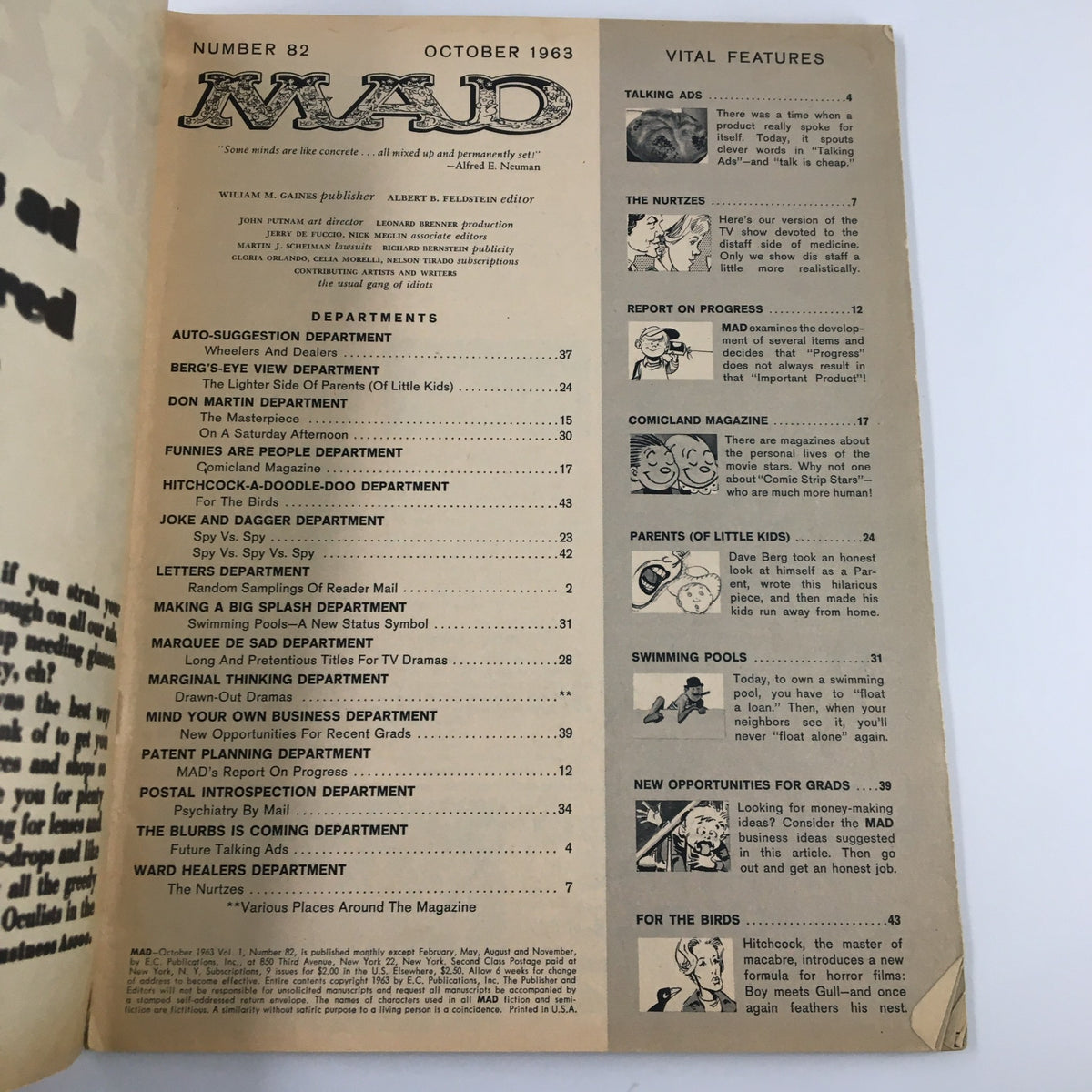
- Parody and pop culture commentary — issues of Mad from this era characteristically included parodies of current films, television programs, and advertising campaigns, alongside recurring features and original comic strips from the magazine's core contributor stable. The specific interior targets for this issue are unconfirmed from available sourcing, but the editorial format was consistent and well-established by No. 82.
- Historical proximity to the Kennedy assassination — published weeks before November 22, 1963, this issue is a document of American cultural life in the final chapter of the Kennedy era, giving it a historical weight that extends beyond its considerable merits as a piece of satirical publishing.
- Note on interior specifics: Precise parody titles, featured targets, and article-level content for this individual issue are unconfirmed from available sourcing. The highlights above reflect what is verifiable from the cover, issue number, publication date, and Mad's thoroughly documented editorial format and priorities for the period.
Condition & Rarity
A CGC-style grade of Very Good (VG) 4.0 applied to a 1963 issue of Mad represents a meaningful and honest collector-grade assessment that situates this issue clearly in the market. In the grading standards used for vintage periodicals and comics, VG 4.0 indicates a copy that has been read and handled but retains its structural integrity — readable throughout, with cover art and interior content fully intact and appreciable, but showing the honest evidence of six decades of existence. The specific condition attributes noted — marks on the cover, binding wear, creases on the front corners, and minor rips — are entirely consistent with a VG 4.0 designation and represent the normal spectrum of wear for a newsstand copy of this age that has passed through multiple hands over the years. Cover creasing at the corners is among the most common condition issues for Mad issues from this era, as the magazine's relatively modest cover stock was susceptible to stress at handling points. Binding wear on a sixty-year-old staple-bound magazine is structural rather than cosmetic and should be assessed for whether the staples remain present and the pages fully secured rather than merely for surface appearance. For a politically significant issue like No. 82 — with a cover that references one of the defining geopolitical crises of the twentieth century — a VG 4.0 copy represents a genuinely displayable and historically substantive example that falls within the range serious collectors regularly acquire for reading and reference collections when higher-grade copies are unavailable or prohibitively priced.
Looking for More Issues Like This?
Mad issues from the early 1960s — particularly those with strong political covers referencing figures like Castro who defined the Cold War era — are among the more actively sought numbers in the magazine's long run, and No. 82 with its nuclear wordplay and Kennedy-era timing is a particularly resonant example. If you're building out a collection of the magazine's most politically engaged issues or simply want to explore its remarkable output across this decade, the Mad magazine collection at OriginalMagazines.com is the best place to browse what's currently available across the full run. For collectors drawn to the broader sweep of Cold War political culture in American print, both the Fidel Castro magazines collection and the 1963 magazines collection offer compelling material from one of the most charged and consequential years in postwar American history.