




Description
Collector's Note – Why This Issue Matters
August 1943 was a specific and historically loaded moment for an American college-focused magazine to appear. The United States was fully mobilized for the Second World War, and the lives of college-age women had been transformed in ways that were simultaneously practical and profound. Men had left campuses in enormous numbers for military service, shifting the demographic and social texture of American higher education dramatically. Women were simultaneously being encouraged into the workforce, into new professional roles, and into forms of civic participation that the prewar generation would not have expected — while also being expected to maintain the domestic and feminine aspirations that magazines like Mademoiselle had always addressed. Mademoiselle's wartime archive documents that contradiction with unusual directness, and the August 1943 College Number is among the most concentrated examples of the magazine grappling with what higher education meant for young women in the middle of a total war.
The editorial content documented in this issue reflects that historical weight with real distinction. Mark Van Doren — one of the most respected literary scholars and educators of his generation, a Columbia University professor whose students included Thomas Merton, Allen Ginsberg, and Jack Kerouac — contributing an essay titled "This Liberal Education" to a women's college issue in 1943 is a meaningful editorial choice. It signals that Mademoiselle's College Number was not merely a fashion and lifestyle supplement for coeds but a serious engagement with what education was for and what it meant during a moment of civilizational crisis. Santha Rama Rau's "Daughter India" adds an international and anti-colonial dimension that is striking for a mainstream American fashion magazine in 1943 — Rau was a young Indian writer whose work would later earn significant literary recognition, and her presence here as a college-age contributor reflects both the issue's genuine ambition and its historically unusual openness to non-Western perspectives. The broader magazine landscape of 1943 captures American print culture at its wartime peak, and this Mademoiselle issue occupies a distinctive position within it.
About the Publication
Mademoiselle, published by Street & Smith and later Condé Nast, was founded in 1935 and aimed specifically at college-age and young professional women — a demographic that other fashion magazines addressed only as a subset of a broader female readership. By the early 1940s it had established a distinctive editorial identity that combined fashion and beauty coverage with serious fiction, poetry, and cultural journalism of a quality that distinguished it from most of its competitors. Its annual College Issue, published each August, was one of the magazine's most ambitious and anticipated editorial productions — a guest-edited number that brought college women onto the masthead and treated the intersection of education, culture, and young women's lives as a subject worthy of sustained intellectual attention. The College Issue's literary ambitions were genuine: over the decades, its fiction and poetry sections introduced or early-published writers who became major figures in American literature.
Key Highlights Inside
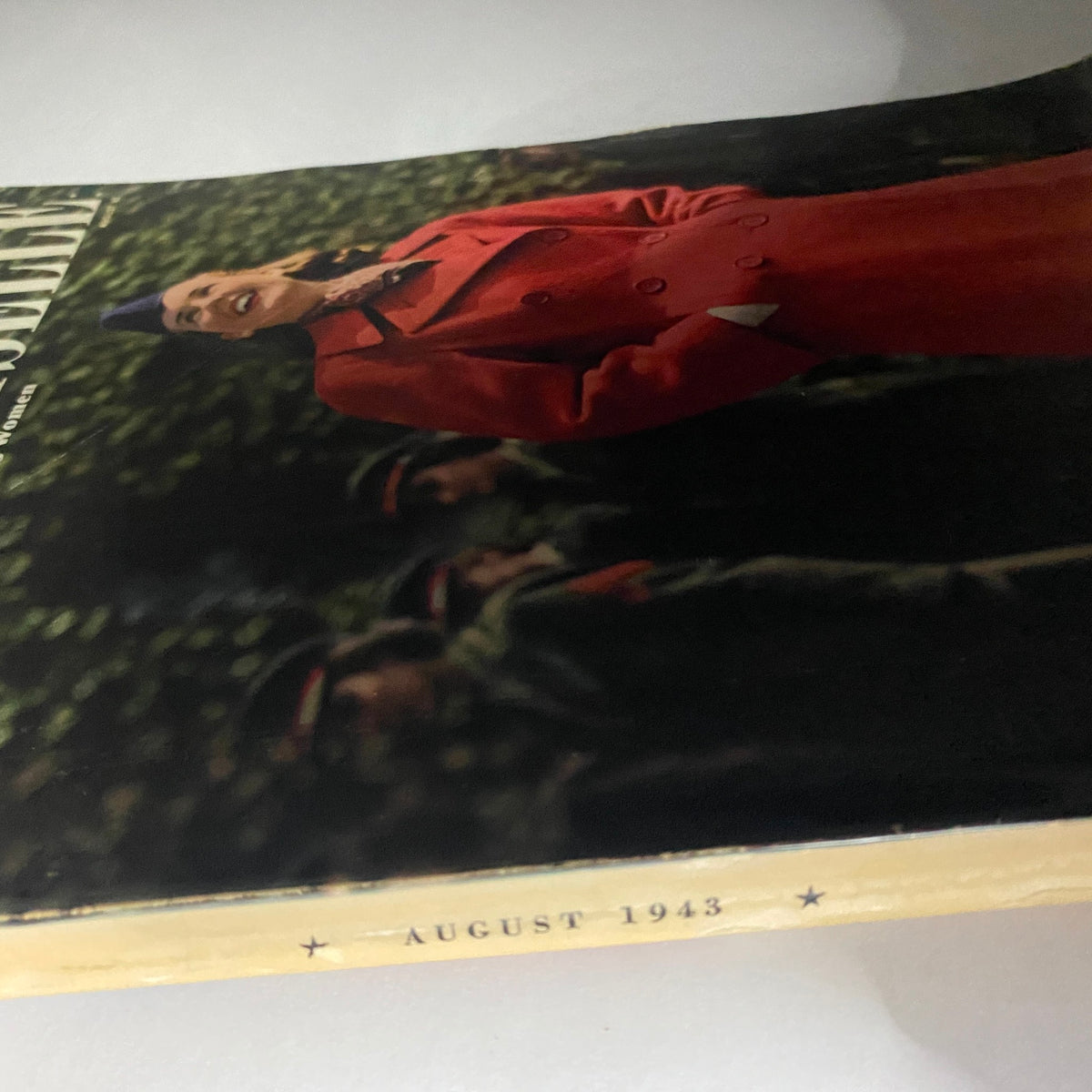
- Cover by James Abbé Jr. A wartime college-issue cover from a photographer working in the tradition of mid-century American magazine illustration, capturing the visual aesthetic of 1943 college life as Mademoiselle framed it for its aspirational readership.
- "This Liberal Education" by Mark Van Doren. An essay by one of Columbia University's most distinguished literary scholars — whose influence on a generation of American writers was profound — addressing the meaning and purpose of a liberal education during wartime. A significant contribution that elevates this issue well above standard college-fashion content.
- "Daughter India" by Santha Rama Rau. An early contribution from the Indian writer whose subsequent memoir Home to India would establish her literary reputation — a notable and historically unusual presence in a mainstream American fashion magazine in 1943, reflecting both the issue's genuine ambition and the wartime moment's expansion of whose voices were considered relevant.
- "Latest Lingo" campus slang feature, Campus '43. A period document of early-1940s college vernacular that serves as a primary source for researchers of mid-century American youth culture, language, and social history.
- Wartime college life coverage. As a College Number published in the third year of American involvement in World War II, the issue reflects the specific social and institutional realities facing women students at a moment when the demographic and cultural landscape of American higher education had been fundamentally altered by the draft.
Condition & Rarity
Mademoiselle College Issues from 1943 present specific preservation challenges that collectors should understand. Printed on wartime paper stock — which in many cases reflected material conservation measures that produced lighter, more acidic paper than peacetime equivalents — issues from this period are particularly susceptible to tanning, brittleness, and edge deterioration over eight decades of storage. The listing describes this issue as in excellent condition with only light wear typical for its age, preserved under protective plastic covering — a notably strong condition assessment for a wartime magazine of this vintage. The absence of a mailing label preserves the James Abbé Jr. cover without adhesive damage or ink impression, a meaningful positive given that subscription-delivered copies are far more common than clean newsstand examples in the surviving market. For a specialized annual issue with a more limited print run than Mademoiselle's regular monthly editions, and with literary content of genuine research significance, a well-preserved surviving copy represents exactly the kind of artifact that both fashion history and literary history collectors have reason to seek.
Looking for More Issues Like This?
The Mademoiselle August 1943 College Number is a wartime artifact with genuine literary and social history significance — not simply a vintage fashion magazine, but a primary document of American women's education, culture, and aspiration at one of the twentieth century's most consequential moments. Issues of this specific type, in excellent preserved condition, are encountered rarely in the collector market. The Mademoiselle collection at OriginalMagazines.com is the most comprehensive place to browse for other issues spanning the magazine's long and editorially ambitious run, including additional wartime and College Issue editions. For collectors building a picture of the full wartime print media landscape, the 1943 magazine collection covers publications across every genre and subject from one of the most consequential years of the American century.