

Description
Collector's Note – Why This Issue Matters
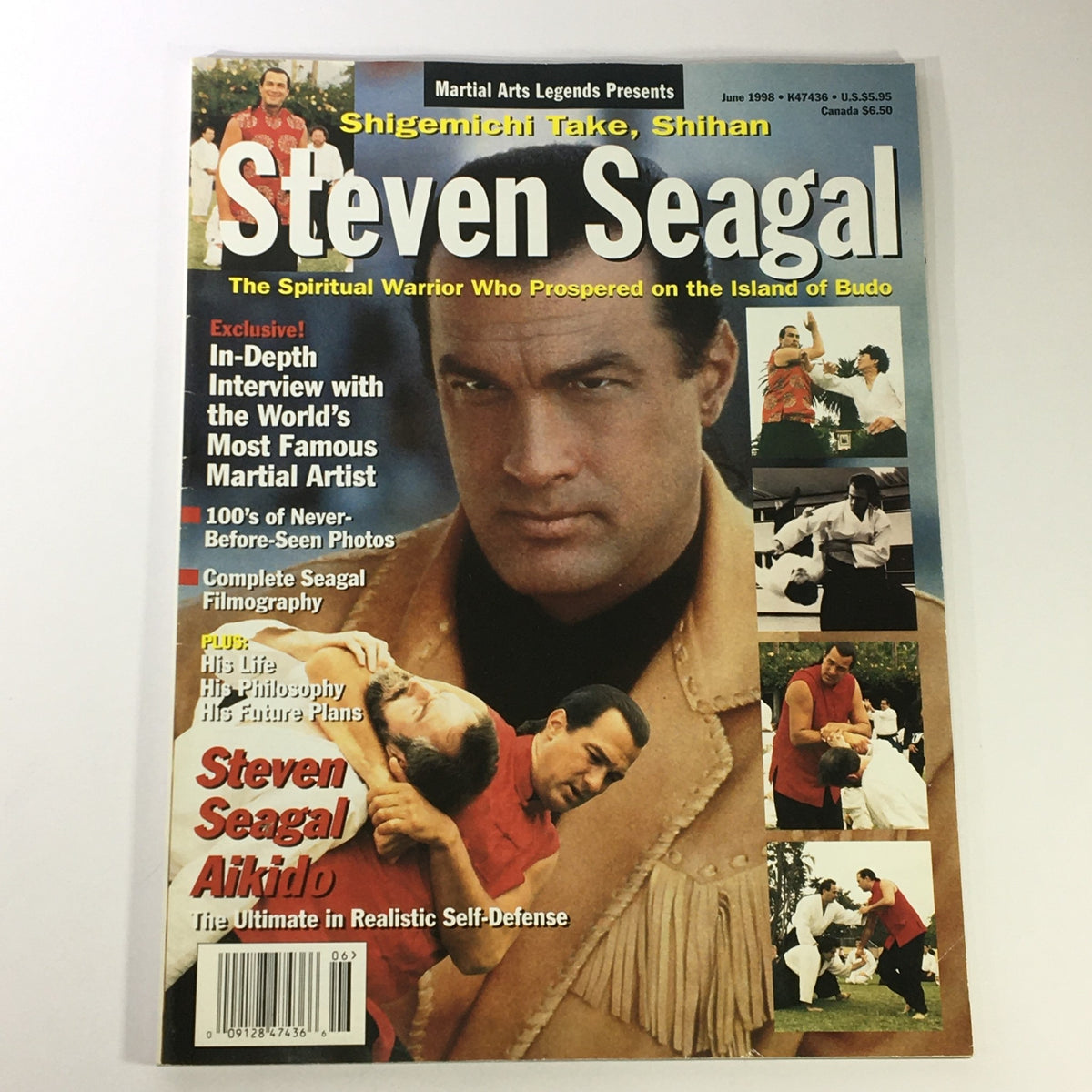
The June 1998 issue of Martial Arts Legends presenting Steven Seagal and Shigemichi Take captures one of the more genuinely interesting figures in the history of American martial arts at a specific and revealing moment in his career and public identity. By 1998, Steven Seagal occupied a unique position in the cultural landscape of American martial arts — he was simultaneously a major Hollywood action star whose films had grossed hundreds of millions of dollars and a practitioner of Aikido who held authentic credentials that the vast majority of action film stars could not claim. His Aikido training in Japan under Kisshomaru Ueshiba, his establishment of a dojo in Los Angeles, and his recognition as the first foreigner to operate an Aikido dojo in Japan gave him a martial arts biography that was substantively different from the cinematic martial arts personas of contemporaries who had primarily performance rather than practice backgrounds. A publication like Martial Arts Legends taking him seriously as an Aikidoka rather than simply as a film celebrity reflects an editorial judgment about the authenticity of his martial arts credentials that distinguishes this issue from the broader entertainment press coverage of Seagal in the same period. Collectors building a focused archive of Seagal's documented martial arts life will find the Steven Seagal magazine collection a valuable resource for tracking how his reputation was presented across different publication types throughout his career.
The inclusion of Shigemichi Take alongside Seagal is a specific and meaningful editorial choice that elevates this issue beyond a straightforward celebrity martial arts profile. Take was a senior Aikido practitioner whose credentials within the Aikido world were entirely independent of the entertainment industry context that inevitably surrounded any Seagal coverage — his presence in the issue signals that Martial Arts Legends was approaching the subject from the perspective of the martial arts community rather than the celebrity press, and was treating Seagal's Aikido practice as worthy of evaluation alongside a recognized traditional practitioner rather than simply as a biographical curiosity attached to a film star. That framing makes the editorial content potentially more substantively useful for serious Aikido practitioners and martial arts historians than the typical entertainment-oriented coverage that dominated Seagal's media presence in this period. For collectors focused specifically on the martial arts magazine archive, this issue represents the kind of technically and philosophically oriented coverage that distinguished the serious martial arts press from its more entertainment-focused competitors throughout the 1990s.
June 1998 sits at an interesting moment in Seagal's career arc more broadly. His film output in the mid-to-late 1990s had begun transitioning away from the major theatrical releases of his early career toward the direct-to-video market that would come to define his subsequent decades, and his public engagement with the martial arts world — including this magazine coverage — represented a continued investment in the Aikido credentials that distinguished him from other action stars even as his Hollywood profile shifted. That biographical context gives the June 1998 issue a documentary specificity that makes it more interesting than a general celebrity martial arts profile: it documents Seagal at a transitional moment, engaging seriously with his practice in a publication aimed at the martial arts community that had followed his career with a combination of pride in his authentic credentials and complex feelings about how Hollywood had packaged and presented them. Collectors focused on this era will find that 1998 magazine issues from martial arts publications document the late-nineties landscape of the American martial arts community with the insider perspective that the specialized press uniquely provides.
About the Publication
Martial Arts Legends was an American martial arts publication that operated in the niche between the broad-audience martial arts magazines like Black Belt and Inside Kung Fu and the more technically specialized instructional publications aimed at practitioners of specific styles. Its format, as suggested by the title, focused on profiles of significant figures in the martial arts world — practitioners, teachers, and performers whose careers and contributions were understood as historically significant within the broader martial arts community. By 1998, the publication was operating in a martial arts media landscape shaped by the continued influence of Bruce Lee's legacy, the ongoing mainstream popularity of martial arts films, and a serious practitioner community that wanted coverage treating their art with philosophical and technical depth rather than simply as entertainment content. A special issue format presenting Steven Seagal's Aikido alongside Shigemichi Take reflects the publication's dual commitment to mainstream recognition and authentic martial arts credentials — an editorial balance that gave it appeal across the community's full spectrum from film fans to dedicated practitioners.
Key Highlights Inside
- Steven Seagal featured in the context of his authentic Aikido practice rather than primarily as a film celebrity — reflecting the publication's commitment to evaluating his martial arts credentials on their own terms, which included his genuine training history in Japan and his establishment of a dojo that gave him a practitioner biography substantively different from action stars without martial arts backgrounds.
- Shigemichi Take featured alongside Seagal — a pairing that signals the issue's orientation toward the serious martial arts community rather than the entertainment press, providing context for Seagal's practice from the perspective of a recognized traditional Aikido figure whose credentials were established entirely within the martial arts world.
- Aikido as the primary subject matter — offering readers philosophical and technical content about a martial art that emphasizes the redirection of force and the use of an opponent's energy, presented in the context of both a recognizable practitioner and a traditional master in a format designed to be valuable to practitioners and interested observers alike.
- Newsstand origin confirmed by the absence of a mailing label — a meaningful attribute for a specialty martial arts publication from 1998, when the practitioner-focused readership was served through a combination of subscription and specialty newsstand distribution at martial arts schools, dojos, and sports retailers.
- Note: Specific interior article titles, interview content, technical instruction details, and additional editorial content beyond what is indicated by the cover subjects and listing description are unconfirmed for this issue. The above reflects what is verifiable from the cover subjects, publication title, date, and the thoroughly documented public record of Steven Seagal's Aikido training and career at this moment.
Condition & Rarity
Good condition with minor edge wear and possible small rips or marks is an honest and realistic assessment for a specialty martial arts magazine now twenty-seven years old. Martial arts publications of this type were produced in relatively modest print runs compared to mainstream consumer magazines — their audience was specifically defined by practice and interest in the subject matter rather than general readership, which means original circulation was smaller and the surviving population of any given issue is proportionally reduced relative to mass-market titles from the same period. The newsstand origin confirmed by the absence of a mailing label indicates the copy entered circulation through specialty retail distribution rather than subscription delivery, avoiding the adhesive label damage that subscription copies sometimes carry on their covers and preserving the full integrity of the cover image. Minor edge wear and light marks are the expected physical record of nearly three decades and do not compromise the legibility or research utility of a publication whose value to collectors lies primarily in its editorial content and its documentation of specific figures and practices in the late-nineties American martial arts community. A protective plastic covering applied to a surviving copy indicates deliberate preservation intent that correlates with better interior page condition and reduced deterioration over the same period.
Looking for More Issues Like This?
Specialty martial arts publications from 1998 featuring authenticated practitioner profiles like this Seagal and Take issue are among the more specifically sought items for collectors working at the intersection of martial arts history and late-nineties popular culture, and newsstand copies in preservable condition from this type of publication require consistent attention to locate. For collectors tracking Seagal's documented martial arts presence across publications throughout his career, the Steven Seagal magazine collection is the most focused starting point for finding other significant issues featuring him across different publications and contexts. The broader martial arts magazine archive offers a wide range of issues from across the genre's publishing history for collectors building a comprehensive picture of American martial arts culture, and those focused on the late nineties specifically will find the complete 1998 magazine collection a valuable resource for contextualizing this issue within the larger cultural landscape of the year it documents.