



Description
Collector’s Note – Why This Issue Matters
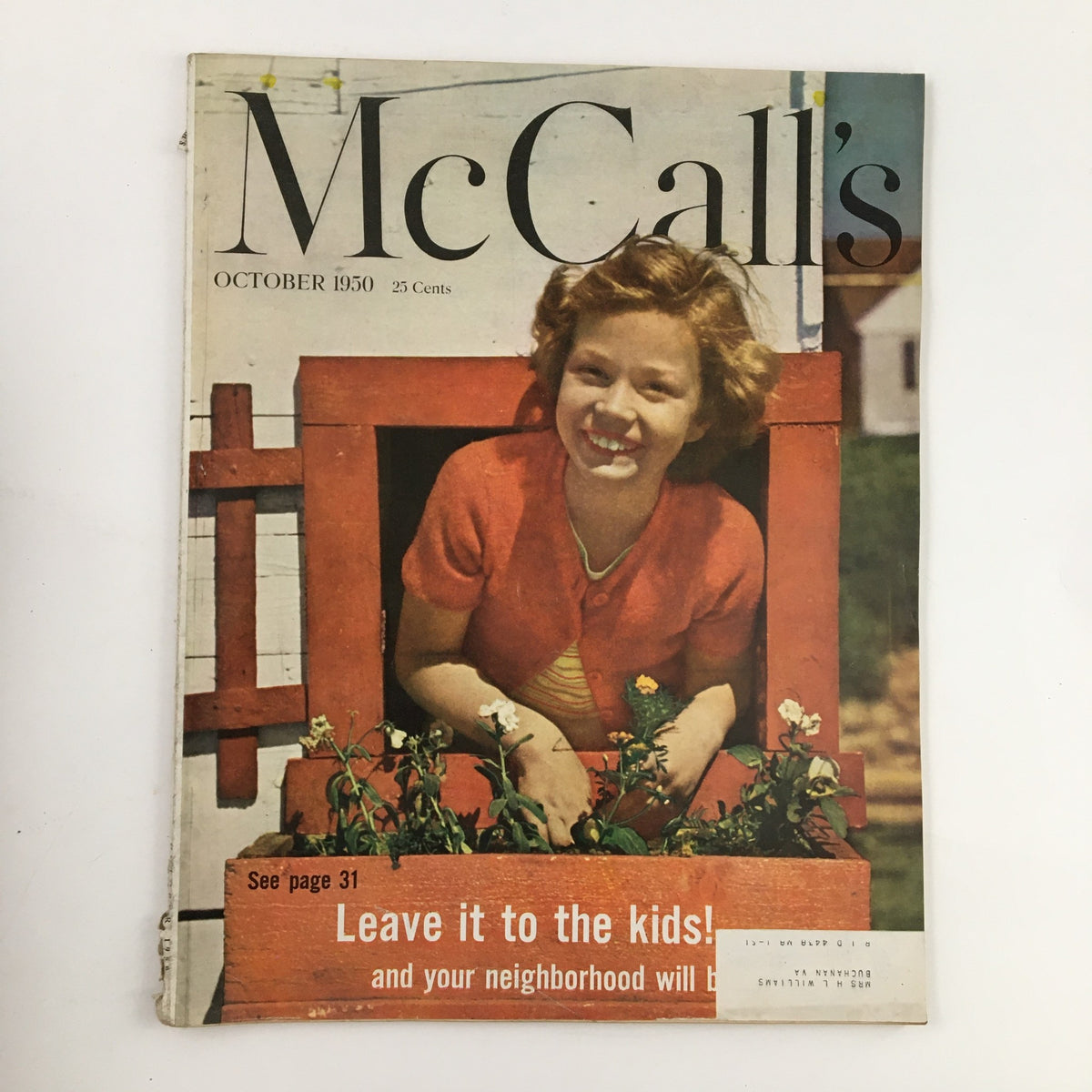
The October 1950 issue of McCall’s presents childhood activity and neighborhood improvement through a cheerful photographic cover centered on a young girl tending a wooden flower box. The principal cover line reads “Leave It to the Kids!” and introduces a feature concerned with what children could accomplish when given space, materials, and meaningful independence. The planted flowers, simple wooden construction, outdoor setting, and child’s evident pride create an image of practical participation rather than passive recreation. Her red clothing and the warm tones of the planter make the activity immediately visible beneath the magazine’s restrained black masthead. The cover does not depict a specific little boy becoming a hero, despite the feature wording used in the supplied listing title. Instead, its confirmed editorial subject is a community experiment that invited children to help create and organize their own play environment. This distinction matters because the cover reflects a serious postwar discussion about recreation, citizenship, urban development, and the place of children within planned neighborhoods. It transforms a modest gardening scene into a statement about trust, responsibility, cooperation, and the constructive potential of unsupervised creative play.
The related article, “Leave It to the Kids,” was written by John Kord Lagemann and examined an experimental play area known as The Yard in Minneapolis. McCall’s supported the project during 1950, the year of the Midcentury White House Conference on Children and Youth. The Yard served a developing residential area containing hundreds of children but lacking established grass, trees, or conventional recreation facilities. Rather than supplying only finished swings and slides, organizers provided used lumber, bricks, pipes, paint, nails, tools, and other materials that children could manipulate themselves. Participants between approximately eight and sixteen years of age could claim small plots, construct projects, plant gardens, and negotiate the practical problems created by working together. Later accounts of the experiment emphasized how children who initially worked alone came to recognize the value of cooperation, shared decision-making, and mutual assistance. The feature gives this issue value as an early popular-media document in the history of adventure playgrounds and child-directed environmental design. Its message also complicates nostalgic assumptions that mid-century children’s magazines dealt only with idealized homes, clothing, food, and family entertainment.
The supplied listing associates the issue with two additional subjects: “A Little Boy Becomes a Hero” and “Godfrey’s Girl Friday.” The exact authorship, plot, and documentary nature of “A Little Boy Becomes a Hero” have not been verified from a complete transcription of the contents page. It should therefore be identified as a listed feature without inventing the circumstances through which the child supposedly became heroic. “Godfrey’s Girl Friday” concerns Margaret “Mug” Richardson, the longtime secretary and production associate connected with broadcaster Arthur Godfrey. Richardson worked behind the scenes during Godfrey’s rise as one of the most prominent personalities in American radio and early television. Her appearance reflects the growing interest of women’s magazines in the largely unseen professional labor supporting major entertainment figures. Other surviving descriptions associate the issue with fashion, recipes, and science-fiction imagery connected with Chesley Bonestell, although exact titles and contributors require confirmation from the original pages. Together, the confirmed and partially documented features place children’s play, broadcasting, fashion, domestic service journalism, fiction, and visual imagination within the same substantial monthly publication.
About the Publication
McCall’s developed from a nineteenth-century publication associated with dress patterns and home sewing. It was established in 1873 under the title The Queen and later became McCall’s Magazine before eventually shortening its name to McCall’s. By the middle of the twentieth century, it was one of the best-known American women’s magazines and a major presence in the field of family and domestic publishing. Its large monthly issues combined fiction, fashion, sewing, food, homemaking, health, childcare, marriage, public affairs, entertainment, and consumer guidance. The publication addressed women as household managers while also recognizing their interests as readers, citizens, workers, parents, and participants in popular culture. Clothing patterns and practical instruction remained important, but fiction and topical nonfiction greatly expanded its editorial identity. McCall’s also published recurring advice and opinion columns, including Eleanor Roosevelt’s “If You Ask Me” during this general period of the magazine’s history. Photographs, illustrations, diagrams, recipes, and advertisements created a visual record of the material culture surrounding postwar family life. Its advertising pages documented cosmetics, packaged food, appliances, automobiles, medicine, clothing, household furnishings, and emerging forms of convenience. The magazine’s treatments of childhood and family life could reinforce conventional assumptions while occasionally presenting more experimental ideas such as child-directed playgrounds. By 1950, McCall’s had become a broad family-oriented publication rather than simply a sewing and pattern journal. Surviving issues now serve as primary sources for studying gender expectations, fashion, parenting, domestic labor, popular fiction, broadcasting, consumer culture, and the changing design of American magazines.
Key Highlights Inside
- John Kord Lagemann’s “Leave It to the Kids” is the confirmed feature connected directly with the cover. It examines The Yard, a Minneapolis play area where children received tools, reused building materials, garden plots, and considerable freedom to create their own environment. The article records an early American example of the adventure-playground principle and the belief that practical cooperation could develop through self-directed play.
- The cover photograph shows a child working among flowers in a simple wooden planter rather than posing with a commercial toy or formal playground apparatus. Its design emphasizes participation, gardening, construction, and visible pride in a completed neighborhood project. The partially obscured cover line promises that leaving such work to children could produce benefits extending beyond the individual child.
- “A Little Boy Becomes a Hero” is associated with the issue through the supplied catalog title. No verified author, page number, characters, setting, or description of the heroic action has been recovered from the available documentation. It should therefore be retained as an identified feature while its narrative details remain expressly unconfirmed.
- “Godfrey’s Girl Friday” concerns Margaret “Mug” Richardson, who worked closely with radio and television personality Arthur Godfrey. Richardson began as his secretary and became involved with the increasingly complicated production and administrative work surrounding his broadcasts. The feature offers a perspective on the professional woman operating behind one of the most recognizable public entertainers of the period.
- Separate marketplace documentation associates the issue with fashion, recipes, and science-fiction material involving illustrator Chesley Bonestell. Bonestell became especially recognized for astronomical and space imagery that helped general audiences visualize distant planets and possible future exploration. The exact article title, images, scientific subject, and relationship to the rest of this issue remain unconfirmed without direct examination of the relevant pages.
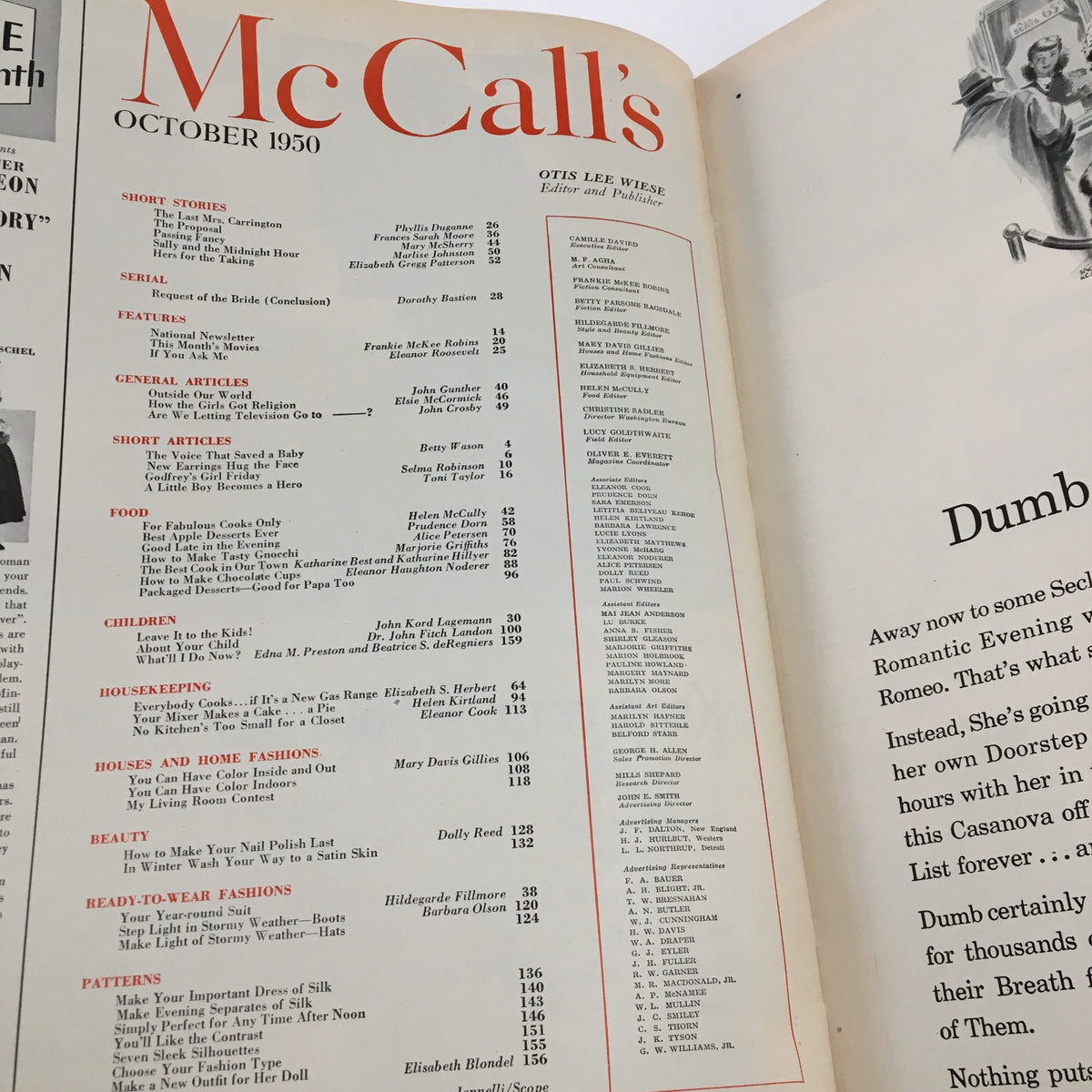
- A photographed table of contents survives with the listing, but its complete wording has not been supplied in a reliable text transcription. Additional fiction, food, fashion, homemaking, health, advice, and family departments may be present in keeping with McCall’s established editorial format. Individual titles, contributors, recipes, and story summaries should not be added until they can be read from the original contents page or interior.
Condition & Rarity
The supplied description classifies this October 1950 McCall’s issue as being in Good overall condition. Minor wear is reported throughout the magazine and is consistent with earlier mailing, reading, handling, and storage. A subscriber address label is attached near the lower portion of the front cover. The label obscures part of the secondary wording beneath “Leave It to the Kids!” and should be considered a permanent element of the cover’s current presentation. It also documents the magazine’s history as a mailed subscription copy rather than an unaddressed example. Wear to the binding is specifically reported and should be assessed for rubbing, stress, looseness, splitting, or partial separation. The accompanying photographs should remain the primary evidence for determining the severity of these characteristics. No complete statement has been supplied concerning tears, detached pages, missing material, clipped patterns, recipe removal, handwriting, stains, tape repairs, or restoration. Those details should remain unconfirmed unless established through additional photographs or physical examination. A later plastic protective covering is reported to accompany the issue and may reduce exposure to dust and unnecessary handling. The plastic sleeve was not part of the magazine when originally published and should not be treated as an original component. Historical interest is best connected with the child-directed playground cover, documented contents, subscriber history, completeness, and observable condition rather than with an unsupported assertion of exceptional rarity.
Looking for More Issues Like This?
Additional examples of fashion, fiction, family journalism, and practical domestic publishing can be explored through the McCall’s Magazine archive. Comparing consecutive issues can reveal how the publication balanced sewing patterns and recipes with public affairs, entertainment personalities, health reporting, and experimental approaches to childhood. The October 1950 cover is especially useful for research into playground history, neighborhood planning, creative education, and adult attitudes toward children’s independence. Other issues may show more conventional play spaces and can therefore help demonstrate what made The Yard unusual. Broadcast historians can follow Arthur Godfrey and members of his production organization as radio personalities increasingly moved into television. Margaret Richardson’s feature provides a reminder that the labor supporting a famous broadcaster extended beyond the performers visible or audible to audiences. Fashion researchers can compare the issue’s seasonal clothing with the September and November editions as publications moved from early-autumn styles toward holiday presentation. Food and advertising pages can reveal the ingredients, appliances, packaged products, and household routines promoted to American families in 1950. Science-fiction historians may examine any verified Chesley Bonestell material alongside his better-documented astronomical illustrations in books, magazines, and scientific features. The broader 1950 magazine archive supplies complementary perspectives from news, entertainment, travel, business, and other women’s publications. The October McCall’s issue contributes a particularly valuable record by placing child-directed community building beside broadcasting, domestic culture, visual imagination, and the extensive commercial world of a postwar family magazine.