
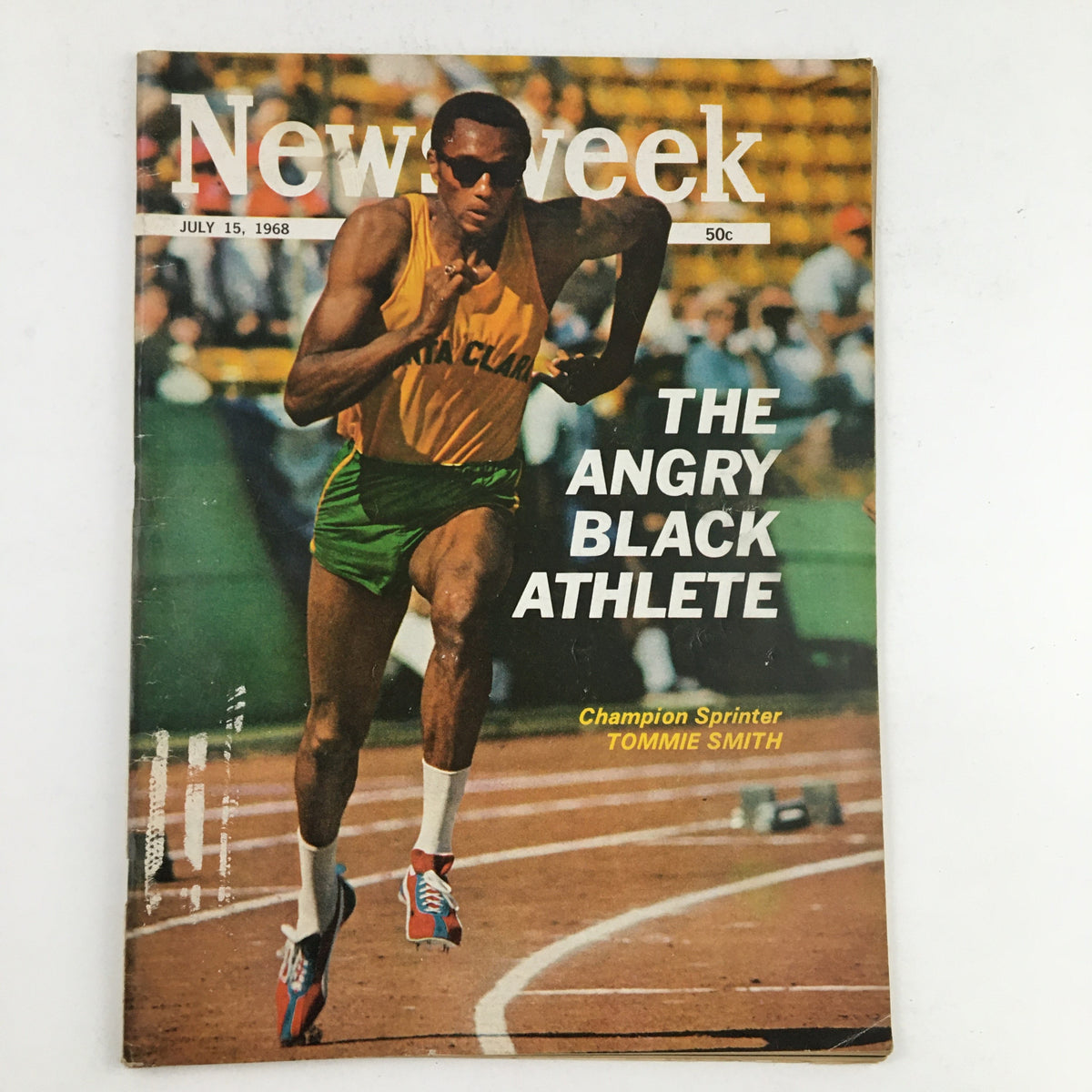


Description
Collector's Note – Why This Issue Matters
The July 15, 1968 issue of Newsweek arrived on newsstands during one of the most turbulent and transformative summers in American history — and its cover subject, sprinter Tommie Smith, was already understood to be one of the most watched athletes heading into that autumn's Mexico City Olympics. Smith was not merely a track star. He was the world record holder in the 200 meters, a deeply principled man who had been vocal about racial injustice in America, and a central figure in the Olympic Project for Human Rights, a movement led by sociologist Harry Edwards that was actively considering a Black athlete boycott of the Games. When Newsweek put his face on the cover in July 1968, the magazine was acknowledging that Smith represented something larger than athletics — he was at the fault line between sport and social protest at one of the most charged moments the country had ever seen.
Of course, what came after this issue was published only amplified its historical resonance. On October 16, 1968, Tommie Smith won the 200-meter gold medal in Mexico City in a world-record time of 19.83 seconds. On the medal stand, he and bronze medalist John Carlos raised black-gloved fists during the American national anthem in one of the most iconic acts of protest in the history of sport. That image — heads bowed, fists raised, socks but no shoes — became a defining symbol of the civil rights era and remains one of the most reproduced photographs of the twentieth century. For collectors of 1968 magazines, this July issue is a remarkable pre-echo of that moment: a major national publication recognizing Smith's significance months before the act that made him immortal.
Nineteen sixty-eight was, by any measure, an extraordinary year to document. The assassinations of Martin Luther King Jr. and Robert F. Kennedy, the Democratic National Convention riots, the Vietnam War at full boil — Newsweek was covering all of it week by week in real time. A July 1968 issue centered on a Black Olympic sprinter navigating the intersection of athletic excellence and political conscience sits squarely within that larger story. Collectors drawn to the Newsweek archive will find few issues that speak as directly to the era's defining tensions as this one.
About the Publication
Newsweek was founded in 1933 and by the 1960s had established itself as the primary weekly rival to Time, competing for the same educated, middle-class American readership hungry for in-depth national and international reporting. Where Time leaned toward a single authoritative narrative voice, Newsweek was known for a somewhat broader range of perspectives and a willingness to foreground social and cultural coverage alongside hard news. In 1968, the magazine was at or near the peak of its influence — a weekly institution whose covers functioned as a national conversation prompt, and whose long-form features on race, war, and politics shaped how mainstream America understood the upheavals happening around it.
Key Highlights Inside
- Tommie Smith cover feature: Smith is spotlighted as a champion sprinter and as a prominent figure in the growing movement of Black athletes using their platform to protest racial injustice in America.
- Olympic Project for Human Rights context: The issue arrives at a moment when the potential Black athlete boycott of the Mexico City Olympics was a live national conversation, giving the Smith coverage immediate political weight beyond sports.
- Broader cultural and social reporting: Per the listing, the issue includes original Newsweek articles reflecting the societal issues of mid-1968 — a news environment shaped by assassination, war, and civil unrest.
- Note: Specific article titles, additional features, and full interior content beyond what is described in the listing have not been independently verified. Collectors seeking a complete content inventory may wish to consult the ProQuest Newsweek archive or a university periodicals library.
Condition & Rarity
For a newsprint weekly now approaching sixty years of age, condition assessment focuses on a handful of critical factors. The presence of a mailing label on the front cover is characteristic of original subscriber copies from this era and, while it affects the visual grade of the cover, it confirms the issue's authenticity as an original printing rather than a reprint. Minor wear throughout is consistent with a circulated copy of this vintage — Newsweek was printed on standard newsstock not designed for archival longevity, which makes any copy retaining page integrity, legible text, and a recognizable cover a legitimate collector specimen. The plastic protective covering indicates that a previous owner treated this as a collectible worth preserving, which is a meaningful provenance signal. When evaluating any surviving copy of this issue, priority should be given to the condition of the Smith cover portrait, the integrity of the spine, and the absence of significant brittleness, foxing, or moisture damage to the interior pages.
Looking for More Issues Like This?
A Newsweek cover feature on Tommie Smith from the summer before his iconic Mexico City protest is a rare find, and copies in collectible condition don't surface often. If this particular issue is unavailable, the broader Newsweek collection at OriginalMagazines.com is an excellent place to explore for other landmark issues from the 1960s. You can also browse the full 1968 magazine archive — a remarkable cross-publication record of one of the most documented years in American history.