



Description
Collector's Note – Why This Issue Matters
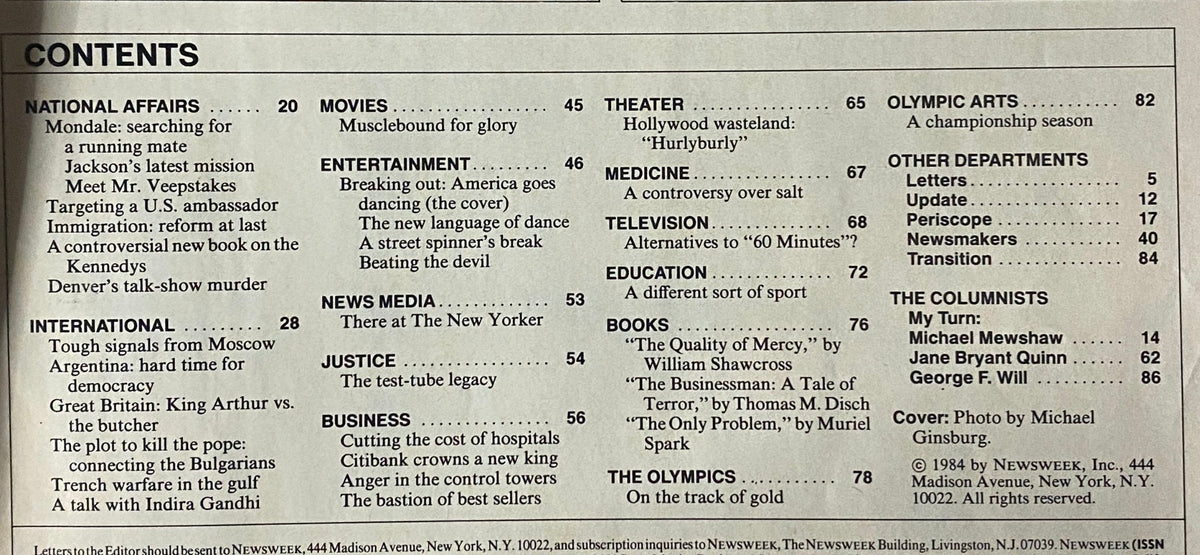
The July 2, 1984 issue of Newsweek — with its cover story "Breaking Out: America Goes Dancing" featuring Robert Taylor from the film Beat Street — is a primary document of one of the most significant cultural moments in American popular music history. By the summer of 1984, hip-hop was completing its transition from a regional New York subculture into a national mainstream phenomenon, and a Newsweek cover story on the subject was the mainstream media's formal acknowledgment that something genuinely new and consequential had arrived. Beat Street, released in June 1984, was one of the first major studio films to bring hip-hop culture — its music, its dance, its visual aesthetic — to a national theatrical audience, arriving alongside Breakin' and Wildstyle as part of a wave of hip-hop cinema that made 1984 the year the genre crossed definitively into mainstream American consciousness. A Newsweek cover story framed as "America Goes Dancing" was an editorial attempt to explain breakdancing, graffiti, and rap to a readership that was encountering them primarily through television and film rather than through the Bronx and Brooklyn communities where they had originated. For collectors building archives of vintage Newsweek magazines, this issue is one of the most historically significant cultural cover stories in the publication's 1980s run — a document of hip-hop's first major national mainstream media reckoning.
The political content of this issue makes it equally significant as a document of the 1984 presidential election cycle. The "Mondale: Searching for a Running Mate" article places this issue in the weeks before the Democratic National Convention, when Walter Mondale's eventual selection of Geraldine Ferraro as his running mate — the first woman nominated for Vice President by a major American political party — was still pending. The July 2 issue thus captures the political moment immediately before that historic decision, with the anticipation and speculation that surrounded it. "Tough Signals from Moscow" reflects the state of Cold War tensions in the summer of 1984, the year the Soviet Union boycotted the Los Angeles Olympics in retaliation for the American boycott of the 1980 Moscow Games. A single July 1984 Newsweek thus holds hip-hop's mainstream arrival, the eve of a historic VP nomination, and Cold War Olympics politics in the same cover. Collectors of 1984 magazines will find this issue documents the year's cultural and political density with unusual completeness.
The broader significance of the "America Goes Dancing" cover story extends beyond its immediate news value. The mainstream media coverage of hip-hop in 1984 — including this Newsweek cover — shaped how the broader American public initially understood the culture, for better and worse, and those initial framings had lasting effects on how hip-hop was perceived, marketed, and eventually commercialized. As a primary source document of that initial mainstream encounter, this issue is of genuine interest to researchers of hip-hop history, American popular culture, and the sociology of media coverage of emerging cultural movements.
About the Publication
Newsweek, founded in 1933 and by 1984 one of the two dominant American weekly news magazines alongside Time, provided comprehensive weekly synthesis of national and international news to a readership of millions. Its editorial format organized the week's events into named departments anchored by a cover story representing the editors' judgment of the most significant development of the preceding week. A hip-hop culture cover story in July 1984 reflected the magazine's consistent effort to explain emerging social and cultural phenomena to its broad, educated readership — the same editorial instinct that had produced its coverage of the civil rights movement, the counterculture, and the women's movement in earlier decades.
Key Highlights Inside
- "Breaking Out: America Goes Dancing" cover story featuring Robert Taylor of Beat Street — Newsweek's first major cover treatment of hip-hop culture, using the 1984 film as an entry point for explaining breakdancing, graffiti, and rap to a mainstream national audience — a primary document of hip-hop's mainstream media breakthrough moment.
- "Mondale: Searching for a Running Mate" — Political coverage from the weeks immediately before Walter Mondale's historic selection of Geraldine Ferraro as the first female major-party Vice Presidential nominee, capturing the anticipation and speculation of that pre-convention moment.
- "Tough Signals from Moscow" — Cold War coverage reflecting the tensions of the summer of 1984, the year of the Soviet Olympic boycott and one of the most fraught periods in US-Soviet relations of the decade.
- "A Controversial New Book on the Kennedys" — Cultural and political coverage engaging the continuing American fascination with Kennedy family history and the ongoing production of Kennedy biography and journalism in the 1980s.
Condition & Rarity
Very good condition with only minor edge wear represents a strong survival grade for a forty-year-old weekly news magazine, and for an issue with the historical significance of the "America Goes Dancing" cover story, condition quality matters to the collector market. The listing does not note a subscription label, suggesting the cover may be fully intact without address obstruction — collectors should confirm this from available photographs, as it is a meaningful distinction for display-grade evaluation of this specific cover. Minor edge wear is standard and expected at this grade and does not affect the reading, research, or display value of the issue. The plastic protective covering indicates deliberate preservation. For Newsweek issues from 1984, the standard structural evaluation points are spine integrity along the staple binding and the completeness of the cover story photography and text, which are the sections of greatest documentary interest for this particular issue.
Looking for More Issues Like This?
This July 1984 Newsweek sits at a unique intersection of hip-hop cultural history and presidential election-year politics, making it one of the more substantive single issues in the magazine's 1980s run — and finding it in very good condition takes genuine patience. The broader Newsweek archive at OriginalMagazines.com spans many decades of the publication's run and regularly surfaces historically significant cover issues from the 1980s and beyond. For collectors focused on the remarkable cultural density of 1984 specifically, the full 1984 magazine collection documents one of the decade's most eventful years across a wide range of titles and subjects.