

Description
Collector's Note – Why This Issue Matters
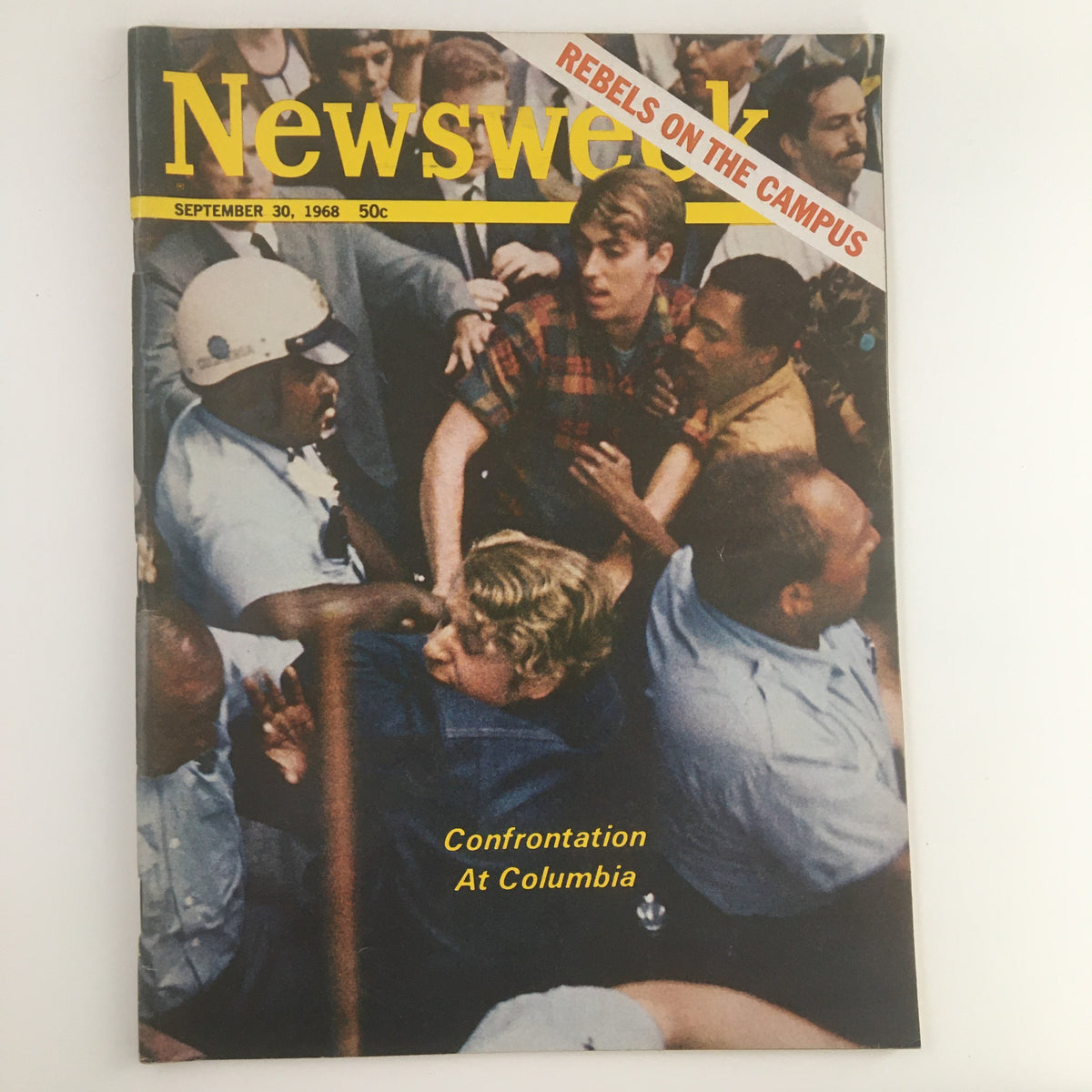
The September 30, 1968 issue of Newsweek featuring "Rebels on the Columbia Campus" on the cover documents one of the most significant episodes in the history of American student activism — and does so at a moment when the national media was still processing what the Columbia University uprising of spring 1968 meant for American higher education, American politics, and the relationship between young people and established institutions. The Columbia protests had occurred in late April and early May of 1968: students had seized university buildings in protest against Columbia's ties to the Institute for Defense Analyses and its plans to build a gymnasium in a Harlem park, holding them for eight days before New York City police cleared the buildings in a brutal overnight action that left hundreds injured and arrested. The event was nationally televised and nationally discussed, and it became one of the defining symbols of the late-sixties campus upheaval alongside the earlier Berkeley Free Speech Movement and the events that would follow at Kent State in 1970. A Newsweek cover story on the Columbia campus rebels published in late September 1968 — five months after the spring uprising — was engaging with that event as an ongoing cultural and political phenomenon rather than a concluded news story, reflecting the magazine's editorial judgment that the questions raised by Columbia had not been resolved and were not going away. Collectors building a serious archive of the late-sixties student movement and its media representation will find the Newsweek magazine collection one of the most comprehensive resources for tracking how the publication engaged with this history across multiple issues.
September 30, 1968 was itself a specific and historically dense moment. The year 1968 as a whole was one of the most traumatic in modern American history: the Tet Offensive in January, the assassinations of Martin Luther King Jr. in April and Robert F. Kennedy in June, the Democratic National Convention protests in Chicago in August — all of these had occurred in the months preceding this September 30 issue, and their cumulative weight was producing a national mood of crisis and radicalization that the Columbia story both reflected and amplified. The student protests at Columbia were not an isolated incident but a specific expression of a broader generational rupture, and Newsweek's decision to return to the campus rebels in late September — after a summer of enormous political upheaval — situates this issue within the year's larger narrative of institutional challenge and social transformation. For collectors building a cross-title archive of this extraordinary year, the 1968 magazine collection provides essential context across multiple publications from the most consequential twelve months of the postwar decade.
The no-label condition of this issue is worth noting as a collector distinction. A newsstand copy of a September 1968 Newsweek preserves the cover image — the specific photograph and headline that the magazine chose to represent the Columbia campus rebels to its national readership — exactly as it was designed and displayed, without the subscriber label obscuration that affects mailed copies. For a cover whose visual and editorial statement is itself a primary historical document of how mainstream American journalism was framing student radicalism in late 1968, the integrity of that original cover presentation carries genuine research and display value.
About the Publication
Newsweek was founded in 1933 and established itself over the following decades as one of the two dominant American weekly newsmagazines alongside Time, providing comprehensive national coverage of politics, foreign affairs, culture, science, and society in a format that combined accessible narrative journalism with the visual authority of a magazine. By September 1968 it had been publishing for thirty-five years and had developed the cover format — a single striking image anchoring the week's most significant story — into one of the most recognizable in American journalism. Its audience was educated, broadly middle-class, and nationally distributed, and its influence on how Americans understood and processed the extraordinary events of 1968 was substantial. The late-sixties run of Newsweek is among the most historically significant in the magazine's publishing history, covering a period of such concentrated national crisis that nearly every issue from 1968 functions as a primary document of one or more consequential events.
Key Highlights Inside
- "Rebels on the Columbia Campus" cover story — published five months after the spring 1968 student uprising that made Columbia one of the defining symbols of late-sixties student radicalism, engaging with the ongoing cultural and political questions raised by the protests at a moment when their implications for American higher education and generational politics were still being actively negotiated.
- Coverage of the Columbia events within the context of the broader 1968 national crisis — the campus rebellion's relationship to the year's other defining events: the King and Kennedy assassinations, the Chicago Democratic Convention protests, and the escalating Vietnam War that was the underlying catalyst for much of the campus activism.
- Editorial commentary and photojournalism consistent with Newsweek's late-sixties approach to covering student protest and social upheaval — the specific framing choices, visual language, and interpretive lens through which a mainstream American newsweekly was presenting campus radicalism to a national readership that was itself divided about what the protests meant.
- Note: Specific additional article titles, bylines, and further interior features beyond the cover story have not been confirmed from available sources. The highlights above reflect what is documented in the listing and Newsweek's well-established editorial format for major cover stories of this period.
Condition & Rarity
Surviving copies of the September 30, 1968 Newsweek in good condition represent a meaningful find for collectors of late-sixties American political and social history. The no-label condition confirms newsstand origin, meaning the cover image — the specific photograph and "Rebels on the Columbia Campus" headline — survives without the subscriber label obscuration that affects mailed copies, preserving the full visual and editorial statement of the cover as originally designed and distributed. Minor aging characteristics are the expected and honest condition profile of an original, unrestored periodical that has passed through more than five decades without archival preservation. The plastic protective sleeve is the correct conservation measure for a magazine of this paper stock and age, stabilizing further deterioration without requiring any alteration to the original item. Newsweek issues covering the major student protest events of 1968 attract consistent collector interest from researchers and collectors working on American political history, campus activism history, and sixties media — a cross-audience appeal that reflects the genuine historical significance of the events being documented.
Looking for More Issues Like This?
A no-label September 1968 Newsweek covering the Columbia campus rebels is a specific and historically significant primary source from one of the most consequential years in twentieth-century American history — and copies in good condition from this year circulate less frequently than their original print runs would suggest. If this particular issue is no longer available, the full Newsweek magazine collection at OriginalMagazines.com is the most comprehensive source for exploring other issues across the publication's long and historically rich run, with particular strength in the late-sixties issues that document the decade's defining crises. For collectors building a broader archive of 1968's extraordinary density of historical events, the complete 1968 magazine collection brings together titles from the most consequential twelve months of the postwar era.