




Description
Collector's Note – Why This Issue Matters
The January 2000 issue of Nintendo Power — Volume 128 — with its feature coverage of Mario Party 2 and the game's minigame format, is a primary document of Nintendo's publishing and gaming culture at one of the most culturally specific moments in the history of the medium: the precise turn of the millennium, when video gaming had completed its transition from niche hobby to mainstream entertainment and when Nintendo's position within that mainstream was being actively contested by Sony's PlayStation and the approaching launch of Sega's Dreamcast. Mario Party 2 was released in North America on January 24, 2000 — making this January issue a direct launch-window publication, with the cover feature timed to coincide with one of Nintendo 64's most anticipated releases of the early year. The original Mario Party, released in 1999, had established the party game format — multiple players competing through a board game structure punctuated by competitive minigames — as one of Nintendo's most commercially successful and culturally visible new franchises of the late 1990s, and the sequel's arrival was among the most anticipated Nintendo 64 titles of the turn-of-the-millennium gaming calendar. A Nintendo Power issue featuring Mario Party 2 minigame coverage at the precise moment of the game's North American launch documents the specific intersection of Nintendo's publishing apparatus and its game release strategy at the height of the Nintendo 64 era — the specific phase of Nintendo's hardware cycle when the platform's party game library was defining a generation of living room gaming experiences. For collectors building a serious archive of vintage Nintendo Power magazine issues across the publication's run, this January 2000 issue represents the magazine at the precise turn-of-millennium moment — a culturally specific publishing date whose historical significance in gaming culture becomes more apparent with each year of retrospective distance.
The specific significance of Mario Party 2 as a subject for a January 2000 Nintendo Power cover feature reflects the particular cultural position that the Mario Party franchise occupied within Nintendo's late-1990s publishing and gaming strategy. The party game format that Mario Party had pioneered on the Nintendo 64 was one of the most successful responses to the specific social context of late-1990s console gaming — the four-controller multiplayer capacity of the Nintendo 64 had created a hardware platform uniquely suited to the kind of competitive, accessible, turn-based multiplayer that Mario Party's minigame structure was designed to exploit, and the franchise's commercial success reflected the degree to which that format resonated with a gaming audience that was increasingly playing in social rather than solitary contexts. The minigame format specifically — dozens of short, varied competitive challenges that required no prior gaming expertise to engage with immediately — was a design philosophy that made the franchise accessible to the casual gamers and family audiences that Nintendo had always prioritized, and its documentation in a January 2000 Nintendo Power feature represents one of the most culturally characteristic expressions of Nintendo's platform philosophy at the Nintendo 64 era's commercial peak. Collectors focused on the broader range of magazines from 2000 as documents of popular culture at the millennium's turn will find this issue providing specific primary evidence of how gaming culture was representing itself in print at the precise moment when the medium's cultural authority and mainstream acceptance had reached their early peak.
The broader context of January 2000 gaming culture gives this issue a further historical dimension that collectors approaching it as a period document should understand. The Nintendo 64 was in the final phase of its commercial life in January 2000 — the Nintendo GameCube was approximately two years from its November 2001 North American launch — and the platform's late-era library, which included Mario Party 2, The Legend of Zelda: Majora's Mask (released April 2000), and Paper Mario (released February 2001), represented some of the system's most creative and commercially successful software at the precise moment of the hardware's commercial decline. The Sega Dreamcast had launched in North America in September 1999, and the Sony PlayStation 2 was months away from its North American launch in October 2000 — making January 2000 a specific moment of competitive transition in the console market that would ultimately reshape the gaming landscape in ways that significantly reduced Nintendo's market position through the early 2000s. A Nintendo Power issue from this specific month captures the publication — and the gaming culture it represented — at a historically specific transitional moment: the Nintendo 64 at its creative late-era peak, the millennium's turn as a cultural marker, and the competitive console landscape on the verge of the most significant reconfiguration since the PlayStation's 1994 launch.
About the Publication
Nintendo Power was Nintendo of America's official monthly magazine, published from July 1988 through December 2012, functioning simultaneously as a subscriber publication, a promotional vehicle for Nintendo's software library, and the primary source of game coverage, strategy guides, and Nintendo-specific news for the most engaged segment of Nintendo's American fanbase. By January 2000 it had been publishing for over a decade and had established the editorial formula — cover features on major upcoming releases, in-depth strategy content, reader correspondence, and the insider access to Nintendo's development pipeline that its official status provided — that defined its identity throughout the Nintendo 64 era. Its readership was the core Nintendo enthusiast demographic: players invested enough in Nintendo's platform to subscribe to its official publication, whose coverage of upcoming releases and strategy content was understood to carry an authority derived from the publication's direct relationship with the company whose games it covered. Nintendo Power's issues from the Nintendo 64 era represent a primary archive of how Nintendo's official publishing apparatus was presenting and contextualizing its software library to its most engaged American audience during the platform's commercial and creative peak.
Key Highlights Inside
- Mario Party 2 minigame coverage — confirmed primary feature, January 2000 — Launch-window documentation of one of the Nintendo 64's most anticipated early-2000 releases, published in direct conjunction with the game's January 24, 2000 North American release date and providing Nintendo Power's official coverage of the minigame format that had made the original Mario Party one of Nintendo's most commercially successful and culturally visible new franchises of the late 1990s.
- Turn-of-millennium Nintendo 64 era coverage — confirmed historical context — Feature content consistent with Nintendo Power's January 2000 editorial focus, documenting the Nintendo 64 platform at its creative late-era peak — the specific phase of the hardware cycle when the platform's social gaming library was at its most fully developed and when Nintendo's publishing apparatus was most actively engaged with the party game format that defined the era's most characteristically social gaming experiences.
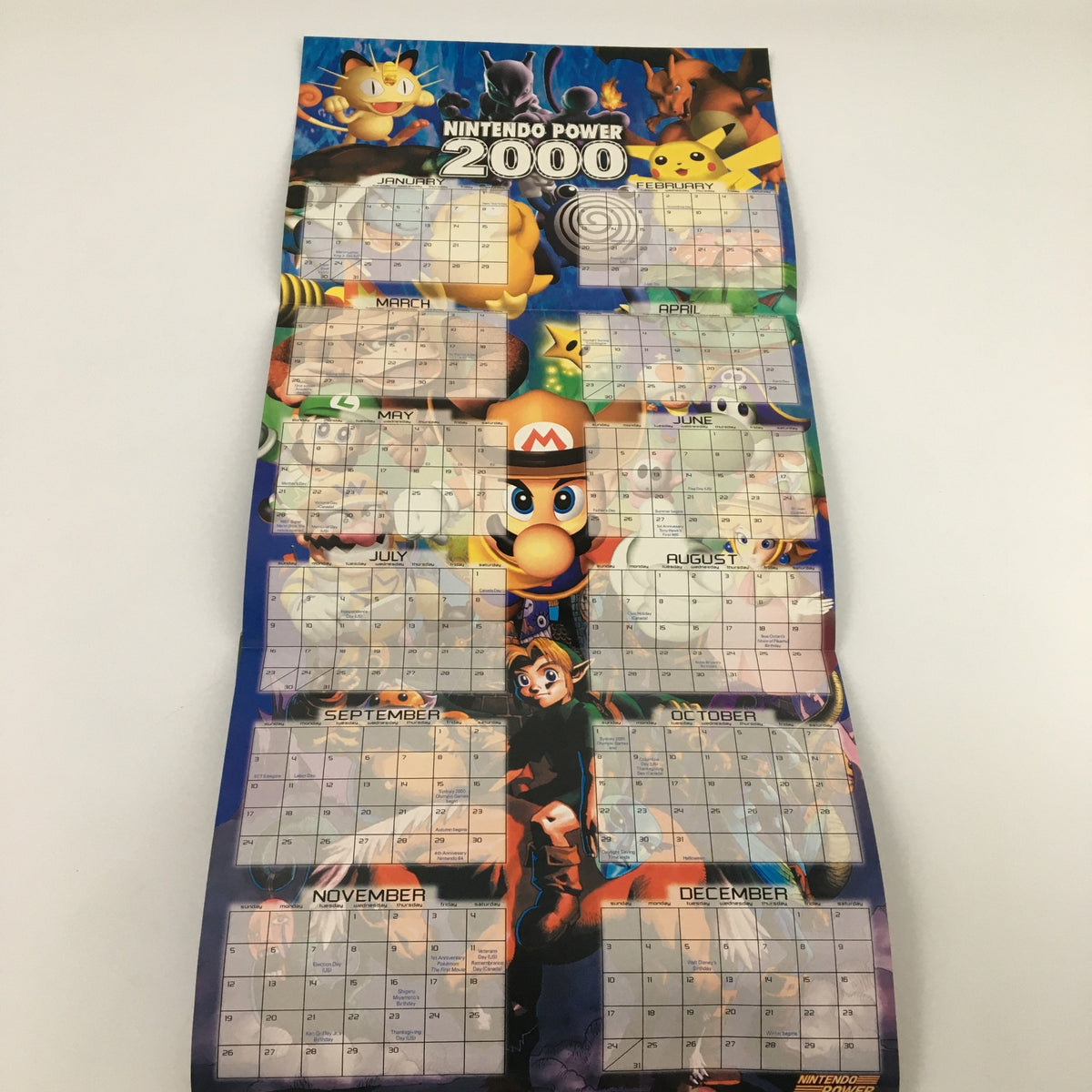
- Poster insert — confirmed collectible content — An original poster attached inside the issue, representing the supplementary collectible content that Nintendo Power regularly included as a subscriber and newsstand value addition — a physical artifact of the publication's engagement with its readership's collecting culture and one of the primary condition variables collectors assess in evaluating the completeness of surviving issues from this era.
- January 2000 competitive gaming landscape — confirmed historical environment — Published in the specific month when the Nintendo 64 was in its commercial late phase, the Sega Dreamcast had launched four months earlier, and the Sony PlayStation 2's North American release was nine months away — a primary document of Nintendo's publishing and gaming culture at the precise transitional moment between the Nintendo 64 era's creative peak and the competitive console reconfiguration that would reshape the market through the early 2000s.
- Note: Specific additional game features, strategy content, and confirmed editorial material beyond the Mario Party 2 primary coverage and poster insert have not been independently verified for this issue. The above reflects documented cover content and the publication's known editorial format for this period rather than comprehensive table-of-contents information.
Condition & Rarity
Surviving copies of this issue described as being in very good to excellent condition with minor wear and newsstand-quality provenance occupy the upper tier of the collector grading spectrum for a twenty-five-year-old gaming magazine — a meaningful distinction within a publication category produced for an active young readership on paper stocks not designed for long-term archival preservation, and one where genuinely high-grade surviving copies are proportionally less common than the issue's relatively recent vintage might suggest. The newsstand origin designation — confirmed by the absence of a mailing label — places surviving copies in the provenance category that collectors of Nintendo Power specifically prioritize, as subscription copies received address labels directly on the cover that affect the primary cover imagery and whose removal frequently causes surface damage on the coated cover stock. The poster insert's presence and condition is the most significant completeness variable for this issue in the collector market: Nintendo Power posters were frequently removed from their host issues during the original reading period, and surviving copies that retain their original poster in undamaged condition represent a meaningfully more complete preservation than those from which the poster has been separated. A protective plastic covering applied during preservation indicates deliberate archival handling. The coated cover stock and interior paper quality of early-2000s Nintendo Power issues provides better long-term color retention and less yellowing than mass-market newsprint publications of equivalent age, making cover imagery fidelity and poster completeness the primary condition variables collectors should assess in any surviving example of this issue.
Looking for More Issues Like This?
A very good to excellent condition, newsstand-origin January 2000 Nintendo Power with its original poster intact — documenting Mario Party 2 at its North American launch window, at the turn of the millennium, and at the Nintendo 64 era's creative late peak — is a specific and purposeful collecting target for serious students of Nintendo gaming history and the broader cultural history of video games at the turn of the century. The complete Nintendo Power archive at OriginalMagazines.com spans the publication's full run from 1988 through 2012 and is the most reliable resource for collectors researching available issues from the Nintendo 64 era and the full arc of Nintendo's official American publishing history. For collectors building a broader picture of gaming culture and popular media at the turn of the millennium, the 2000 magazine collection covers the range of publications from a year that sits at the precise opening of a decade whose gaming landscape would be fundamentally reshaped by the competitive forces that were already visible in January of that year.