

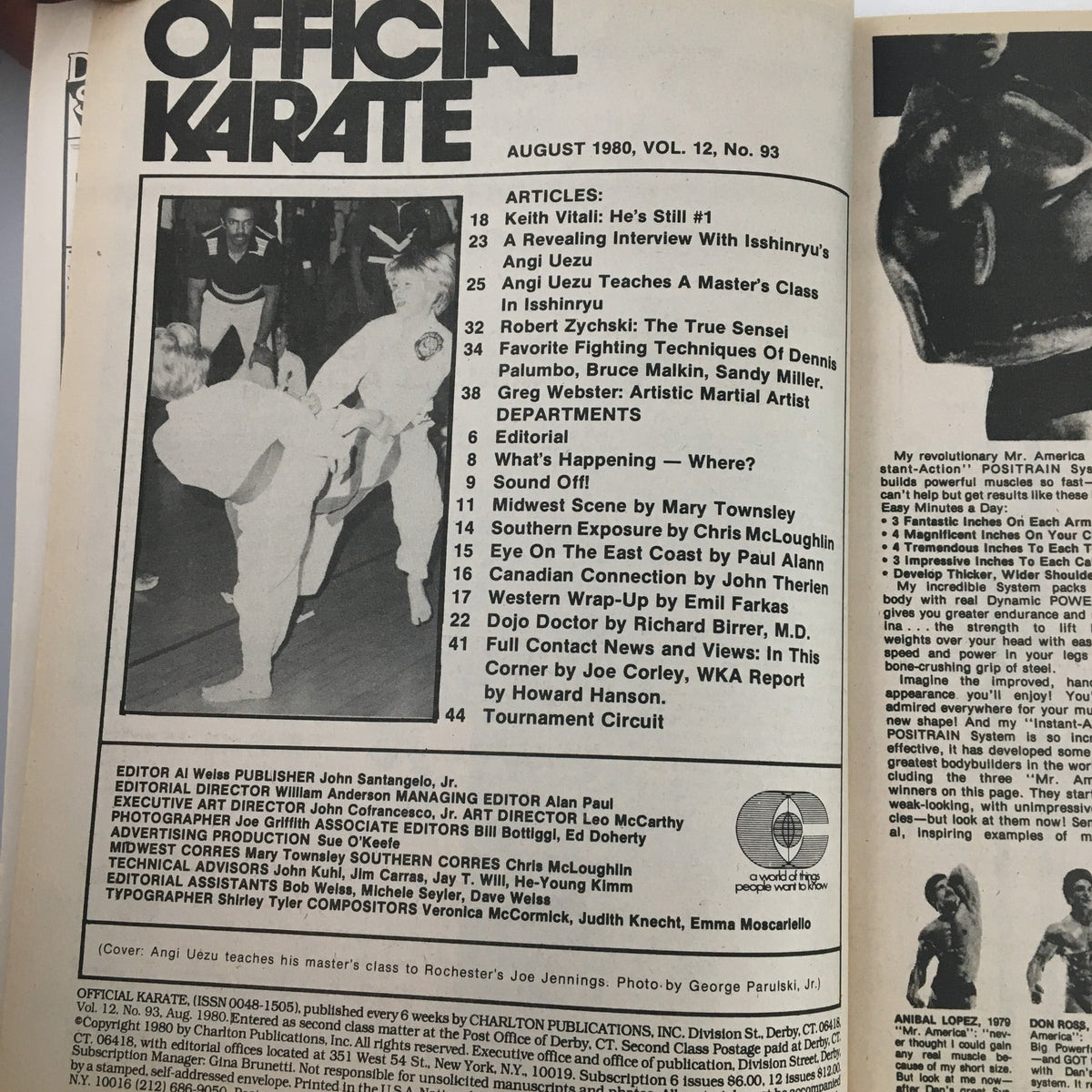


Description
Collector's Note – Why This Issue Matters
The August 1980 issue of Official Karate, identified in the listing as Volume 12, Issue #93, is notable for its stated feature in which Angi Uezu teaches Joe Jennings. Uezu is associated with Okinawan karate and the preservation of traditional instruction, making his name especially relevant to collectors interested in karate lineage, technique transmission, and instructor-centered martial arts publishing. The presence of a named teacher-and-student feature gives the issue a strong instructional identity rather than a purely celebrity or tournament focus. For collectors of vintage Official Karate magazines, this issue reflects the period when martial arts magazines served as practical bridges between respected instructors and readers who wanted access to training ideas beyond their own local schools. It also preserves a style of martial arts documentation in which the teacher’s method, posture, and instructional sequence were communicated through still photography and carefully arranged print layouts.
The 1980 date places the issue at the start of a new decade in American martial arts culture. By this point, karate had already gained substantial visibility in the United States through schools, tournaments, demonstrations, books, films, and specialty magazines. Yet print magazines remained one of the most important ways for practitioners to encounter teachers, techniques, and training philosophies from outside their immediate region. A feature built around Angi Uezu teaching Joe Jennings captures that instructional print culture clearly: the magazine was not only reporting on martial arts, but helping circulate lessons, names, systems, and training values to a national readership. For students reading in 1980, an article like this could function almost like a seminar on paper, offering exposure to instruction they might never have encountered in person.
This issue also belongs to a period when traditional karate and broader martial arts culture were being documented with increasing seriousness. Readers were often looking for more than spectacle; they wanted structure, discipline, forms, applications, ranking context, and a sense of connection to established teachers. Within the broader field of original magazines from 1980, this issue is useful for studying how karate instruction was packaged for English-language readers at the beginning of the 1980s. It preserves a moment when magazine photography, captions, and instructional articles helped shape how martial artists studied, compared styles, and understood authority in the pre-internet era. For collectors, that makes the issue valuable not only as a vintage martial arts magazine, but as a document of how karate knowledge circulated through print culture.
About the Publication
Official Karate was a specialty martial arts magazine aimed at karate students, instructors, competitors, collectors, and readers interested in traditional training, self-defense, tournaments, martial arts personalities, and technique-based instruction. Its editorial format commonly included instructional features, teacher profiles, demonstrations, interviews, competition coverage, training advice, and discussion of martial arts culture. During the late 1970s and early 1980s, magazines of this kind played a major role in connecting scattered martial arts communities, especially before video instruction and online resources became widely available. Although the title emphasized karate, issues often reflected the broader martial arts publishing world, where readers followed instructors, styles, philosophies, and practical methods across different systems. Complete issues preserve the terminology, photography, advertising, instructional priorities, and community concerns of their period, making them valuable artifacts for collectors who study martial arts history in print. They also show how martial arts magazines balanced authority and accessibility, presenting specialized instruction in a format that could reach casual readers, serious students, and longtime practitioners alike.
Key Highlights Inside
- August 1980 issue of Official Karate, identified in the listing as Volume 12, Issue #93.
- Features Angi Uezu teaching Joe Jennings, as stated in the listing, giving the issue a clear teacher-and-student instructional focus.
- Relevant to collectors interested in karate instruction, Okinawan karate traditions, teacher-student training features, and 1980s martial arts publishing.
- The listing describes the issue as containing martial arts techniques and cultural reflections connected to the karate community of the 1980s.
- Reflects the instructional role of martial arts magazines before online video, digital archives, and instant access to teacher demonstrations.
- Useful for studying how karate methods, training values, and instructor authority were presented to English-language readers in printed form.
- Identified as a newsstand issue with no label, giving the cover a cleaner presentation than a mailed subscription copy.
- The listing notes Very Good/Excellent condition, minor age-typical wear, great overall shape, and a plastic protective covering.
- Interior details beyond the stated Angi Uezu and Joe Jennings teaching feature are not fully confirmed from the listing, so no additional specific article titles are attributed here.
Condition & Rarity
Surviving examples of the August 1980 Official Karate should be evaluated by cover presentation, page completeness, spine stability, edge condition, surface handling, and the presence or absence of a mailing label. The listing describes the magazine as being in Very Good/Excellent condition, with minor wear typical for its age and strong overall preservation. It is also identified as a newsstand issue with no label, which is a meaningful collector detail because the cover can be viewed without an address label or mailing block interrupting the design. A plastic protective covering is noted, which can help with storage and handling, though it should be understood as preservation packaging rather than a formal condition grade. For martial arts magazines from 1980, condition can vary widely because many examples were actively read, used for technique reference, carried to schools, or stored casually by practitioners. A clean, complete, no-label issue in strong condition is especially useful when the content is instructional, because both cover presentation and readable interior pages contribute to its long-term reference value. Minimal wear is also noteworthy because instructional magazines were often handled repeatedly by readers studying techniques or sharing the issue with classmates. Collectors should look for intact pages, a stable spine, and a cover that still presents clearly as a record of the issue’s martial arts focus.
Looking for More Issues Like This?
This August 1980 Angi Uezu and Joe Jennings issue may be sold out, and technique-focused karate magazines from this period can be especially rewarding for collectors who value instructor lineage and practical training history. Readers looking for related examples can browse more collectible Official Karate issues to compare instructors, training features, tournament coverage, and the changing martial arts conversation of the late 1970s and early 1980s. Looking across multiple issues can also show how different teachers, systems, and methods were introduced to a national readership before digital instruction became common.
For broader context around the same year, the collection of 1980 magazines offers a useful way to place this issue within the wider print culture of its time, including sports, fitness, entertainment, martial arts, and popular culture. Together, these issues help show how specialized martial arts publishing fit into the broader magazine landscape at the beginning of the 1980s, when niche magazines played an important role in building communities around specific disciplines and interests.