



Description
Collector's Note – Why This Issue Matters
The January 1981 issue of Official Karate belongs to a period when martial arts publishing in the United States was becoming more confident, more visible, and more closely tied to personality-driven sports culture. By the early 1980s, karate magazines were no longer serving only a narrow dojo audience. They had become a key part of how practitioners, fans, and collectors followed fighters, training methods, tournament developments, and the changing public image of the martial arts. An issue from this exact moment preserves that shift in printed form.
Benny Urquidez is the major historical draw here. By 1981, he was already one of the most recognizable American names associated with full-contact fighting, and his appearance on the cover gives the issue significance well beyond routine monthly publication history. For collectors of martial arts print culture, a Benny Urquidez cover often signals crossover value: part karate history, part fight-sport history, and part media history from the years when combat sports identities were still being defined in print.
Glenn Wilson's presence adds another layer of interest, especially for readers who track the broader network of martial arts personalities featured in American magazines of the era. What makes this date matter is not just who appears on the cover, but what the issue represents: a January 1981 snapshot of the martial arts world at a time when technique, competition, and celebrity were increasingly sharing the same editorial space. In that sense, this issue fits naturally within both the Official Karate run and the broader landscape of 1981 magazines that documented specialized enthusiast culture in transition.
About the Publication
Official Karate was part of the martial arts magazine tradition that helped connect practitioners to a larger national scene before the internet era. Its readership likely included students, instructors, competitors, and devoted fans who wanted more than local instruction. Titles like this typically combined profiles of notable fighters and teachers with competition coverage, training features, photo-heavy presentation, and general reporting on the expanding martial arts community.
That editorial mix mattered. A magazine such as Official Karate did not simply report on events; it helped shape how readers understood the hierarchy of names, styles, and trends that defined the period. For collectors today, the publication is valuable because it captures the way martial arts were packaged, discussed, and visually presented to an American audience during a formative decade.
Key Highlights Inside
- January 1981 issue of Official Karate, with Benny Urquidez and Glenn Wilson named on the cover. Even without a confirmed contents page, those cover references alone make the issue notable to collectors of martial arts periodicals.
- Represents the early-1980s phase of martial arts publishing, when karate magazines increasingly reflected both traditional practice and the growing visibility of full-contact competition. That broader historical positioning gives the issue research value beyond its monthly date.
- Especially relevant to collectors interested in Benny Urquidez material, American kickboxing history, and the print culture surrounding martial arts personalities. Cover-documented appearances are often an important part of how these magazines are cataloged and studied.
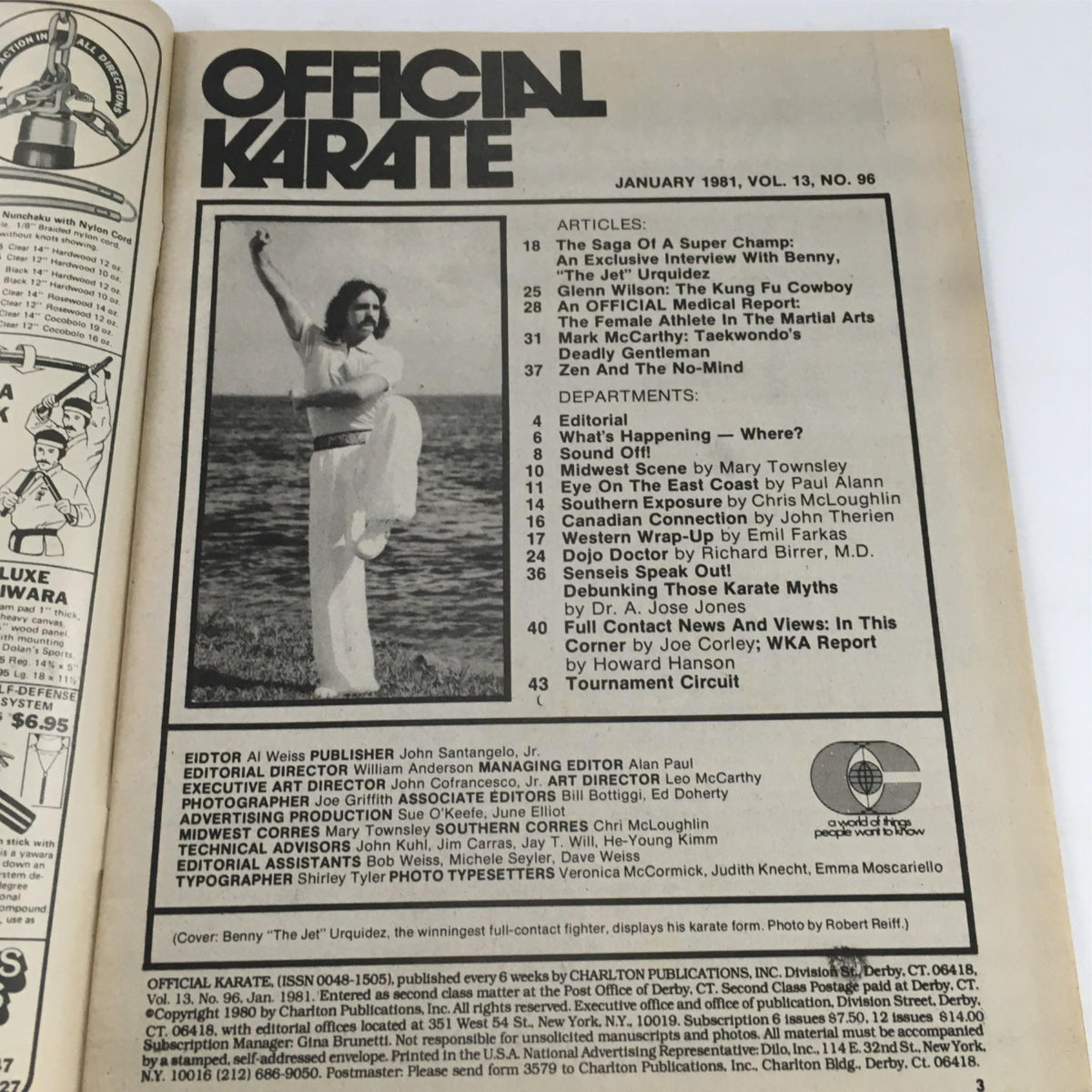
- The raw listing describes the issue in general terms as covering techniques, competitions, and training-oriented material associated with the era. Because no table of contents or scanned interior pages are provided here, those details are best treated as broad category descriptions rather than confirmed article-level documentation.
- Interior specifics remain unconfirmed beyond the named cover subjects. For serious archival use, article titles, departments, interviews, and photo features should be verified against a surviving contents page or a full interior review.
Condition & Rarity
The source description characterizes surviving examples of this issue as being found in good overall vintage condition, with minor rips, edge wear, and creasing consistent with age and handling. For a martial arts magazine from 1981, those traits fall within the ordinary range of collector-grade wear. These publications were often read, stored casually, and circulated as enthusiast material rather than preserved as formal archives, so moderate exterior wear is common across surviving copies.
The note that this issue is a no-label example is meaningful in collector terms. A cover without a mailing label generally presents more cleanly and is often preferred by collectors who value uninterrupted cover photography, typography, and display appeal. Protective plastic storage is also a positive preservation detail, though experienced collectors would still evaluate any surviving copy by spine condition, page completeness, staple security, cover gloss, odor, tears, and whether creases or edge damage materially affect presentation. In practical terms, desirability here comes less from dramatic rarity claims and more from the combination of complete survival, presentable condition, and the strength of the named cover figures.
Looking for More Issues Like This?
Issues like this often matter most when seen as part of a longer run rather than as isolated artifacts. Readers researching Benny Urquidez-era martial arts publishing, or the editorial character of early-1980s fight magazines, usually learn the most by comparing adjacent issues and surrounding years.
The broader Official Karate collection is the most direct place to continue that kind of research, especially for understanding how the magazine presented major personalities across its run. The 1981 magazine collection is also useful for placing this issue within the wider print culture of the year, where niche enthusiast titles were capturing highly specific communities with unusual depth. For collectors, that context is often what turns a single cover into a much richer historical reference point.