




Description
Collector's Note – Why This Issue Matters
This April 1958 issue of Playboy holds a notable place in the magazine's early literary history as the issue containing John Steinbeck's only original contribution to the publication, the satirical piece "The Short-Short Story of Mankind." Steinbeck was already one of America's most celebrated novelists by 1958, having won the Pulitzer Prize for "The Grapes of Wrath" nearly two decades earlier, and his appearance in Playboy reflects the magazine's continued strategy of securing major literary names to build its reputation beyond photography and lifestyle content. The issue also featured a piece titled "Weird Show" by Herbert Gold, another respected literary voice of the period, further reinforcing the issue's substantial fiction credentials. That combination of two notable literary contributions in a single issue makes this a genuinely significant artifact for collectors focused on Playboy's early literary history specifically, distinct from its better-known photographic legacy. The issue also carried a Las Vegas theme throughout its content, reflecting the city's rapidly growing postwar identity as a national entertainment destination during the late 1950s. That thematic framing extended to its featured Playmate, Felicia Atkins, an Australian-born showgirl who was performing in the Tropicana Hotel's Folies Bergère revue at the time of her selection. The pairing of a Las Vegas showgirl with a Las Vegas-themed issue reflects a deliberate editorial choice connecting the magazine's photographic content directly to its surrounding thematic material.
Felicia Atkins herself represents a specific and well-documented figure within Playboy's early Playmate history, having been discovered for the magazine through her stage work in Las Vegas rather than through film or conventional modeling channels. She would go on to hold the record for the longest tenure of any performer in the Tropicana's Folies Bergère revue, appearing in the production for nineteen years, a career longevity that distinguishes her from many other Playmates of the era whose public visibility often faded quickly after their centerfold appearance. That sustained career in one of Las Vegas's most enduring stage productions gives her Playboy feature an unusually well-documented afterstory compared to many contemporaries from the same period. Her centerfold was photographed by Bruno Bernard and Bill Bridges, both notable contributors to Playboy's early visual identity during the magazine's formative years. The Las Vegas theme connecting her feature to the issue's broader content reflects how thoroughly the city's entertainment culture had captured the American imagination by the late 1950s, a fascination Playboy was well positioned to channel through both its photography and surrounding editorial content. This issue captures that specific cultural moment, pairing a genuine Las Vegas performer with a magazine increasingly interested in the city's growing national profile.
The presence of two significant literary contributions within a single issue also reflects Playboy's broader strategy during this period of building genuine literary credibility alongside its photographic content. Hugh Hefner had established the magazine just five years earlier, in 1953, and by 1958 was actively courting serious authors as part of a deliberate effort to distinguish Playboy from competitors relying solely on photography and lifestyle material. Steinbeck's contribution, an allegorical satire in the style of Mark Twain examining human progress from savagery toward civilization, reflected exactly the kind of substantive literary content Hefner sought to feature. That a novelist of Steinbeck's stature contributed to the magazine at all speaks to how quickly Playboy had established itself as a credible literary venue despite its still-recent founding. Herbert Gold's accompanying contribution further reinforced that literary ambition within the same issue, giving readers two distinct works of serious fiction alongside the magazine's photographic content. This issue therefore captures Playboy's dual identity in an unusually concentrated form, combining genuine literary achievement with the visual and thematic content the magazine was becoming known for nationally.
For collectors specifically interested in Playboy's literary history, this issue represents one of the most significant single volumes in the magazine's early run, given Steinbeck's limited direct association with the publication and the added presence of Herbert Gold's contribution in the same edition. For collectors and historians of Las Vegas entertainment culture, Felicia Atkins's connection to the long-running Folies Bergère revue offers an unusually well-documented afterlife for a Playmate feature from this era. Taken together, this issue's literary contributions, its Las Vegas theming, and its featured Playmate's subsequent stage career combine to make it a genuinely multifaceted historical artifact. Few issues from Playboy's first decade can claim this particular combination of documented literary significance and thematic coherence across their content. This issue stands as a notable touchpoint for anyone studying either Playboy's early literary ambitions or the broader cultural fascination with Las Vegas during the late 1950s.
About the Publication
Playboy was founded in 1953 by Hugh Hefner and quickly grew into one of the most influential men's lifestyle magazines of the 20th century, combining photography with fiction, journalism, and cultural commentary aimed at a readership the magazine cultivated as sophisticated and culturally engaged. From its earliest years, the magazine distinguished itself by actively courting contributions from serious literary figures, treating written content as a genuine editorial priority rather than filler surrounding its photography. By 1958, that strategy had already yielded notable results, with the magazine successfully securing contributions from major authors as part of its broader effort to build credibility beyond its centerfold format. The monthly Playmate feature remained a defining structural element of every issue, and by the late 1950s the magazine had established consistent conventions for how these features were photographed, presented, and thematically integrated into surrounding content. Playboy's audience consisted primarily of young, professionally engaged American men, a readership the magazine's combination of literary ambition, cultural commentary, and photography was specifically designed to reach. Advertising within issues from this period commonly reflected products marketed toward that same aspirational male readership, offering useful secondary context for researchers studying mid-century consumer culture. The magazine's early willingness to weave thematic content, such as this issue's Las Vegas focus, across both its editorial features and its Playmate selection reflected an increasingly sophisticated approach to issue-wide coherence. That editorial sophistication, combined with genuine literary contributions from figures like Steinbeck, helped distinguish Playboy from competitors throughout its early history. Issues from this formative period remain significant reference points for understanding how thoroughly the magazine balanced photography, literary ambition, and cultural theming within a single publication.
Key Highlights Inside
- "The Short-Short Story of Mankind" by John Steinbeck, an allegorical satire on human progress. This remains Steinbeck's only original contribution to Playboy. Its inclusion makes this issue significant to collectors of both Playboy and Steinbeck literary history.
- "Weird Show" by Herbert Gold, a respected literary voice of the period. Gold's contribution reinforced this issue's substantial fiction credentials alongside Steinbeck's piece. Together they reflect Playboy's broader literary ambitions during this era.
- The centerfold feature of Felicia Atkins, an Australian-born showgirl performing at the Tropicana's Folies Bergère in Las Vegas. She was discovered for Playboy through her stage work rather than conventional modeling channels. She went on to hold the longest tenure of any performer in the Folies Bergère's history.
- A Las Vegas theme connecting the issue's editorial content to its featured Playmate. This thematic coherence reflects the city's rapidly growing postwar entertainment profile. It represents a deliberate editorial pairing of photography and surrounding content.
- Additional fiction, travel, and fashion content consistent with Playboy's standard late-1950s issue structure. Issues typically combined multiple written features alongside photography. Specific additional bylines beyond those noted here are unconfirmed.
- Photography by Bruno Bernard and Bill Bridges for the featured centerfold. Both photographers were notable contributors to Playboy's early visual identity. Their work here reflects the magazine's developing photographic conventions during this period.
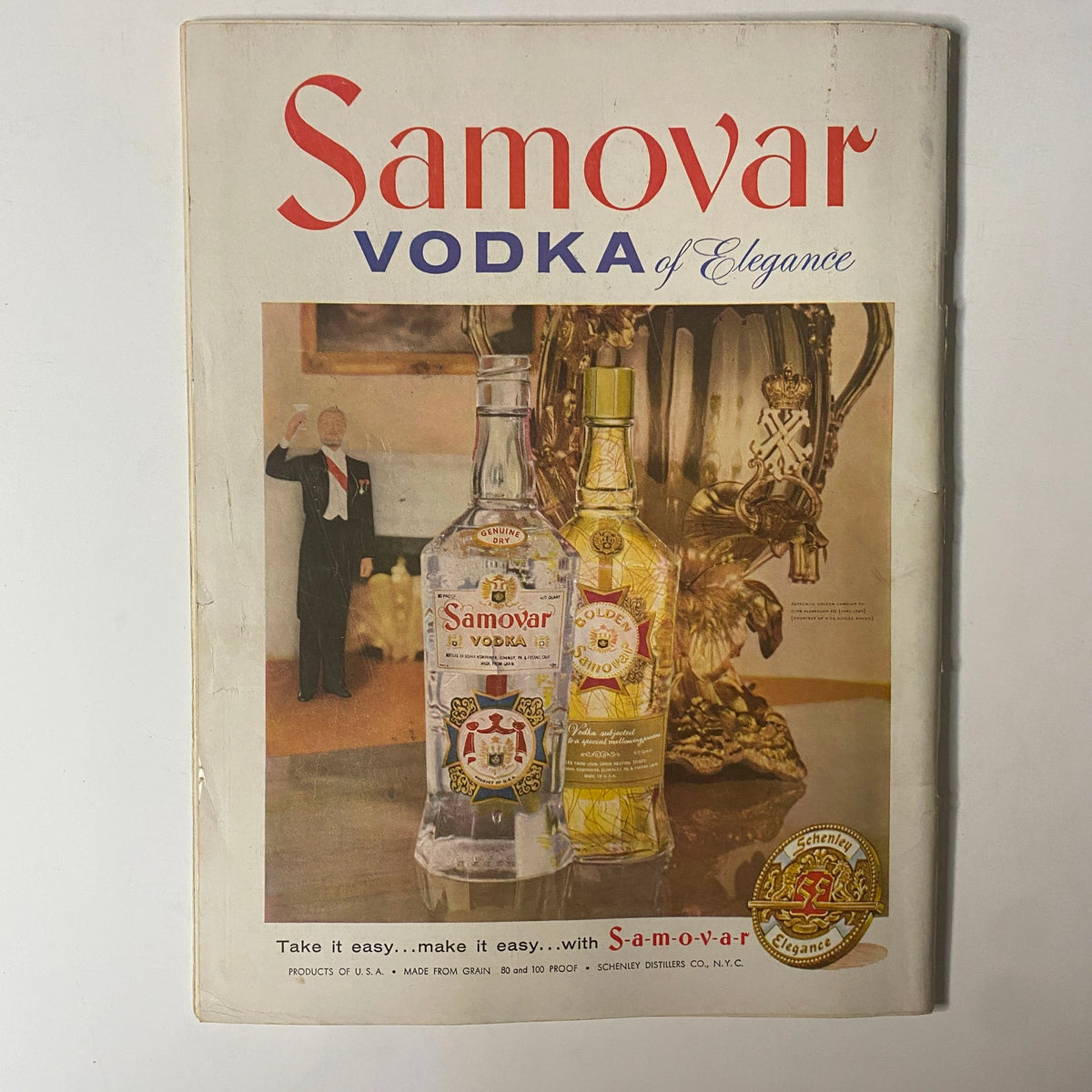
- Advertising content reflecting Playboy's aspirational, consumer-driven readership during the late 1950s. These pages offer useful secondary context for researchers studying period consumer culture. Specific advertisers appearing in this issue are not detailed in available records.
Condition & Rarity
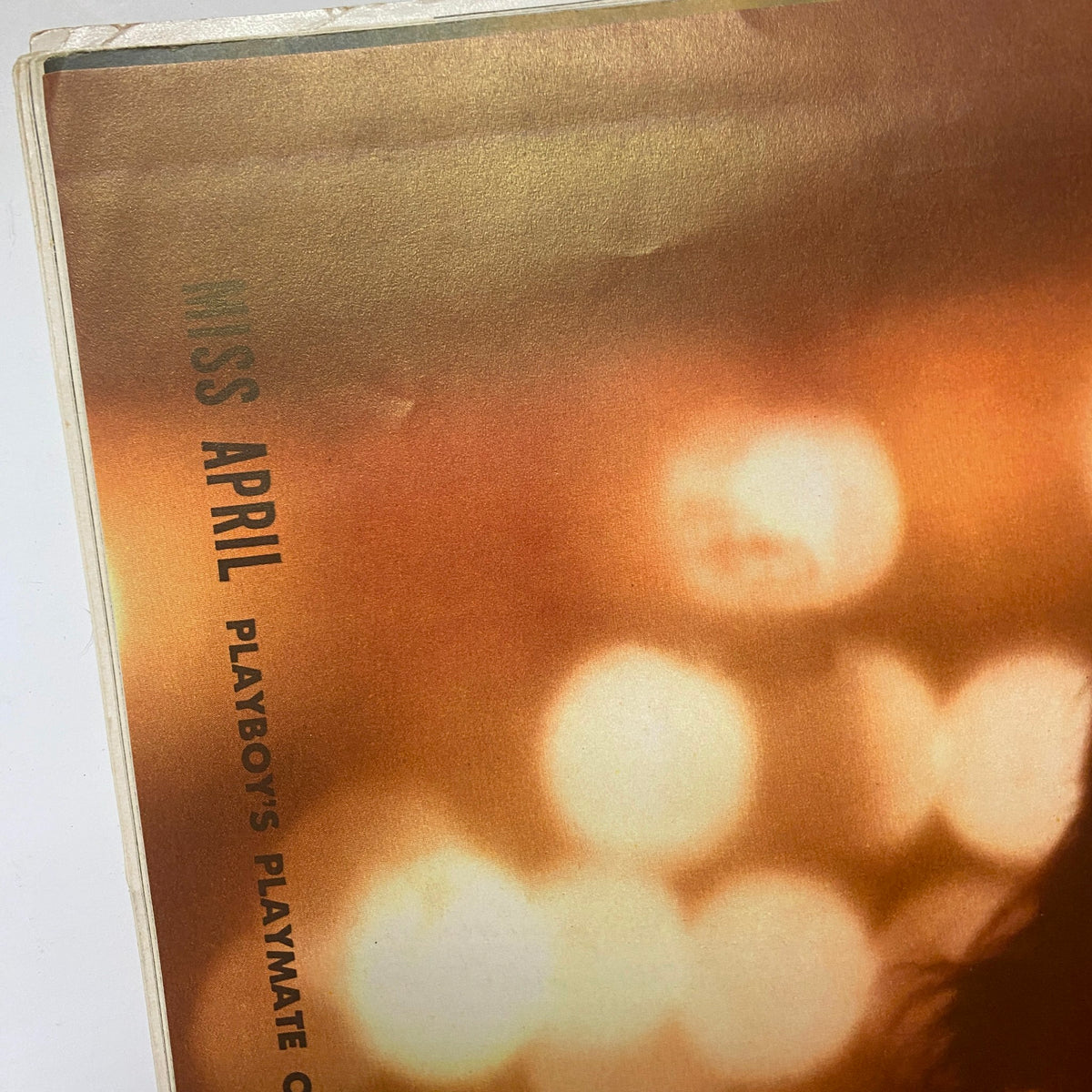
This issue is described as being in good condition, a grade reflecting a periodical with visible age and handling, in this case including some noted water exposure evident in the accompanying photographs. At this grade, collectors should expect some degree of moisture-related staining or page texture change, in addition to the general wear typical of a magazine that has survived nearly seven decades since its original publication. Water exposure is one of the more significant condition factors collectors evaluate for vintage periodicals, since it can affect page integrity, staining, and overall structural stability more substantially than ordinary handling wear. It is a copy issued without an accompanying label, a variant collectors often value for its unobstructed cover presentation. The centerfold in this copy remains intact and attached, a significant condition factor for Playboy collectors specifically, since detached or missing centerfolds are common among surviving copies of this magazine and considerably reduce both completeness and collector value. Early Playboy issues from the 1950s are generally scarce in complete, well-preserved condition, given the magazine's disposable newsstand origins and the tendency for centerfolds in particular to be removed or damaged over decades of handling. A plastic protective covering, when present, functions as a stabilizing measure intended to prevent further deterioration rather than a factor that changes the underlying grade already present. Collectors evaluating any surviving copy of this issue should weigh the significance of an intact centerfold against any noted moisture damage, since both factors substantially affect a copy's overall desirability. Given the combination of an attached centerfold and this issue's significant literary content, a good-grade copy with some water exposure still represents a meaningful find for collectors focused on early Playboy history.
Looking for More Issues Like This?
Early Playboy issues carrying significant literary contributions, particularly one containing John Steinbeck's only original piece for the magazine alongside a companion work by Herbert Gold, are genuinely difficult to find complete and well-preserved today. The added significance of an intact centerfold, combined with the issue's documented Las Vegas theming and its featured Playmate's unusually well-recorded subsequent career, makes this a notably well-rounded historical artifact within the magazine's early run. For those drawn to this particular issue, our Playboy collection is an excellent place to continue browsing, since it gathers other surviving issues from across the magazine's long publishing history, including further examples from its formative literary years. That collection offers a broader look at how Playboy's editorial ambitions evolved across different decades and cultural moments. Collectors with a specific interest in Steinbeck, mid-century literary contributions to popular magazines, or the history of Las Vegas entertainment culture may find related material of interest scattered throughout that same collection. Beyond the publication itself, our 1958 magazines collection offers useful context for the broader publishing landscape of the same year, spanning titles well outside Playboy alone. Browsing by year can be especially valuable for researchers interested in a specific cultural moment rather than one particular magazine. Given how scarce well-preserved, complete issues from this era tend to be once found, we'd encourage anyone interested in this period to browse both collections at their own pace. There is always more of this history available than a single issue can represent on its own. We hope these collections help round out whatever corner of Playboy's early literary and cultural history you're most drawn to.