

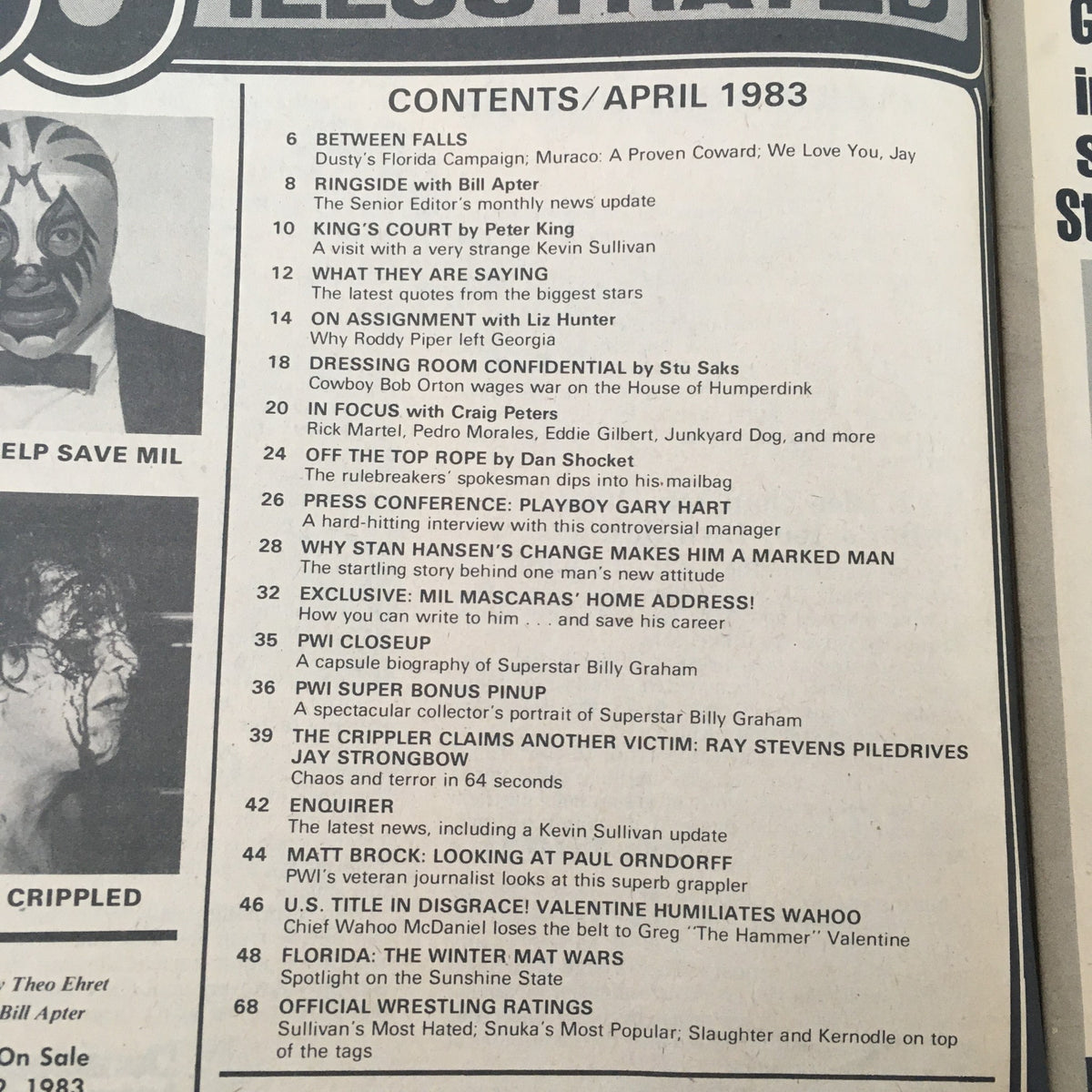


Description
Collector's Note – Why This Issue Matters
The April 1983 issue of Pro Wrestling Illustrated featuring Mil Mascaras and Billy Graham on its cover brings together two of the most visually distinctive and culturally significant figures in professional wrestling history — and does so at a moment when both represented something deeper than individual stardom. They embodied, between them, the full breadth of wrestling's multicultural and stylistic range in the early 1980s: Mascaras the high-flying, masked lucha libre tradition from Mexico, and Graham the flamboyant, muscle-bound showman whose influence on the American professional wrestling aesthetic was so profound that a young Terry Bollea would later credit him as the primary inspiration for Hulk Hogan's entire persona. Placing these two on the same PWI cover in April 1983 is an editorial statement about wrestling's diversity of tradition and style at a moment when the industry was about to undergo the national consolidation that would, within a few years, produce the WWF's dominant monoculture. For collectors who focus on vintage Pro Wrestling Illustrated issues from the territorial era, this cover is a document of two legends whose careers intersected with the sport's most transformative decade.
Mil Mascaras — whose name translates to "Man of a Thousand Masks" — had been one of the most internationally recognized professional wrestlers since the late 1960s, a Mexican superstar whose combination of athletic ability, spectacular aerial offense, and the mystique of his rotating collection of ornate masks had made him a genuine celebrity across multiple continents. By April 1983, he had worked for virtually every major American territory and was one of the most recognizable international stars in the industry — a figure whose presence on a card elevated its prestige regardless of where it was held. Superstar Billy Graham had been one of the most important figures in American wrestling throughout the 1970s, his charisma, physique, and mic work having directly influenced the next generation of wrestling's biggest stars. His WWF championship reign in 1977–78 had demonstrated that a heel with genuine star power and a theatrical persona could draw at the highest level, and his stylistic innovations — the tie-dye tights, the boastful promo style, the bodybuilder's physique as character — were still visible throughout the industry in 1983. Collectors building archives around the wrestling magazines of 1983 will find this cover a document of two careers whose influence on the sport was disproportionate to what their individual title reigns might suggest.
The broader context of April 1983 in professional wrestling is essential for understanding why this PWI cover matters beyond the individual significance of its two subjects. The territorial system was still in full operation, with regional promotions across the United States each maintaining their own title structures, rosters, and television relationships — the NWA, the AWA, the WWF, and dozens of regional territories were all competing for talent and audience simultaneously. But the forces that would disrupt and ultimately dismantle that system were already building: Vince McMahon Jr. had taken control of the WWF from his father in 1982 and was beginning the national expansion strategy that would reshape the industry by the mid-decade. In this context, a PWI cover featuring Mascaras — a figure whose career had been built on the international and interterritorial traditions of the old system — and Graham, whose career was winding down but whose influence on the WWF's developing style was still very much present, captures the territorial era at its last moment of genuine pluralism before the consolidation that would follow.
About the Publication
Pro Wrestling Illustrated, published by the Stanley Weston Group and launched in 1979, had by the early 1980s established itself as the most widely read and editorially serious of the American professional wrestling magazines — a publication that treated wrestling with statistical rigor, long-form profiling, annual rankings, and the kind of comprehensive multi-territory coverage that no single regional publication could provide. Its audience was the dedicated American wrestling fan who followed the sport across multiple promotions and wanted the kind of in-depth coverage that PWI's monthly format uniquely offered. The magazine's annual awards — Wrestler of the Year, Match of the Year, Rookie of the Year — were genuinely influential within the wrestling community and are cited by historians as meaningful records of the era's critical consensus. By April 1983, PWI was the essential reference publication for serious wrestling fans, its coverage of the territorial landscape providing a documented record of the industry at the last peak of its decentralized, multi-promotional form.
Key Highlights Inside
- A cover feature on Mil Mascaras and Billy Graham — two figures whose careers represented fundamentally different but equally important traditions within professional wrestling, their shared cover placement in April 1983 reflecting the territorial era's capacity to bring together international and American wrestling cultures in ways that the post-consolidation industry would largely abandon.
- Coverage almost certainly engaging with Mascaras's ongoing interterritorial career and his status as one of the most internationally recognized stars in the sport — a figure whose Mexican lucha libre tradition and spectacular aerial style had influenced a generation of wrestlers and whose cross-cultural appeal was unlike that of any other wrestler of his era.
- Reporting on Billy Graham's career trajectory and legacy at a time when his most influential period was behind him but his impact on the industry's developing aesthetic — particularly on the WWF's character-driven, showmanship-oriented approach that was becoming increasingly dominant — was being recognized and discussed within the wrestling community.
- Multi-territory coverage consistent with PWI's April 1983 editorial format — comprehensive reporting on the NWA, AWA, WWF, and regional territories that constituted the full American wrestling landscape at the height of the territorial era, providing the kind of complete industry snapshot that gives PWI issues from this period their particular historical value.
- Rankings, title histories, and industry news reflecting the state of professional wrestling in early 1983 — the period immediately before Hulk Hogan's January 1984 WWF title win and the subsequent national expansion that would transform the industry, making PWI coverage from this transitional moment a primary source for understanding what the sport looked like in its last pre-Hulkamania year.
Note: Specific interior article titles, additional featured wrestlers, and further editorial details beyond the cover story are unconfirmed for this issue from available sources. The highlights above reflect verifiable historical context drawn from the cover subjects, publication date, and the well-documented editorial character of Pro Wrestling Illustrated during this period.
Condition & Rarity
This copy is identified as a no-label newsstand edition in good condition with minor wear including small rips, edge wear, and creases — an honest and characteristic condition description for a forty-plus-year-old wrestling magazine that has been stored rather than actively preserved. The newsstand provenance and absence of a mailing label are positive attributes that distinguish this copy from subscription-processed examples, preserving the cover as originally printed without the label adhesive damage that affects the display presentation of many surviving copies from this era. The noted minor wear — rips, edge wear, and creases — is typical for newsstand copies of wrestling magazines from the early 1980s, a format that was produced for regular reading rather than archival preservation and whose paper stock is correspondingly more vulnerable to the wear patterns of ordinary storage over four decades. Collectors should examine the provided photographs carefully to assess the specific location and extent of any wear relative to the cover image, as the placement of the Mascaras and Graham cover photography determines how significantly the noted imperfections affect the issue's display potential. The plastic protective sleeve indicates preservation-conscious storage and will help prevent further deterioration. For a PWI cover of this specific historical and cultural significance, a no-label newsstand copy in good condition with readable interior pages represents a legitimate and purposeful acquisition for collectors of territorial-era wrestling memorabilia.
Looking for More Issues Like This?
A PWI cover pairing Mil Mascaras and Billy Graham from April 1983 is a specific and historically resonant find for collectors of territorial-era wrestling culture, and if this issue has already found a home, the broader vintage Pro Wrestling Illustrated collection at OriginalMagazines.com is an excellent resource for other significant covers from the magazine's remarkable early-1980s run — the last years of the territorial system's full operation and the period that produced the competitive landscape from which the national wrestling boom would emerge. Collectors focused on the wrestlers, promotions, and cultural atmosphere of wrestling's most pluralistic and historically rich era will also find it well worth exploring the full 1983 magazine archive, which brings together wrestling and general interest publications from one of the most consequential transitional years in the history of the sport.