


Description
Collector's Note – Why This Issue Matters
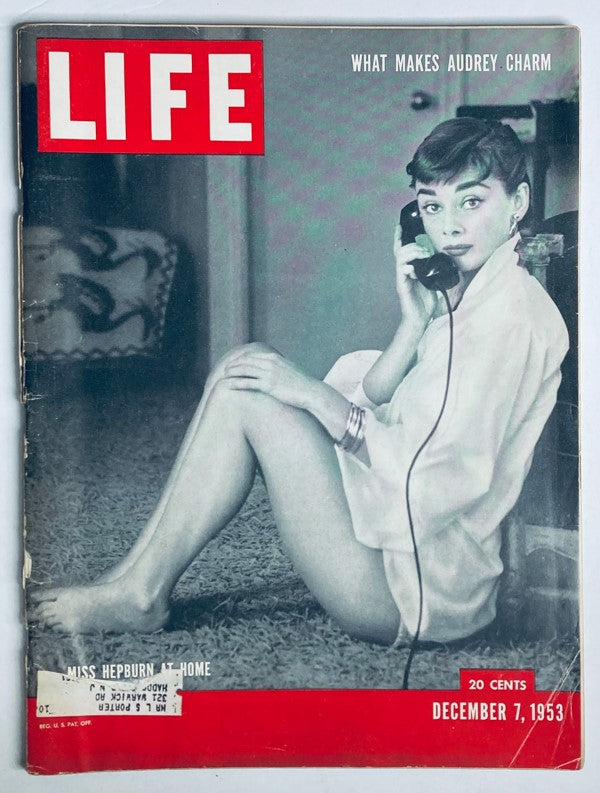
December 7, 1953 is one of the most historically significant publication dates in Audrey Hepburn's career, and this Life Magazine cover is a primary document of her public identity at its most transformative moment. Hepburn had won the Academy Award for Best Actress for Roman Holiday in March 1953 — nine months before this issue's publication — becoming in the process one of the most discussed and most celebrated new film personalities in Hollywood. Roman Holiday had been her first major film role, and the combination of the film's commercial success, its critical esteem, and Hepburn's undeniable screen presence had produced a level of mainstream celebrity that the Life cover in December 1953 both reflected and amplified. She had also won the Tony Award for Best Actress for Ondine on Broadway in the same year — 1953 was, in the most literal sense, the year Audrey Hepburn became Audrey Hepburn as a cultural institution, and a December Life cover appearance at the close of that extraordinary year is a primary document of that transformation at its most acute. For collectors building an archive of Audrey Hepburn magazine covers and features, this Life issue is the foundational document of her mainstream American celebrity — the major photojournalism publication's formal recognition of her as one of the year's most significant cultural figures, produced at the end of her breakout year and preserved in the specific form of the large-format photographic journalism that Life had made its signature.
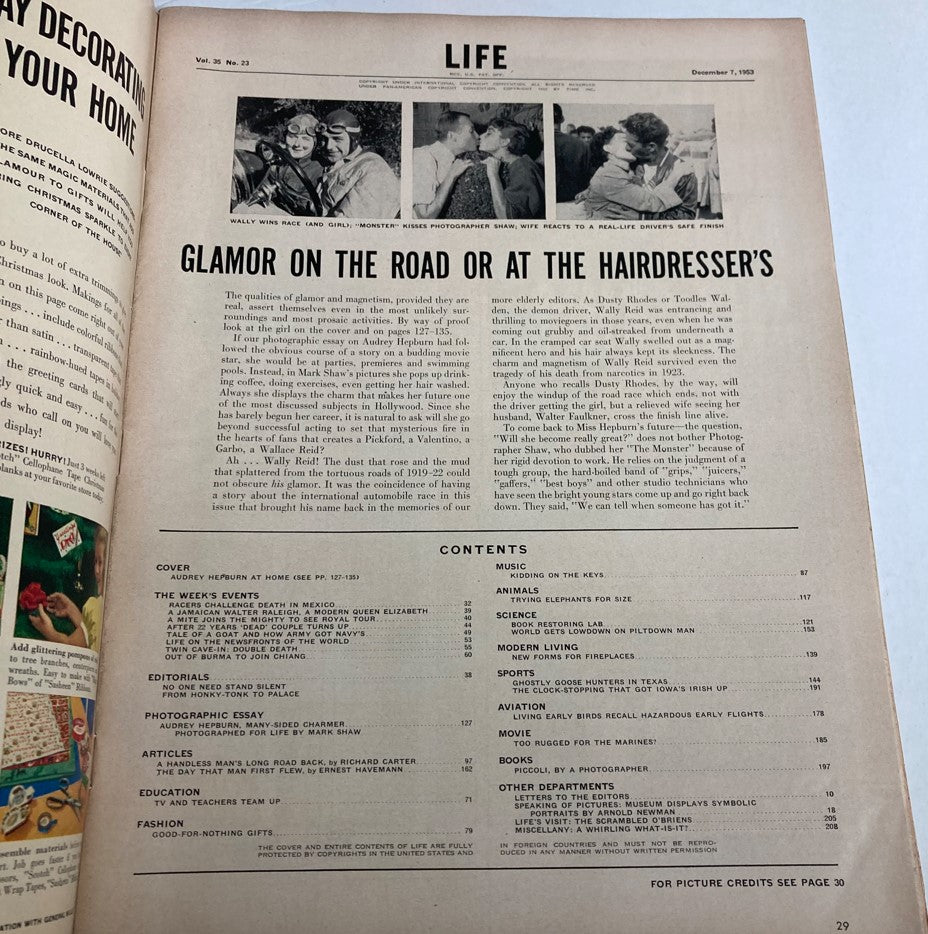
The "Tale of a Goat" article referenced in the listing alongside the Hepburn cover is an intriguing editorial detail that reflects Life's characteristic approach to its weekly issues — the juxtaposition of major celebrity content with human interest stories that gave the magazine's pages a specific texture and variety that its competitors rarely matched. Life's editorial philosophy was built around the conviction that photojournalism could find equal documentary power in the famous and the obscure, the globally significant and the locally charming, and the survival of this issue with both the Hepburn cover and the goat story documented is itself a small record of that philosophy in operation. The December 7 publication date adds a further historical dimension: exactly twelve years after Pearl Harbor, the anniversary of which would have been very much present in the consciousness of Life's readership in 1953, still only eight years from the war's end. An Audrey Hepburn cover on this specific date carries the resonance of a culture that was simultaneously processing its recent history and celebrating the glamour of its present — and Hepburn herself, born in Belgium, shaped by the German occupation of the Netherlands during her childhood, carried within her biography a personal connection to the war that gave her Hollywood celebrity an additional emotional complexity for audiences who knew or suspected that history. Collectors researching Life Magazine covers from this peak postwar period will find this December 1953 edition a richly situated primary document.
The broader context of December 1953 in American cultural life deepens this issue's significance as a collector's artifact. The early Eisenhower years were a period of postwar prosperity and cultural confidence, and Hollywood was producing some of its most enduring films with an ambition and a star system that were both approaching their final decade of dominance before television's full impact was felt. Hepburn represented something specific within that system — a new kind of femininity that was less overtly sexual than the Monroe model, more intellectually and aesthetically serious, connected to European culture and sensibility in ways that gave her an aspirational quality that crossed demographic and class lines effectively. Life's cover captured her at the precise moment when this new persona was most freshly revealed and most actively discussed, and the large-format photographic treatment that Life brought to its subjects gave the Hepburn cover an artistic quality and a visual authority that smaller-format publications of the era could not match. Collectors researching American cultural and entertainment magazines from 1953 will find this issue a primary document of both Hepburn's cultural emergence and the specific aesthetic moment in which it occurred.
About the Publication
Life Magazine was founded by Henry Luce in 1936 as a weekly photojournalism publication and operated continuously in that format until 1972, when it transitioned to special issues before relaunching as a monthly in 1978. At its peak in the postwar decades it was among the most widely circulated magazines in the United States, built on the editorial conviction that photography could document history, convey emotion, and communicate across barriers of education and background in ways that text alone could not. By December 1953 Life was in its seventeenth year of publication and had established itself as the primary venue through which mainstream America encountered the famous, the beautiful, and the historically significant in photographic form. Its large format and high-quality photographic reproduction gave its cover subjects a visual authority and a physical scale that translated into the kind of mainstream cultural recognition that a Life cover appearance uniquely conferred — to appear on the cover of Life in 1953 was to be formally recognized by the most widely read photojournalism publication in America as one of the year's most significant figures.
Key Highlights Inside
- Audrey Hepburn cover — a primary visual document of the actress at the close of her extraordinary 1953 breakout year, following her Academy Award for Roman Holiday and Tony Award for Ondine, representing Life's formal photojournalistic recognition of her emergence as one of the year's most significant cultural figures and one of the most important early cover appearances in her documented magazine history.
- "Tale of a Goat" human interest feature — a documented secondary story that reflects Life's characteristic editorial approach of juxtaposing major celebrity content with the human interest stories that gave the magazine its specific weekly texture, and preserving in this issue a small but authentic example of the editorial philosophy that made Life's pages unlike those of any competitor.
- Weekly news and cultural coverage consistent with Life's December 7, 1953 editorial scope — the Eisenhower administration's first year in office, the ongoing Korean War armistice's aftermath, and the full range of American and international developments of the first week of December 1953, all situated in the specific emotional context of the twelfth anniversary of Pearl Harbor.
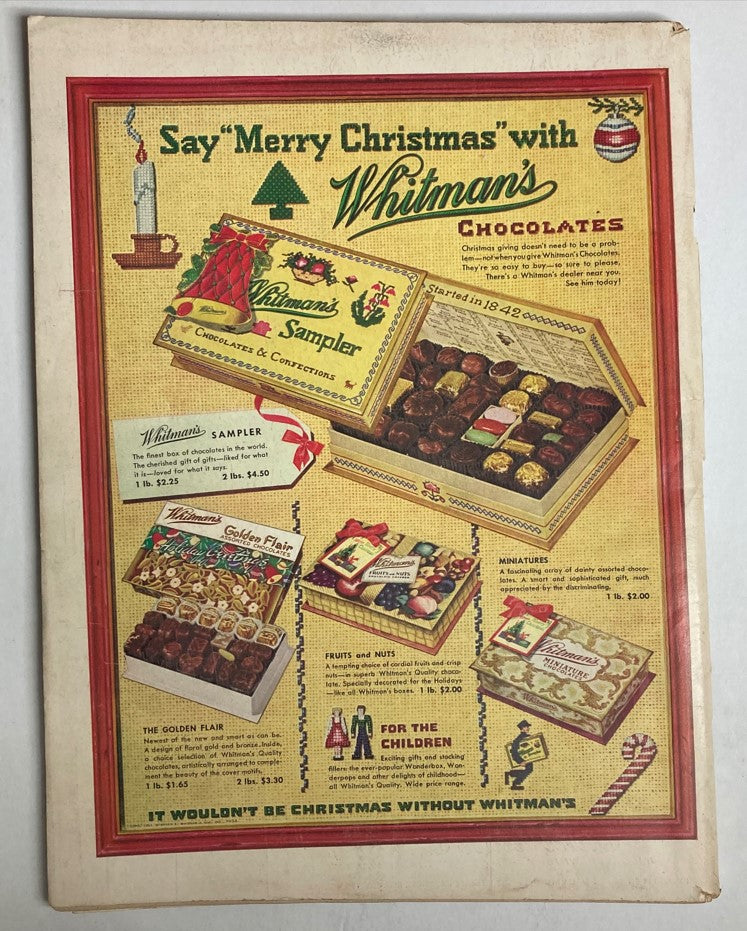
- Period advertising reflecting the commercial culture of Life's affluent, broad American readership in December 1953 — the advertising pages of a peak-era Life issue from the early Eisenhower years document the brands, products, and holiday commercial messaging of a specific moment in postwar American consumer culture prosperity.
- Note: Specific secondary article titles, confirmed photography credits for the Hepburn feature, and detailed interior content details beyond the documented cover story and "Tale of a Goat" article have not been individually verified for this issue. The highlights above reflect Life's well-established editorial format, the verified cover subject and article title, and the historical context of December 7, 1953.
Condition & Rarity
Life Magazine issues from December 1953 are approaching their seventy-third year of existence, and the condition landscape for surviving copies of this specific issue reflects both the general attrition of that age and the specific collecting pressure that an Audrey Hepburn cover generates across multiple overlapping collector communities — classic film enthusiasts, Life Magazine completists, and the broader community of mid-century celebrity memorabilia collectors. The listing directs collectors to the photographs for condition assessment — the standard and appropriate practice for a publication of this age — and the plastic protective sleeve provides ongoing archival protection for what is now a seventy-two-year-old publication whose paper stock has had ample time to develop the characteristic aging of mid-century coated and newsprint pages under any storage conditions. Life's large-format staple-bound design made it more susceptible to cover separation, page stress, and spine wear than smaller-format publications, and surviving copies from this era that have maintained display-grade condition are a meaningful minority of those that circulated originally. Collectors evaluating surviving examples of this issue should prioritize cover legibility — the Hepburn image is the primary visual document — alongside the security of the staple binding, the completeness of all interior pages including the "Tale of a Goat" feature, and overall structural soundness as primary condition criteria.
Looking for More Issues Like This?
A surviving copy of the December 7, 1953 Life Magazine with the Audrey Hepburn cover is one of the most sought-after entries in the postwar Life archive — the combination of her 1953 breakout year, the December 7 publication date, and Life's unmatched photographic authority give this issue a collector profile that attracts sustained interest from multiple communities simultaneously. If this issue is no longer available, the Audrey Hepburn magazine collection at OriginalMagazines.com is the most focused resource for other significant cover appearances and features from her career across publications and decades. The full Life Magazine collection offers surviving issues from across the publication's history for collectors building a broader archive of its postwar celebrity and cultural coverage, and the 1953 magazine collection brings together issues from across that year's major publications for collectors interested in the full range of American print culture during the year that gave us Audrey Hepburn and the beginnings of the decade that would define her legend.