




Description
Collector's Note – Why This Issue Matters
This February 1989 issue of Rock magazine captures Stryper at a pivotal, slightly precarious moment in their career. The Orange County Christian metal band had spent the back half of the 1980s building one of the more improbable success stories in mainstream hard rock, pairing yellow-and-black spandex and arena-scale glam theatrics with unapologetically Christian lyrics, and by 1989 they were riding the momentum of their 1988 album In God We Trust, which had gone gold and produced two Billboard Hot 100 singles. At the same time, the band was facing real friction: critics and longtime fans had begun pushing back against the album's increasingly polished, pop-leaning production, even as Stryper's profile on MTV and mainstream rock radio continued to grow. A Rock magazine cover feature from this exact window freezes that tension in place — a band simultaneously at a commercial high point and under mounting pressure to justify its sound and image to an increasingly fragmented metal audience. That makes this issue a useful primary-source snapshot, not just a celebratory fan artifact.
It's also worth situating this issue within the broader hair metal and glam metal landscape of early 1989, a genre that Stryper had helped popularize even while standing apart from it lyrically. Twin-guitar solos, towering hair, and visually maximal stage shows were the genre's lingua franca, and Stryper had leaned into all of it while still singing directly about salvation and scripture — a combination that drew skepticism from secular critics and some Christian conservatives alike, yet somehow built them a sizable crossover audience. By early 1989, that balancing act was becoming harder to maintain, as thrash and more stripped-down rock acts were beginning to chip away at the pop-metal audience Stryper had courted. A 1989 magazines like this one offers a contemporary record of how that shift was being covered in real time, before anyone reading it knew where the band's sound and image were headed next. Within two years, Stryper would abandon the yellow-and-black look entirely on a markedly heavier, more secular-leaning album — a reinvention that this issue, naturally, has no way of anticipating.
For collectors of Christian rock and glam metal ephemera specifically, this issue sits at a genuinely interesting inflection point in Stryper's documented history. It predates the band's image overhaul, meaning it reflects them at the height of their most recognizable era — the stripes, the spandex, the Bible-toss stage routine — rather than the harder-edged reinvention that followed. That makes it a useful anchor point for anyone tracing how the band's public image evolved across the press coverage of the late 1980s. Issues from this narrow window, before the shift, carry a particular kind of nostalgia for fans who associate Stryper most strongly with their classic look. The accompanying poster only reinforces that appeal, giving readers a piece of visual memorabilia tied directly to this specific era of the band's run.
About the Publication
Rock magazine was part of the crowded field of late-1980s newsstand music titles competing for the hard rock and heavy metal readership, a category that also included long-running peers covering the same beat of artist profiles, concert coverage, and glossy pin-up-style photography aimed at genre fans. Magazines in this category typically followed a familiar newsstand format: a single marquee artist or band featured prominently on the cover, paired with interior content built around interviews, tour coverage, and poster inserts designed to be pulled out and displayed. This kind of music magazine thrived in the cassette-and-CD era of the late 1980s, when print remained the primary way fans outside of MTV's rotation kept up with their favorite acts, and when a glossy cover photo or fold-out poster carried real value as collectible memorabilia in its own right. Specific editorial details about this particular title beyond what's reflected in this issue are not independently confirmed here, but the format and audience are consistent with the broader genre of hard rock and metal newsstand magazines that flourished alongside acts like Stryper throughout the decade.
Key Highlights Inside
- Cover feature on Stryper, captured at a high point of their classic yellow-and-black, Christian metal era and not long after the gold-certified success of their 1988 album In God We Trust. This places the issue squarely within the band's most visually iconic and commercially successful period. It's a useful reference point for collectors tracking how the band's image was covered just before their early-1990s reinvention.
- Includes an original poster insert featuring Stryper, a format common to late-1980s rock magazines that doubled as wall-display memorabilia for fans. Poster inserts like this were often the primary draw for readers buying a given issue off the rack. Their survival intact, rather than removed and displayed or discarded, adds to the collectibility of any surviving copy.
- Published in February 1989, placing the issue in the months following the peak chart and touring activity around In God We Trust, and ahead of the more dramatic image shift the band would undergo by 1990. That timing makes it a useful snapshot of press coverage during a relatively narrow transitional window for the band. Readers picking this issue up at the time would have had no indication of the harder-edged reinvention still to come.
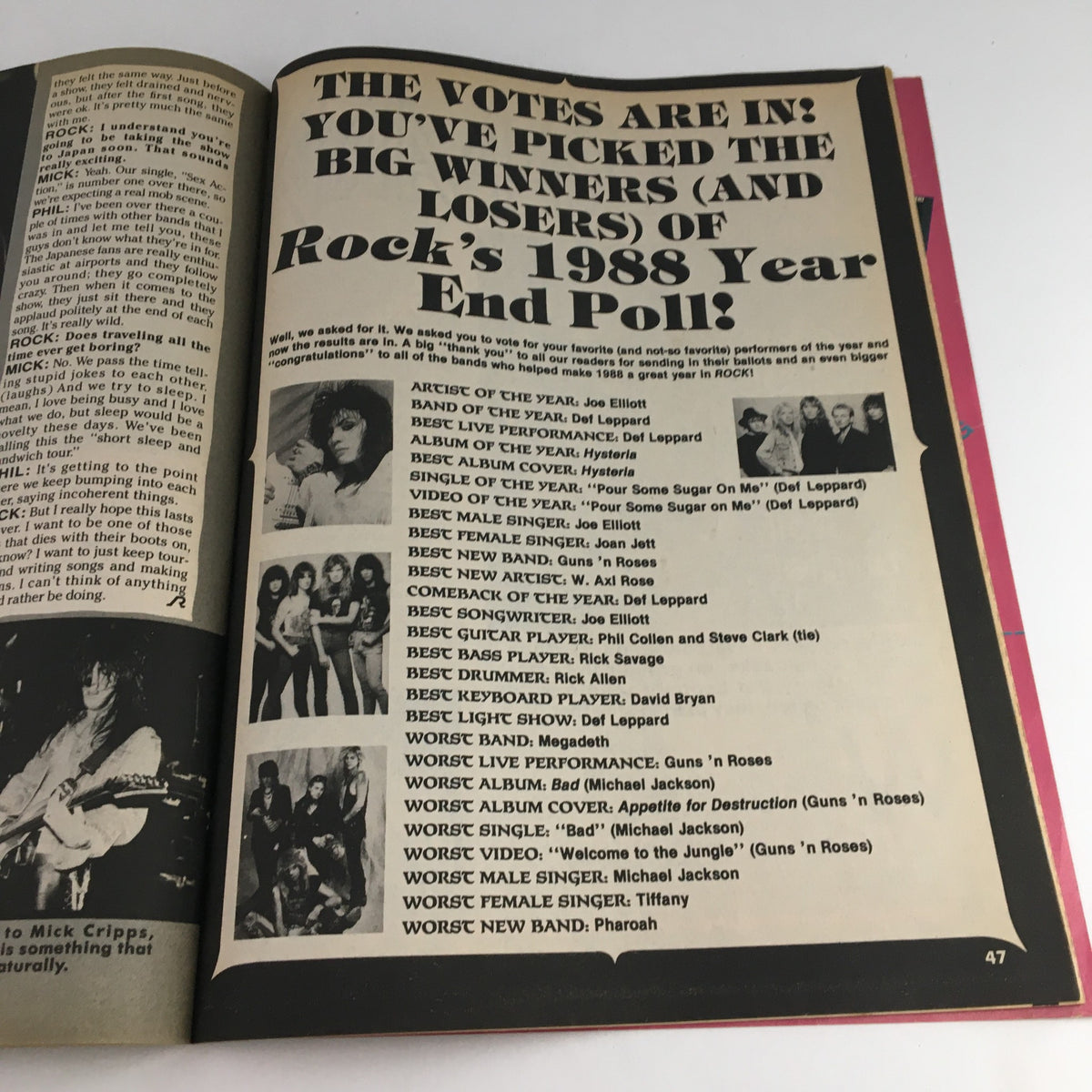
- Beyond the cover feature and poster, specific article titles, interviews, or additional interior content for this issue are not confirmed. Music magazines of this era typically included additional content such as concert listings, other artist profiles, or reader mail alongside a marquee feature. Collectors interested in the full contents should plan to verify them directly against the physical issue.
Condition & Rarity
Issues of this type are generally evaluated by collectors against a few key benchmarks: whether the copy is a newsstand edition or a subscription copy, whether a mailing label is present on the cover, and the overall condition of the spine, pages, and any included inserts. A newsstand edition without a label is typically considered more desirable than a labeled subscription copy, since the unmarked cover preserves the original photography and design exactly as it appeared on the rack — a meaningful factor for music magazines, where the cover image is often as central to the item's appeal as the interior content. Condition graded as acceptable generally indicates noticeable wear consistent with age and handling, which can include cover creasing, edge wear, and small rips of the kind described here, rather than the crisp, near-original presentation associated with higher grades. Rips and similar wear are a common and expected characteristic in surviving copies of music magazines from this era, particularly given that these were inexpensive, mass-produced periodicals not built for long-term archival preservation. The presence of an intact poster insert is a significant factor in evaluating a copy like this, since loose inserts were frequently removed, displayed, or discarded by original readers, making complete copies meaningfully harder to find than the base magazine alone. Protective plastic sleeving is a common and recommended storage method for vintage music magazines and their inserts alike, as it limits further handling wear without altering the item itself. Collectors evaluating any surviving copy of this issue should pay particular attention to the condition of the poster insert, the integrity of the spine and staples, and the extent of any rips or creasing relative to the listed grade.
Looking for More Issues Like This?
A complete, no-label copy of this February 1989 Rock issue — poster intact — is the kind of find that doesn't surface often, especially given how frequently inserts like this were separated from their original magazines over the years. If you're tracking down more from this era of hard rock and Christian metal press coverage, our Rock magazine collection is worth a look, alongside our broader 1989 magazines collection for a wider sense of what else was on newsstands that year. Both are good starting points whether you're chasing a specific gap in your Stryper memorabilia or just exploring the music journalism of the period more broadly.