



Description
Collector’s Note – Why This Issue Matters
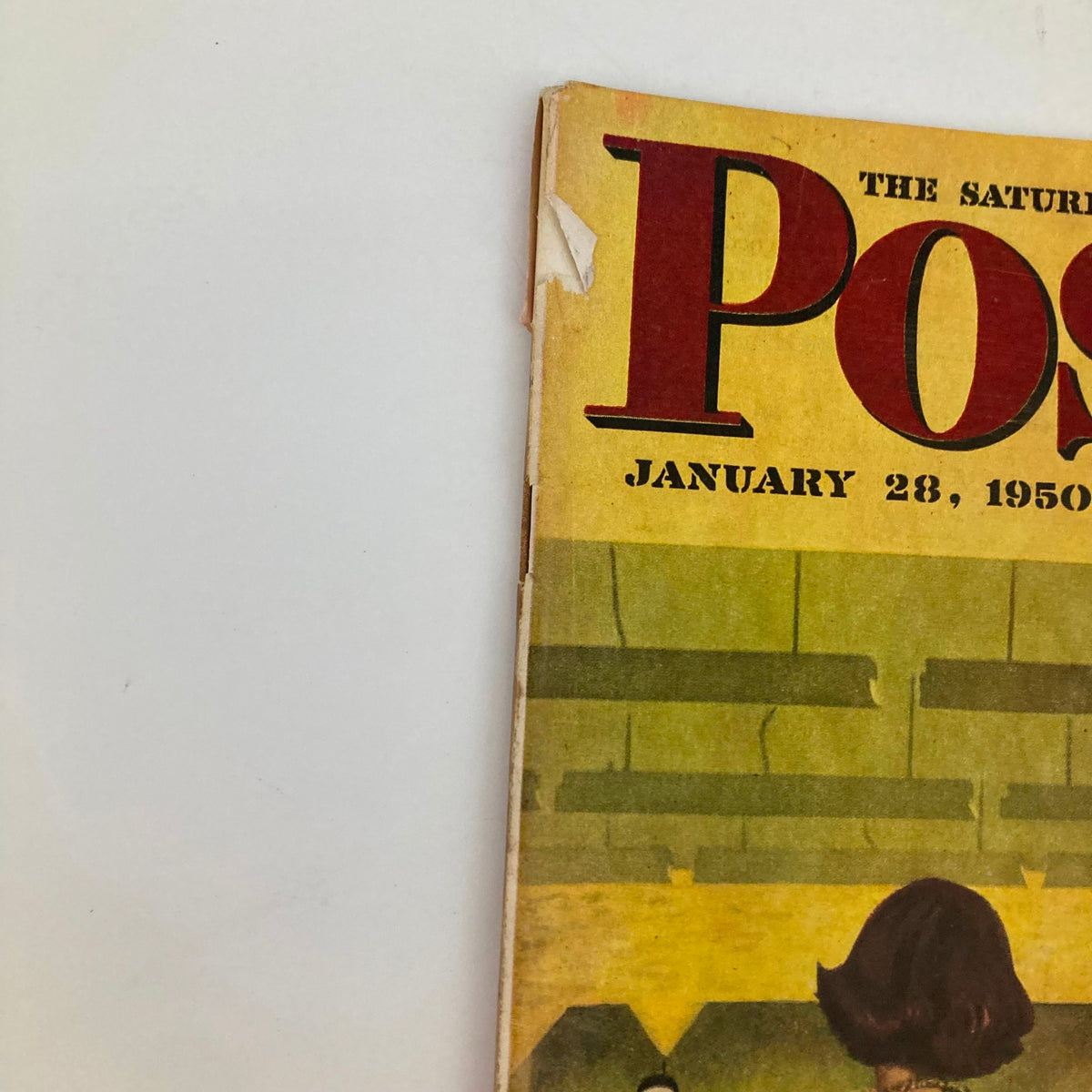
The January 28, 1950 issue of The Saturday Evening Post features George Hughes’s illustrated cover “Bowling Strike,” a polished social comedy set inside a modern bowling alley. A young woman in a black dress has removed her high-heeled shoes and delivered a ball while moving forward in her stockinged feet. All ten pins appear to have fallen, leaving her male companion holding his own ball with an expression of open disbelief. Her discarded shoes rest beside him as she walks away from the lane with an air of calm satisfaction. The man had apparently expected the outing to demonstrate his athletic superiority, only to watch his inexperienced date achieve the result every bowler seeks. Hughes captures the moment after the decisive action rather than the throw itself, allowing the reactions and scattered pins to explain what has occurred. The glossy lanes, scoring equipment, distant bowlers, seating, and muted green interior establish the recreational setting with considerable period detail. The result is a concise visual narrative about courtship, competition, confidence, and the disruption of an expected gender hierarchy.
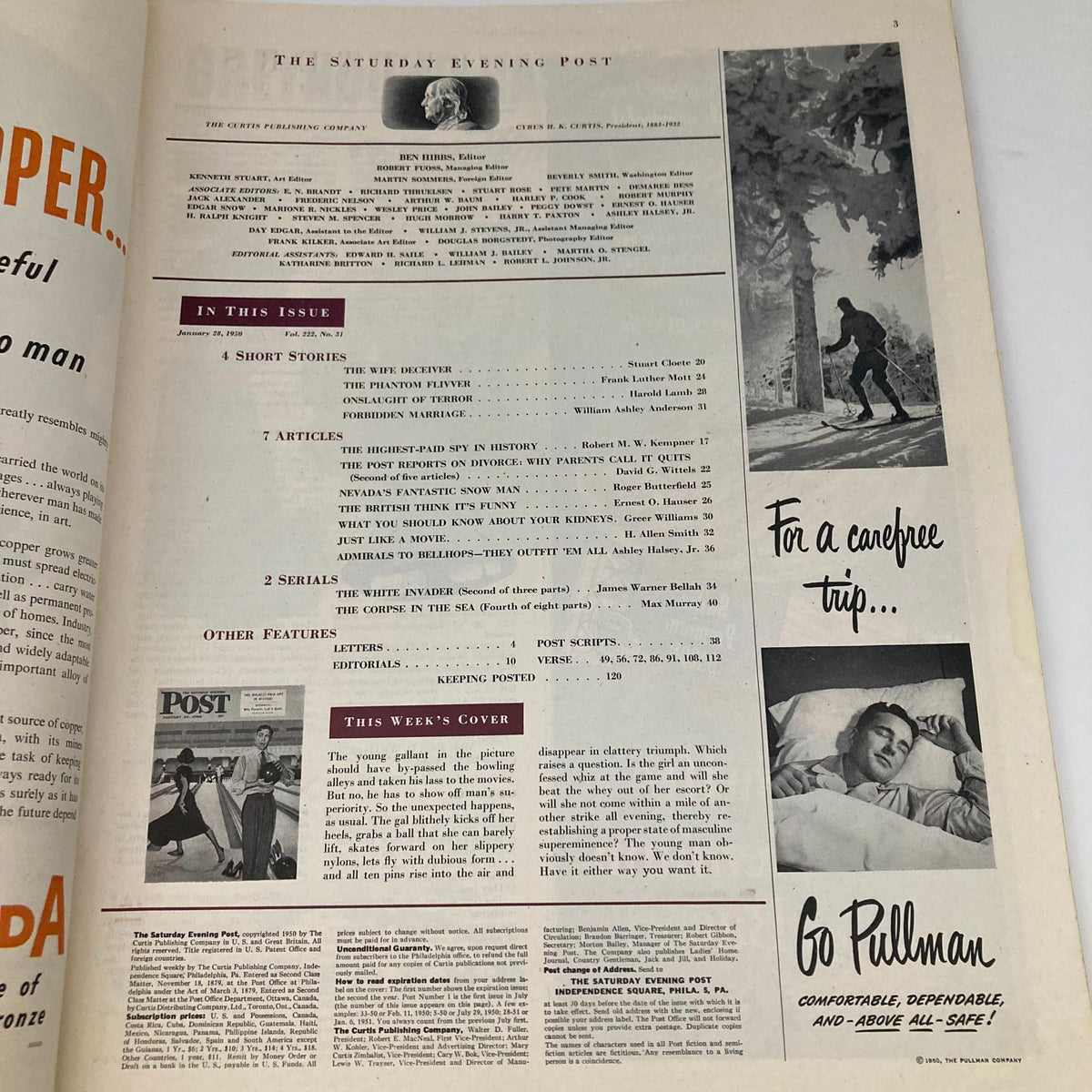
The magazine’s “This Week’s Cover” commentary expands the scene by describing the young man as a gallant who should perhaps have taken his companion to the movies instead of trying to display male superiority at a bowling alley. The woman selects a ball she can barely lift, slides forward on slippery nylon stockings, and releases it with technically questionable form. Despite that doubtful method, the pins rise and disappear in what the editors call a triumphant clatter. The commentary then asks whether she possesses an undiscovered natural talent or has simply achieved one accidental strike that she will be unable to repeat. Either answer would affect the balance between the couple, leaving her escort uncertain about how the remainder of the evening will develop. The Post’s later account of the artwork explains that the underlying idea came from Stanley Ekman, whose own wife had been outperforming him in a neighborhood bowling league. Details of the interior were observed at bowling alleys in Wilmette and Chicago, connecting Hughes’s imagined couple with recognizable recreational spaces. These circumstances show how the magazine transformed a familiar middle-class leisure activity into a gently satirical study of pride and romantic competition.
The editorial contents give the issue substantial historical importance beyond its humorous cover. Robert M. W. Kempner’s “The Highest-Paid Spy in History” examines the wartime espionage story of Elyesa Bazna, who became known through the German codename Cicero. David G. Wittels continues The Post’s five-part investigation of divorce with an installment titled “Why Parents Call It Quits.” Roger Butterfield profiles James E. Church, the University of Nevada professor and snow-survey pioneer celebrated as “Nevada’s Fantastic Snow Man.” Ernest O. Hauser studies British humor, Greer Williams offers a period medical explanation of kidney health, and H. Allen Smith visits the Western-film community of Pioneertown. Ashley Halsey Jr. examines an organization supplying uniforms to customers ranging from admirals to bellhops. Four complete short stories and two continuing serials bring espionage, family conflict, aviation, historical adventure, romance, and mystery into the same weekly publication. Together, the illustration and written contents make this edition a revealing part of the Saturday Evening Post magazine archive and the wider record of magazines published in 1950.
About the Publication
The Saturday Evening Post is an American general-interest magazine historically associated with fiction, reporting, social commentary, humor, advertising, and narrative cover illustration. The publication entered its defining mass-circulation period after Cyrus H. K. Curtis acquired it in 1897. Under editors including George Horace Lorimer and Ben Hibbs, it developed a weekly format designed to reach a broad national readership. Individual issues commonly combined complete short stories, serialized novels, political reporting, international affairs, medicine, sports, travel, editorials, poetry, cartoons, and reader correspondence. Fiction remained one of its principal attractions because established and developing writers could reach millions of readers through a single appearance. The Post also became one of the most influential showcases for twentieth-century American commercial illustration. Cover artists included Norman Rockwell, J. C. Leyendecker, John Falter, George Hughes, Coby Whitmore, John Clymer, Stevan Dohanos, and Constantin Alajálov. Hughes became especially recognized for sophisticated domestic and social scenes involving couples, families, fashionable interiors, public outings, and moments of quiet embarrassment. His paintings frequently rely on facial expression, gesture, clothing, and carefully positioned objects rather than exaggerated physical action. By 1950, the magazine functioned simultaneously as a literary platform, national news source, advertising medium, and visual interpreter of American life. Surviving issues now provide primary-source evidence of illustration, popular literature, political attitudes, consumer culture, recreation, gender expectations, and mid-century publishing design.
Key Highlights Inside
- George Hughes’s “Bowling Strike” cover depicts a young woman unexpectedly outperforming the man who brought her to the bowling alley. Her abandoned heels, stockinged approach, scattered pins, and companion’s stunned expression communicate the entire story without a printed dialogue. The scene humorously challenges the assumption that experience, technique, or masculine confidence will necessarily determine the result.
- Robert M. W. Kempner’s “The Highest-Paid Spy in History” concerns Elyesa Bazna, the wartime spy widely known by the German codename Cicero. Bazna obtained secret material while working in the household of the British ambassador in neutral Turkey and passed information to Nazi Germany. The article should be read as a 1950 reconstruction of an espionage case whose evidence, payments, motives, and strategic value continued to attract debate.
- “The Post Reports on Divorce: Why Parents Call It Quits” by David G. Wittels is the second installment of a five-article investigation. Its placement on the cover shows that marital breakdown and its effects on children were considered matters of major national interest rather than purely private difficulties. The article’s terminology, assumptions, interviews, and proposed explanations should be interpreted within the social and legal environment of 1950.
- Roger Butterfield’s “Nevada’s Fantastic Snow Man” profiles James E. Church, a University of Nevada professor who became a pioneer of systematic snow surveying. Church developed methods and equipment for measuring the water contained in mountain snowpack, helping improve forecasts of seasonal runoff and water supply. The feature connects scientific observation, mountaineering, agriculture, flooding, and the practical management of water in the American West.
- Ernest O. Hauser contributes “The British Think It’s Funny,” while Greer Williams writes “What You Should Know About Your Kidneys.” The first examines British humor and the cultural circumstances in which it operated, while the second translates contemporary medical information for a general readership. Both articles should be read as period documents because their examples, language, and professional conclusions reflect the knowledge and attitudes available in 1950.
- H. Allen Smith’s “Just Like a Movie” visits Pioneertown, California, a community developed around permanent sets for Western motion pictures. Its buildings could function both as real businesses and as locations for productions requiring streets, saloons, stables, and other frontier settings. The feature documents the unusual boundary between everyday community life and the manufactured geography of the Hollywood Western.
- Ashley Halsey Jr.’s “Admirals to Bellhops—They Outfit ’Em All” examines the large-scale business of producing or supplying uniforms for widely different occupations. The title places senior naval officers and hotel employees at opposite ends of a commercial range united by standardized clothing. Its photographs and reporting can be studied for period information about manufacturing, occupational identity, design, service work, and institutional appearance.
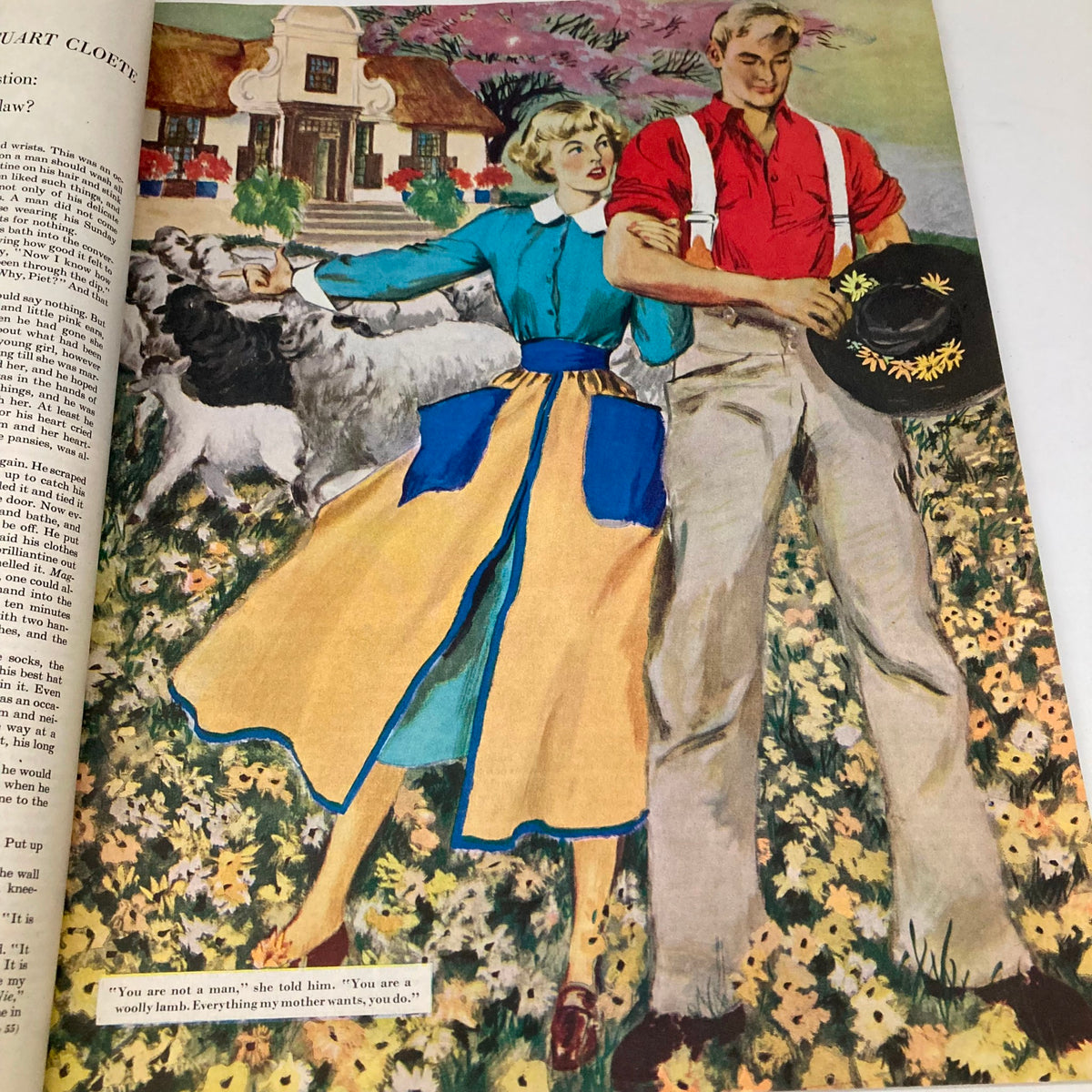
- The short-fiction section includes “The Wife Deceiver” by Stuart Cloete and “The Phantom Flyer” by Frank Luther Mott. Harold Lamb contributes “Onslaught of Terror,” while William Ashley Anderson supplies “Forbidden Marriage.” The confirmed titles and authors establish a varied literary program, but the characters, settings, and resolutions should not be reconstructed without consulting the complete stories.
- James Warner Bellah’s “The White Invader” appears in the second of three installments, while Max Murray’s “The Corpse in the Sea” reaches the fourth of eight parts. The different positions of the two serials allowed readers to approach one narrative near its conclusion while continuing another through the middle of a longer mystery. Earlier and later issues are necessary to preserve the full development of both works.
Condition & Rarity
The supplied description characterizes this January 28, 1950 issue as being in Excellent overall condition. Light wear is reported and is described as consistent with the age of the publication. The term “Excellent” should be understood as the listing’s general assessment rather than a standardized or independently certified numerical grade. The magazine shown in the accompanying photographs is identified as the exact example represented rather than a stock image of another copy. Those photographs should therefore remain the principal evidence for evaluating the cover, corners, edges, spine, binding, and visible surface condition. No detailed written inventory has been supplied concerning creases, rubbing, marks, fading, paper toning, corner wear, or spine stress. The presence or absence of a subscriber mailing label is also not stated and should not be inferred from archival photographs of other examples. No definite information has been provided concerning tears, detached pages, clipping, handwriting, staining, moisture exposure, tape repairs, missing advertisements, or restoration. Those characteristics should remain unconfirmed unless they can be established through the photographs or direct physical inspection. A plastic protective covering is reported to accompany the magazine and may reduce exposure to dust and unnecessary handling. That covering is a later preservation accessory rather than an original component of the January 1950 publication. Historical and collector interest is best assessed through the Hughes cover, documented articles and fiction, completeness, and actual physical condition rather than through an unsupported claim of exceptional rarity.
Looking for More Issues Like This?
Additional examples of narrative American illustration can be explored through the Saturday Evening Post magazine collection. Comparing George Hughes covers across several years reveals how he approached courtship, marriage, family life, recreation, shopping, restaurants, travel, and social embarrassment. His polished couples and interiors can also be considered beside Coby Whitmore’s romantic figures, John Falter’s broader environments, and Norman Rockwell’s character-centered storytelling. Bowling covers provide a particularly useful record of clothing, equipment, alley design, dating customs, and the expansion of organized indoor recreation. The January 28 issue can also be studied alongside the four neighboring editions containing the remaining installments of The Post’s divorce series. Espionage researchers may compare Kempner’s Cicero account with later biographies, official records, motion-picture treatments, and other popular histories of wartime intelligence. Environmental historians can place the Church profile within the development of snow surveying, water forecasting, western agriculture, and the long-term management of mountain runoff. Film and regional-history researchers may compare the Pioneertown feature with later accounts of the settlement’s use by filmmakers, residents, tourists, and local businesses. The broader 1950 magazine archive provides complementary perspectives from news, travel, family, entertainment, and business publications. Studying these titles together shows how leisure, marriage, espionage, medicine, science, film production, clothing, and popular fiction coexisted within the same cultural moment. The January 28 Post contributes an especially balanced document by placing Hughes’s lighthearted bowling reversal beside serious investigations of divorce, intelligence, health, water science, and postwar life.