





Description
Collector’s Note – Why This Issue Matters
The October 25, 1952 issue of The Saturday Evening Post features George Hughes’s illustrated cover “St. Bernard in Lamp Shop,” a carefully staged domestic comedy set inside a crowded lighting store. A fashionably dressed woman examines a lamp while her husband stands close behind her and a visibly anxious salesman watches the situation develop. At their feet sits Bernie, a large St. Bernard whose size alone threatens the fragile merchandise surrounding him. The dog appears fascinated by a small decorative figure positioned on one of the display tables. Lamps, shades, cords, ornaments, tables, and narrow walking spaces create an environment in which even an innocent movement could produce widespread damage. Hughes builds suspense without showing the expected accident, allowing viewers to imagine what will happen when Bernie rises or wags his tail. The result is an elegant example of narrative illustration in which posture, scale, expression, and carefully placed objects establish the joke before any printed explanation is read.
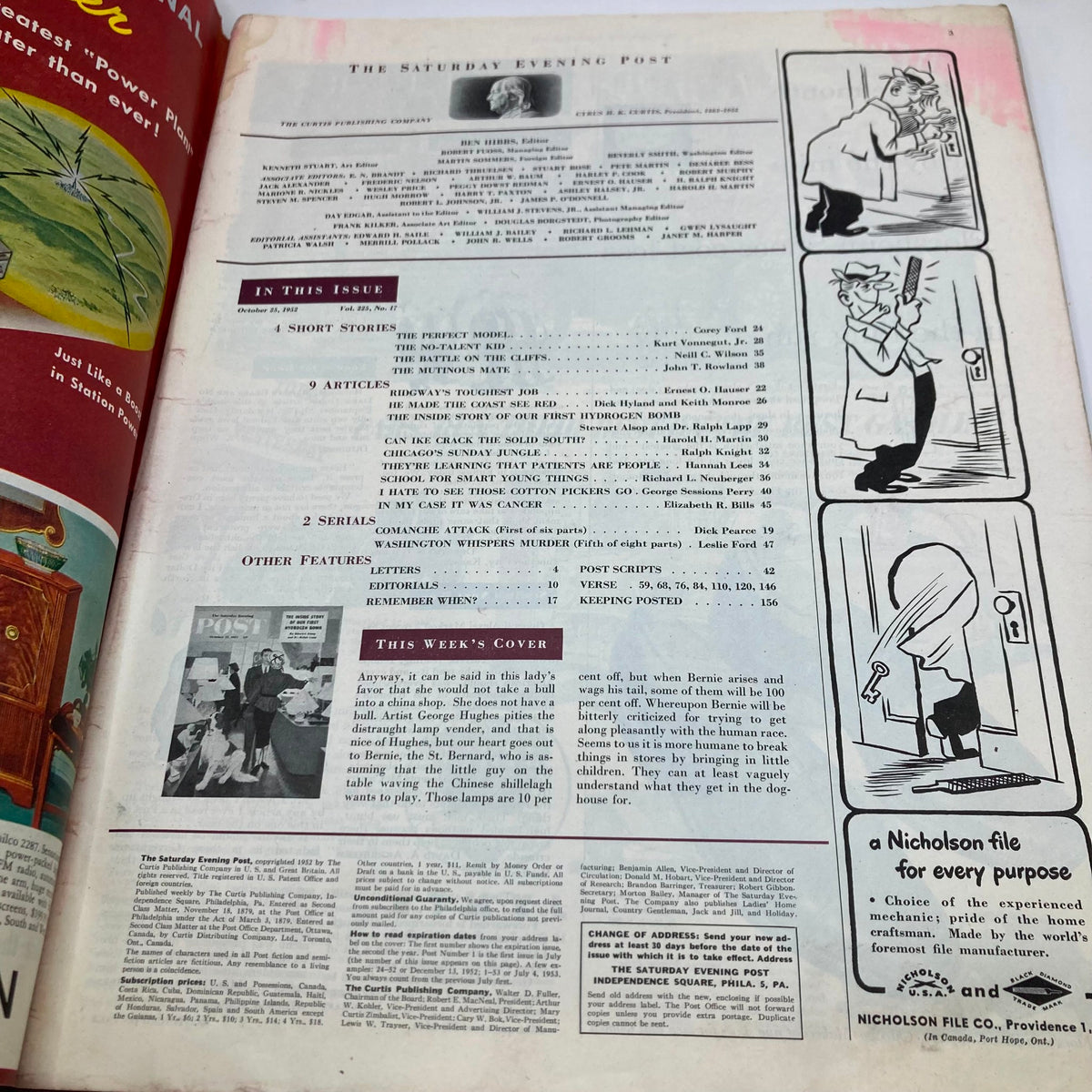
The supplied title “Lady’s Favor” is not the official archival name of the cover. That phrase derives from the opening sentence of the magazine’s “This Week’s Cover” commentary, which observes that it can be said in the woman’s favor that she has not brought a bull into a china shop. The editors then shift their sympathy from the distressed lamp seller to Bernie, who apparently believes the small figure waving a decorative weapon wants to play. The lamps are advertised at ten percent off, but the commentary jokes that several may soon become completely knocked off their tables. Bernie would then be blamed despite approaching the human world with friendly intentions. The note concludes that small children might be more appropriate agents of accidental destruction because they can at least partly understand why they are being punished. This written extension preserves the Post’s characteristic method of adding verbal wit to a visual situation whose likely outcome was already apparent.
The interior contents make the issue historically substantial beyond its humorous cover. Stewart Alsop and physicist Ralph Lapp contribute “The Inside Story of Our First Hydrogen Bomb,” a feature promoted prominently above the masthead. The article appeared immediately before the United States conducted the first full-scale thermonuclear test in the Pacific, placing readers at the threshold of a new and more destructive phase of the atomic age. Harold H. Martin’s “Can Ike Crack the Solid South?” examines Dwight D. Eisenhower’s attempt to weaken long-established Democratic dominance in Southern presidential voting shortly before the 1952 election. Ernest O. Hauser considers General Matthew Ridgway’s difficult responsibilities, while other reports address medicine, education, urban Sunday life, agricultural labor, cancer, and regional sports culture. The fiction section includes an early Kurt Vonnegut story together with work by Corey Ford, Neil C. Wilson, and John T. Rowland. Two continuing serials add crime, western danger, and political mystery to the weekly reading experience. Together, the artwork, election reporting, nuclear discussion, fiction, and social journalism establish this edition as an important part of the Saturday Evening Post archive and the broader collection of magazines published in 1952.
About the Publication
The Saturday Evening Post is an American general-interest magazine historically associated with fiction, journalism, commentary, humor, advertising, and narrative cover art. The publication entered its defining mass-circulation period after Cyrus H. K. Curtis acquired it in 1897. Under editors including George Horace Lorimer and Ben Hibbs, it developed a weekly format intended to serve readers throughout the United States. Individual issues commonly combined complete short stories, serialized novels, political reporting, international affairs, sports, medicine, travel, social commentary, editorials, poetry, and reader correspondence. Fiction remained one of its strongest attractions because established and developing writers could reach a very large national audience through a single appearance. The Post also became one of the most influential showcases for twentieth-century American commercial illustration. Its artists included Norman Rockwell, J. C. Leyendecker, John Falter, George Hughes, Coby Whitmore, Stevan Dohanos, John Clymer, and Constantin Alajálov. Hughes became especially associated with polished domestic situations involving fashionable interiors, married couples, families, social misunderstandings, and moments of impending embarrassment. His paintings frequently depended on facial expression and body language rather than exaggerated action. By 1952, the Post functioned simultaneously as a literary platform, national news source, advertising medium, and visual interpreter of American life. Surviving issues now provide primary-source evidence of illustration, popular literature, political attitudes, consumer culture, gender expectations, and the changing appearance of mid-century publishing.
Key Highlights Inside
- George Hughes’s “St. Bernard in Lamp Shop” cover presents Bernie the dog as the innocent cause of an accident that has not yet occurred. The woman, her husband, and the lamp seller each respond differently to the danger created by his size and curiosity. The official title should be used in archival descriptions, while “Lady’s Favor” may be noted only as wording derived from the accompanying editorial joke.
- “The Inside Story of Our First Hydrogen Bomb” is written by journalist Stewart Alsop and physicist Dr. Ralph Lapp. Its publication placed a discussion of thermonuclear weapons before a mass readership during an especially secretive and consequential stage of American weapons development. The complete article should be read critically for its scientific explanations, security assumptions, civil-defense implications, and understanding of radioactive destruction in 1952.
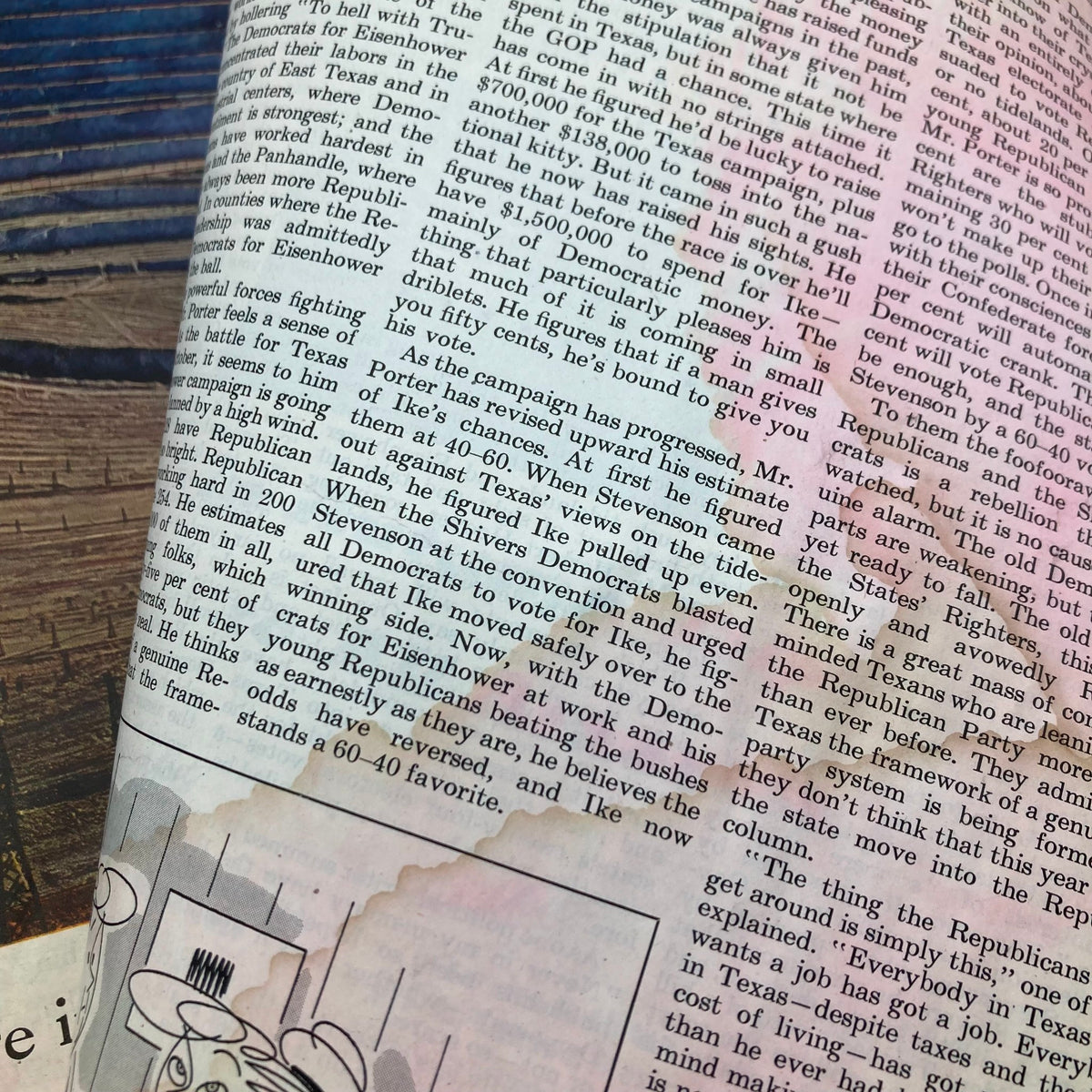
- Harold H. Martin’s “Can Ike Crack the Solid South?” examines Republican candidate Dwight D. Eisenhower’s prospects in a region long associated with Democratic presidential strength. The article appeared shortly before the November 1952 election, when Southern support had become an important part of the national campaign. Its political analysis preserves contemporary uncertainty rather than interpreting the contest through knowledge of the final result.
- Ernest O. Hauser’s article is correctly titled “Ridgway’s Toughest Test,” not “Ridgway’s Toughest Job.” The feature concerns General Matthew Ridgway during a period when his military leadership was connected with Korea, NATO, and broader Western defense responsibilities. Its precise definition of Ridgway’s test should be taken from the original article rather than inferred solely from his public positions.
- Kurt Vonnegut Jr. contributes “The No-Talent Kid,” an early short story published before his later reputation as a major American novelist had been established. Its appearance documents the years when Vonnegut regularly wrote accessible fiction for large-circulation magazines. The story should be studied within the Post’s middle-class fiction market as well as within the development of themes and character types that recur elsewhere in his work.
- The remaining short stories are Corey Ford’s “The Perfect Model,” Neil C. Wilson’s “The Battle on the Cliffs,” and John T. Rowland’s “The Mutinous Mate.” These works bring fashion, conflict, maritime authority, or adventure into the issue’s literary section. Their plots, settings, and conclusions should not be expanded beyond the confirmed titles and authors without consulting the complete texts.
- Hannah Lees contributes “They’re Learning That Patients Are People,” while Elizabeth R. Bills writes “In My Case It Was Cancer.” The two articles approach health through institutional practice and personal experience rather than treating medicine only as abstract science. Their language, treatments, and assumptions belong to the medical culture of 1952 and should not be presented as current health guidance.
- Richard L. Neuberger’s “School for Smart Young Things” examines an educational setting intended for academically advanced students. Ralph Knight’s “Chicago’s Sunday Jungle” addresses a separate aspect of urban life, while George Sessions Perry’s “I Hate to See Those Cotton Pickers Go” turns to labor and agricultural change. Together, these reports connect schooling, city culture, mechanization, work, race, migration, or regional economics within the magazine’s broad social coverage.
- Dick Hyland and Keith Monroe contribute “He Made the Coast See Red,” a sports or personality feature whose exact subject should be confirmed from the printed article. The title relies on energetic promotional language characteristic of the Post’s mid-century article headings. The individual, team, competition, and achievements discussed should not be identified solely by speculation.
- Dick Peace’s “Comanche Attack” begins as the first of six installments, while Leslie Ford’s “Washington Whispers Murder” reaches the fifth of eight parts. The first serial invites readers into a newly opening western or frontier conflict, while the second continues an established mystery involving the national capital. Their serialized form encouraged readers to retain earlier issues and obtain later dates to follow each narrative in full.
Condition & Rarity
The supplied description reports visible signs of age, including creases and marks on the cover and within the interior pages. These characteristics should be treated as documented condition factors rather than described only as generalized vintage charm. The magazine represented in the listing is stated to be the exact example shown in the accompanying photographs. Those images should therefore remain the primary evidence for assessing the cover, corners, edges, spine, binding, and surface condition. No standardized numerical or letter grade is supplied in the description. The precise size, depth, and placement of the reported creases and marks are not fully itemized in writing. The presence or absence of a mailing label should be determined from the photographs rather than assumed from the date or distribution history. No complete statement has been provided concerning tears, detached pages, clipping, writing, staining, water exposure, tape repairs, or restoration. Those characteristics should remain unconfirmed unless visible in the listing photographs or established through direct physical inspection. Completeness is particularly important because the issue contains four short stories, nine articles, two serial installments, and several recurring departments. Preservation of the cover also matters because numerous fragile objects and subtle facial reactions contribute to Hughes’s visual narrative. A plastic protective covering is reported to accompany the magazine, but it is a later storage accessory rather than an original element of the October 1952 issue. Historical and collector interest should be based on the Hughes cover, hydrogen-bomb article, Eisenhower campaign reporting, early Vonnegut fiction, completeness, and actual physical state rather than on an unsupported assertion of exceptional rarity.
Looking for More Issues Like This?
Additional examples of narrative American illustration can be examined through the Saturday Evening Post magazine archive. Comparing George Hughes covers across different years reveals how he used fashion, domestic interiors, family relationships, pets, retail spaces, and social embarrassment to create visual stories. His polished treatment of modern households can be considered alongside Coby Whitmore’s romantic figures, John Falter’s broad environments, and Norman Rockwell’s character-centered scenes. Animal-centered covers provide a particularly useful comparison because dogs, horses, birds, and household pets often become innocent causes of human confusion. The interior fiction offers another path for following Kurt Vonnegut’s early magazine career before the publication of the novels most closely associated with his reputation. Nuclear-history researchers may compare the Alsop and Lapp article with later Post coverage written after thermonuclear testing became publicly confirmed. Political researchers can place the Eisenhower feature beside other campaign articles addressing Adlai Stevenson, Richard Nixon, Harry Truman, and the changing voting patterns of the South. Medical and social historians may examine the articles on cancer, patient care, education, agricultural labor, and city life within their original advertising and editorial setting. The wider 1952 magazine archive supplies complementary perspectives from news, picture, family, entertainment, and business publications. Studying those titles together helps reveal how electoral change, nuclear power, medicine, fiction, consumer culture, and domestic humor coexisted during the same historical moment. The October 25 Post is especially useful because its light cover comedy introduces an issue containing some of the most serious political and technological concerns of the early Cold War.