




Description
Collector's Note – Why This Issue Matters
The April 2003 issue of Slam Magazine featuring Allen Iverson of the Philadelphia 76ers — with original poster intact and no label — is a primary document of one of the most compelling and most culturally consequential individual careers in NBA history at a specific and historically revealing phase of its trajectory. By April 2003, Iverson had been the league's most discussed and most polarizing player for seven consecutive seasons: the 2001 NBA Finals run — in which he led the 76ers to a Game 1 upset victory over the Los Angeles Lakers before losing the series, while winning the regular season MVP and Finals MVP recognition as the smallest player ever to achieve those honors — had established his historical significance beyond any remaining doubt, and the debate about his playing style, his cultural identity, and his relationship to the league's establishment had become one of the central conversations in American sports culture. April 2003 places this issue in the specific season after that peak: the 76ers had not returned to the Finals and were in the process of the roster adjustments that would eventually separate Iverson from the team he had defined, and the specific quality of his celebrity in April 2003 was one of undiminished individual brilliance operating in an increasingly uncertain team context. For collectors building a focused archive of Slam's most historically significant player coverage from the early-2000s NBA era, the Slam magazine collection at OriginalMagazines.com is the most comprehensive resource for issues across the publication's run.
Iverson's specific relationship to Slam Magazine gives this April 2003 issue a collecting dimension that extends beyond his individual basketball significance. Slam had been founded in 1994 precisely to cover the intersection of basketball and hip-hop culture that the mainstream sports press was systematically ignoring or marginalizing, and Iverson — more than any other player of his era — was the figure whose career embodied everything that intersection represented. His cornrows, his tattoos, his baggy clothing, his authentic connection to the streets of Hampton, Virginia, and his refusal to modify his personal aesthetic for the comfort of the NBA's marketing establishment made him simultaneously the league's most commercially valuable individual personality and its most institutionally problematic one. A Slam cover featuring Iverson was always a specific kind of cultural statement — an affirmation that the magazine's readership's relationship to the player was more authentic and more complete than anything the mainstream sports press was offering — and the April 2003 issue is a primary document of that relationship at a specific and historically instructive phase. The 2003 magazines collection at OriginalMagazines.com gathers publications from a year whose NBA culture was being defined by the specific tension between individual brilliance and institutional resistance that Iverson embodied more completely than any other figure.
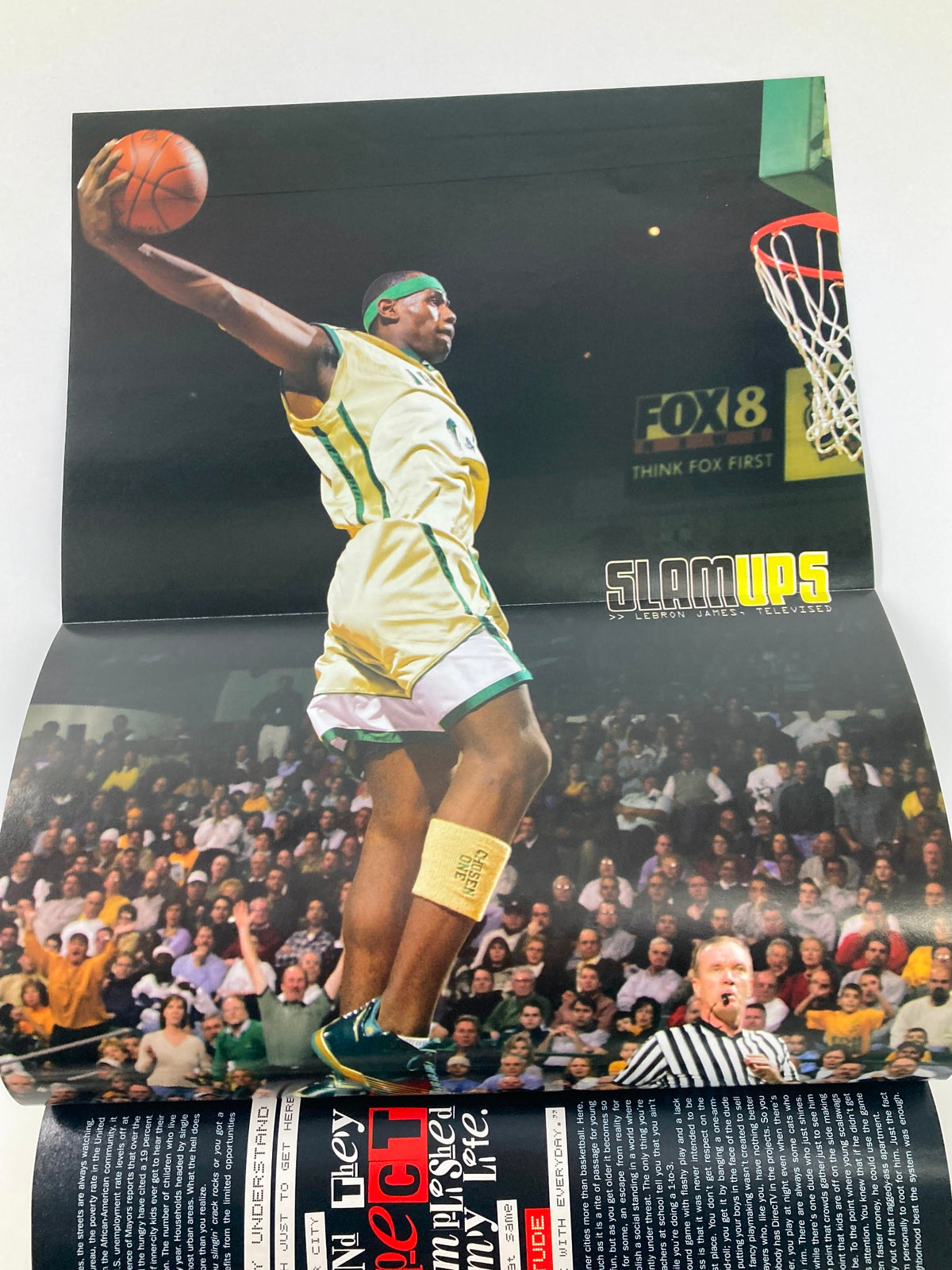
The intact attached poster is the single most significant collecting attribute of this issue, and its survival in attached condition represents a specific and well-understood rarity in the Slam collecting community. The magazine's poster inserts were among the primary visual documents of early-2000s basketball culture — large-format images of the players who defined the era's aesthetic, in the specific photographic style that Slam's visual identity had established as the authoritative look of NBA culture — and an Iverson poster from April 2003 is a primary visual document of his specific athletic and cultural presence at this phase of his career. The vast majority of surviving Slam issues from this era have had their poster inserts removed by original readers for display, making intact-poster copies a specifically identified and consistently valued subset of the surviving pool for any issue from this period.
About the Publication
Slam Magazine was founded in 1994 and established itself as the first major American basketball publication to fully integrate the visual language and cultural values of hip-hop into its editorial identity, covering the NBA and basketball culture with a combination of long-form journalism, irreverent editorial voice, and design aesthetics that distinguished it completely from the mainstream sports press. By April 2003, in its ninth year of publication, the magazine had become the most culturally authoritative basketball publication for the demographic whose relationship to the sport was most directly tied to hip-hop culture, and its coverage of Allen Iverson across the preceding years had been among the most sustained and most culturally significant of any player in the publication's history.
Key Highlights Inside
- Allen Iverson cover — post-2001 Finals peak, early transition documentation — a major cover feature on the Philadelphia 76ers star in the specific season after his 2001 regular season MVP and Finals run, documenting him at the phase when his individual brilliance was operating in an increasingly uncertain team context and when the specific tension between his cultural identity and the NBA's institutional establishment was at its most publicly discussed.
- Original Iverson poster intact and attached — the confirmed survival of the original poster in attached condition is the most significant collecting attribute of this issue, distinguishing it from the substantial majority of surviving examples whose poster inserts were removed by original recipients and providing a primary large-format visual document of Iverson's athletic presence in the specific photographic aesthetic of early-2000s Slam.
- Philadelphia 76ers coverage — franchise at post-Finals crossroads — coverage of the 76ers organization at the specific phase when the roster decisions that would eventually separate Iverson from the team were beginning to take shape, providing primary documentation of the franchise's trajectory at a historically significant transitional moment.
- Newsstand edition, no label — confirmed clean cover presentation — the confirmed newsstand origin and absence of address label places this issue in the more desirable subset of surviving copies, preserving the Iverson cover portrait in its fully unobstructed state and distinguishing it from the labeled subscriber copies that represent a significant portion of what survives from any given Slam issue of this era.
- Very Good condition — favorable profile for active-readership category — VG condition for a Slam issue from 2003 represents a meaningfully more favorable preservation state than the typical surviving example from this category, which was produced for active readership by a young audience rather than for collector preservation.
Condition & Rarity
Very Good condition with light wear, intact attached poster, no address label, and a plastic protective covering represents a particularly favorable condition profile for a twenty-three-year-old basketball magazine produced for active readership by a young audience. The intact poster is the most significant single condition attribute — distinguishing this issue from the majority of surviving examples in the most collecting-relevant way and representing a survival that required either collector-oriented original acquisition or unusually careful preservation. Light wear is honest and expected at this age. The newsstand no-label presentation preserves the Iverson cover in its undisturbed state. The plastic protective covering confirms deliberate archival effort. For a Slam Iverson cover from the early-2000s phase of his career — one of the most culturally significant periods in the most culturally consequential individual career of the magazine's defining era — this combination of intact poster, no label, and Very Good condition represents a meaningfully more favorable profile than what the majority of surviving examples from this issue can offer.
Looking for More Issues Like This?
Allen Iverson Slam covers from the early 2000s — the years immediately following his 2001 MVP and Finals run and during the specific period when his relationship to the NBA's cultural establishment was most actively contested — are among the most historically significant and most collecting-significant issues in the magazine's run, and the April 2003 number with its intact poster and no-label newsstand condition is a particularly complete example. Those assembling a serious collection of Slam's most historically significant covers will find the Slam magazine collection at OriginalMagazines.com the most comprehensive place to browse. The 2003 magazines collection offers essential context from a year whose NBA culture was being shaped by the specific tensions and individual brilliances that defined the early-decade game.