


Description
Collector's Note – Why This Issue Matters
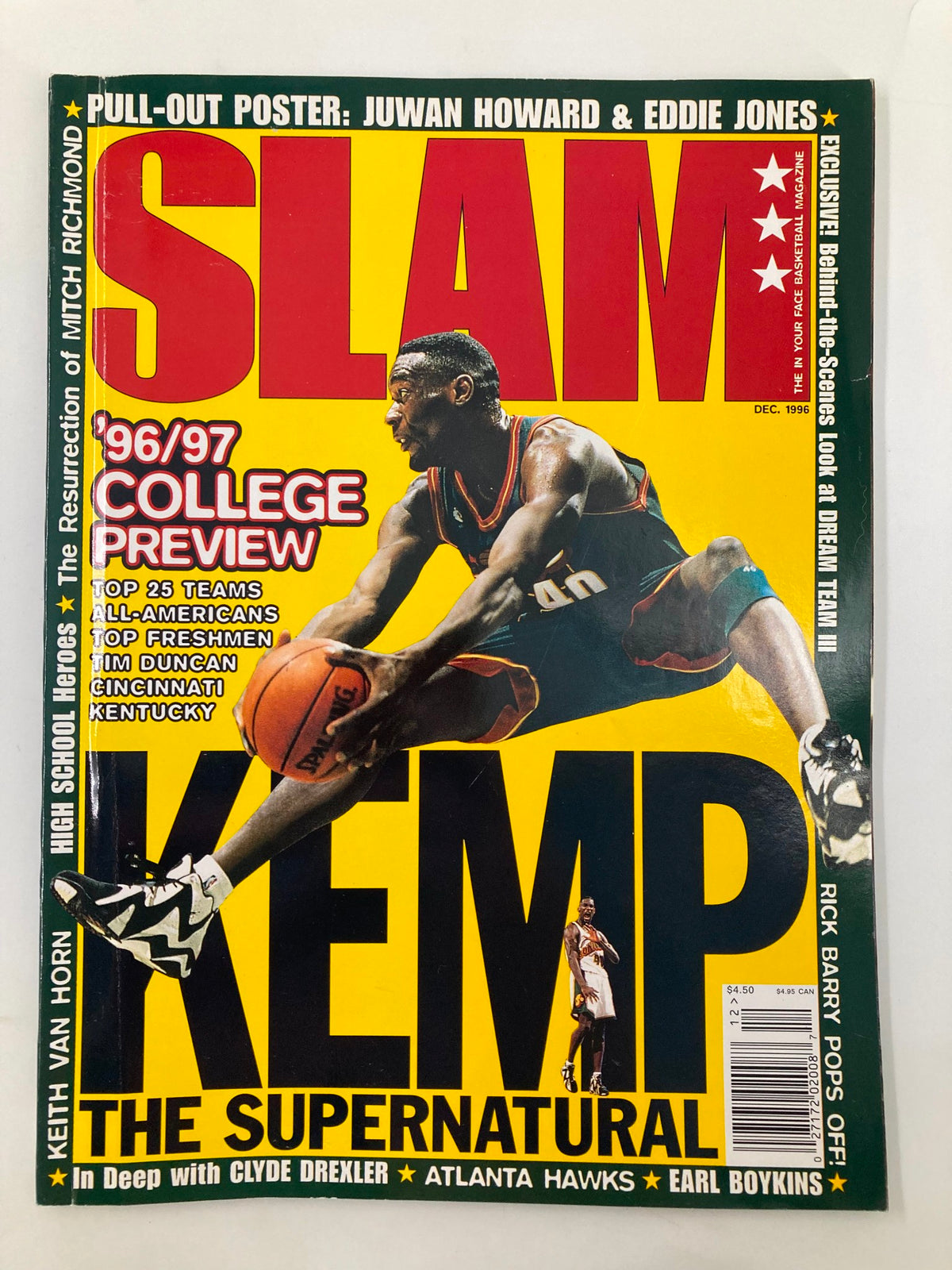
The December 1996 issue of Slam Magazine featuring Shawn Kemp of the Seattle SuperSonics arrives at one of the most significant moments in both Kemp's career and the franchise's history. The 1995–96 Seattle SuperSonics had just completed one of the most celebrated seasons in the franchise's history, finishing with a 64-18 record and reaching the NBA Finals before losing to the Chicago Bulls dynasty in six games. That Finals appearance — against a Bulls team that had just finished a 72-10 regular season — had brought the SuperSonics and their core of Kemp, Gary Payton, and Detlef Schrempf to the attention of the entire basketball world. Kemp in particular had been at the center of that run, his combination of explosive athleticism, rim-rattling dunks, and improved offensive repertoire making him one of the most visually exciting players in the league and a genuine franchise cornerstone.
Shawn Kemp in December 1996 was at the apex of his public profile. The Finals exposure had made him a national figure in a way that his previous years of excellence in Seattle had not — the SuperSonics had been a winning team, but the Finals platform gave Kemp a visibility that translated directly into commercial endorsements, increased All-Star consideration, and the kind of popular cultural recognition that Slam's covers were designed to document and amplify. His particular style of play — the aerial theatrics, the emotional intensity, the spectacular dunks that became highlight reel staples — was exactly what Slam had been founded to celebrate, and a December 1996 cover represents the magazine putting one of the era's most electrifying players on its platform at the peak of his fame. For collectors building archives of Slam Magazine's 1990s NBA coverage, this issue is a primary document of the mid-decade Sonics and one of the most visually dynamic players of the era.
The inclusion of a Shawn Kemp poster with this issue adds a meaningful layer of collectibility beyond the magazine itself. Slam's bound-in and insert posters were a significant part of the publication's appeal to its young readership, and they are frequently separated from their host issues over time — making intact copies with the poster still present considerably more complete as collector artifacts. December 1996 was also a culturally rich moment for the NBA broadly: Michael Jordan and the Bulls were in the midst of their second three-peat, the league's global expansion was accelerating, and the competitive landscape that would define the late 1990s was fully in view. Collectors interested in the NBA and sports magazine landscape of 1996 will find this issue a visually and historically specific piece of that era.
About the Publication
Slam Magazine was founded in 1994 and quickly established itself as the most culturally attuned basketball publication in America, distinguished from more traditional sports magazines by its street-level editorial voice, bold photography, and deep engagement with the hip-hop and urban culture that surrounded the NBA during its commercial and creative peak in the mid-to-late 1990s. Its covers featured the league's most charismatic and visually exciting players in high-impact photography that captured the athleticism and personality of the game in ways that conventional sports journalism could not. Its issues from the 1990s are now collected as primary artifacts of both NBA history and the broader popular culture of the decade.
Key Highlights Inside
- Cover feature on Shawn Kemp of the Seattle SuperSonics — documenting one of the NBA's most explosive and athletically gifted power forwards at the peak of his fame, in the months following the Sonics' memorable run to the 1996 NBA Finals.
- Shawn Kemp poster — an insert poster that represents a distinct collectible element beyond the magazine's editorial content, and which remains present in this issue.
- Coverage of the Seattle SuperSonics during the 1996–97 season — documenting the franchise's attempt to build on its Finals appearance and remain competitive in a Western Conference still defined by the Bulls' dynasty.
- Broader NBA coverage typical of a December 1996 Slam issue, reflecting the league at one of its most commercially and athletically dynamic periods.
Note: Specific interior articles and features beyond the cover story and poster are unconfirmed for this issue. The above reflects what is verifiable from the listing description, cover subject, and publication format.
Condition & Rarity
Graded Good with minor wear consistent with age — an honest condition profile for a monthly sports magazine now thirty years old. The no-label designation identifies this as a newsstand copy rather than a subscriber edition, which is the preferred form for display-oriented collectors and preserves the Kemp cover as originally presented. The most significant condition consideration for this specific issue is the status of the poster: intact, undamaged posters substantially enhance the completeness and collector value of surviving copies, as inserts of this kind are routinely removed and separately displayed, making their continued presence in an otherwise Good-grade issue a meaningful positive attribute. A protective plastic sleeve provides appropriate ongoing preservation for both the magazine and the poster. Kemp and SuperSonics issues of Slam from the mid-1990s Finals era attract collectors across basketball memorabilia, vintage sports magazine, and 1990s NBA culture archives simultaneously.
Looking for More Issues Like This?
Mid-1990s Slam issues covering the SuperSonics and Shawn Kemp from the Finals era are a specific and actively collected category in vintage basketball magazine history, and a Good-grade no-label copy with the poster intact is a complete and presentable find. The full Slam Magazine collection at OriginalMagazines.com is the best place to explore available issues across the magazine's celebrated run of NBA coverage. For collectors building a broader documentary archive of 1990s basketball culture in print, the complete 1996 magazine collection offers a wide range of titles from the year the Bulls won 72 games and the SuperSonics came closest to stopping them.