
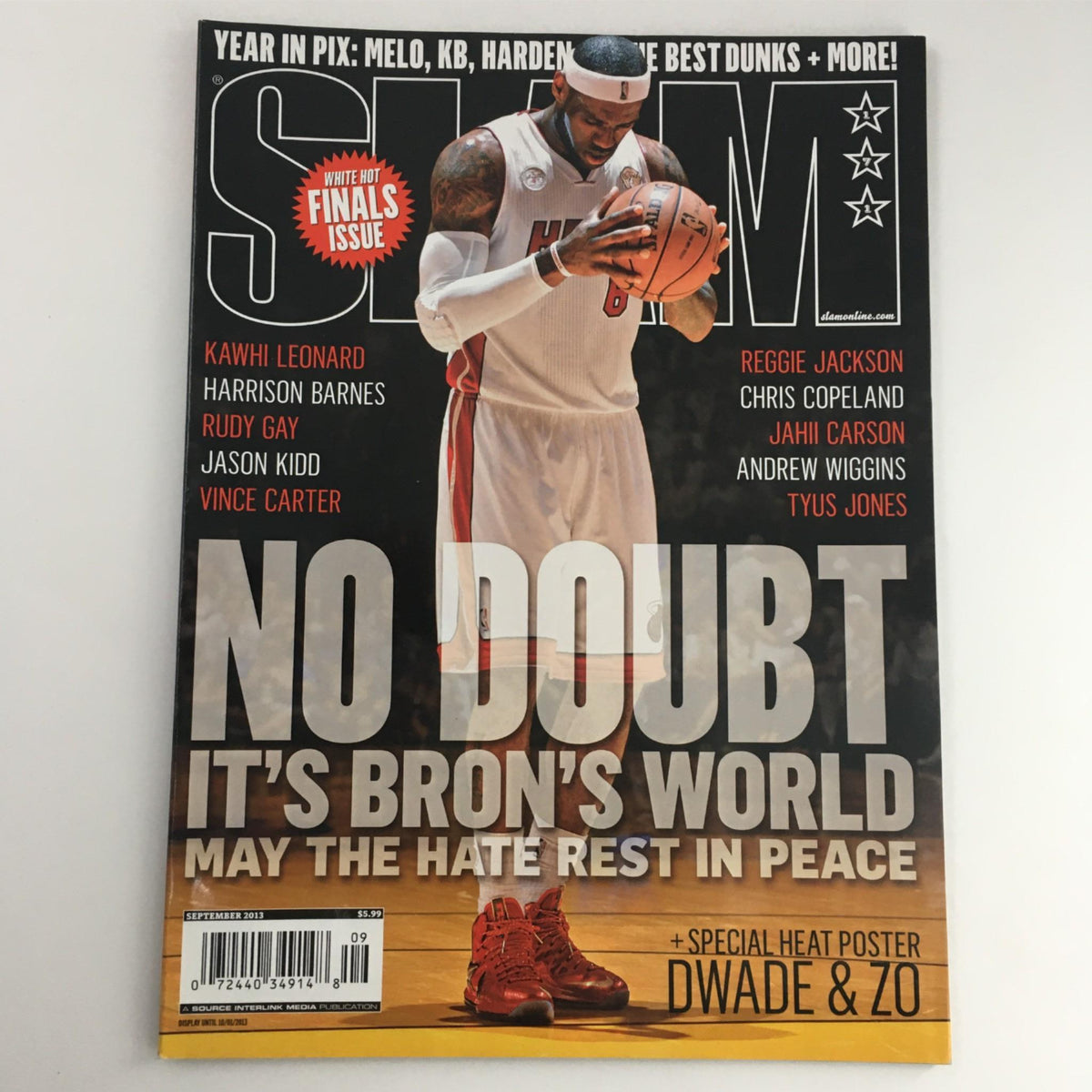


Description
Collector's Note – Why This Issue Matters
The September 2013 issue of Slam magazine featuring LeBron James of the Miami Heat arrives at what is, without question, one of the defining moments of his extraordinary career — and one of the most dramatic single months in recent NBA history. The summer of 2013 was the immediate aftermath of the Heat's second consecutive NBA championship, won in June of that year in a seven-game Finals against the San Antonio Spurs that produced one of the most celebrated individual performances in championship history. Game 6 of that series — in which James scored 32 points to stave off elimination and force the deciding game — is widely considered among the greatest individual playoff performances of the modern era, and Ray Allen's corner three-pointer with 5.2 seconds remaining to tie that game has become one of the most replayed moments in basketball memory. A Slam cover featuring James in his Heat incarnation in September 2013 is a document produced at the absolute peak of the Miami dynasty he led — a two-time defending champion, a two-time Finals MVP, a figure at the height of his powers and his public prominence. For collectors who focus on vintage magazines featuring LeBron James, this cover represents one of the most historically significant and precisely timed documents of his career available in the collector market.
The September 2013 publication date places this issue at a specific and consequential juncture in the LeBron James story that rewards careful attention. He had just completed his fourth MVP season and his second championship with the Heat, and the narrative surrounding him — which had been so bitterly contested since "The Decision" in 2010 — had shifted decisively and perhaps permanently in his favor. The 2012 championship had silenced the most vocal doubters; the 2013 championship, won under the most dramatic possible circumstances, had transformed the conversation entirely. James was no longer being compared unfavorably to Jordan and Bird; he was being assessed on his own terms as one of the greatest players in the history of the sport, a transformation in public perception that this Slam cover both reflected and reinforced. The magazine had covered his career since his high school days, and a September 2013 cover captures the culmination of that long documentary arc — James as defending champion, at thirty years old, with his legacy secured and his peak years still ahead of him. The broader Slam magazine archive contains multiple James covers across his career, but the Heat dynasty era covers carry a specific historical weight that distinguishes them from both the earlier promise and the later Cleveland return.
The Miami Heat context of this cover adds a dimension that is significant for collectors of this specific chapter of LeBron's career. The Big Three era — James, Dwyane Wade, and Chris Bosh — had produced four consecutive Finals appearances and two championships by the time this issue was published, and the team's combination of James's physical dominance, Wade's veteran championship experience, and Bosh's versatility represented one of the most deliberately constructed and intensely scrutinized rosters in NBA history. September 2013 comes before the dynasty's end — James would leave for Cleveland after the 2013–14 season, making the Heat years a discrete and complete chapter in his story — and a cover from this precise moment captures him at the center of an experiment that had been controversial, successful, and historically consequential in ways that continue to shape how the NBA's superstar free agency landscape operates.
About the Publication
Slam magazine, founded in 1994, had by 2013 maintained nearly two decades of cultural authority as the defining voice of basketball culture for fans who wanted coverage that combined serious NBA journalism with the visual language and cultural sensibility of hip-hop and urban American life. Its relationship with LeBron James had been long and consistent — the magazine had tracked his career from his high school days at St. Vincent–St. Mary through his Cleveland years and into the Miami era — and its covers featuring James across this period constitute one of the most complete photographic and journalistic records of his career in print media. By 2013, Slam's audience included both longtime readers who had grown up with the publication and a new generation of basketball fans for whom James himself was the central figure of the sport they had come to love.
Key Highlights Inside
- A cover feature on LeBron James of the Miami Heat, produced in the immediate aftermath of the Heat's second consecutive NBA championship and James's second Finals MVP award — arriving at the precise moment of his highest public standing and his most complete vindication as a player whose talent, competitive will, and leadership had been scrutinized and debated more intensely than that of any other athlete of his generation.
- Editorial coverage reflecting the specific landscape of the NBA heading into the 2013–14 season — a league that was processing the Heat dynasty's dominance while watching the emergence of the Oklahoma City Thunder, the San Antonio Spurs' continued excellence, and the young talent across the Western Conference that would define the competitive environment of James's final Miami season.
- Visual content consistent with Slam's reputation for high-quality basketball photography — a LeBron James Heat cover in 2013 would have brought the full resources of the magazine's visual identity to bear on the most discussed and most photographed player in the sport, producing images that documented both the athletic excellence and the cultural significance of his Miami years.
- Content reflecting Slam's characteristic approach to basketball culture in the early 2010s — a period when social media was transforming how players communicated with fans and how basketball culture circulated beyond traditional media, and when the magazine was navigating the relationship between its print identity and a rapidly changing media landscape.
Note: Specific interior article titles, additional featured players, bylines, and further editorial details beyond the cover story are unconfirmed for this issue from available sources. The highlights above reflect verifiable historical context drawn from the cover subject, publication date, and the well-documented editorial character of Slam Magazine during this period.
Condition & Rarity
This copy is rated near mint and is identified as a no-label newsstand edition that has been bagged and boarded — the strongest possible combination of condition grade and preservation methodology for a magazine collector market. Near mint indicates a copy showing no meaningful wear, with original cover gloss, color fidelity, and page integrity consistent with a publication that has been handled minimally and stored correctly from early in its life. The bagged-and-boarded format provides structural support against spine stress and page warping while creating a sealed microenvironment that significantly reduces exposure to humidity, light, and airborne contaminants — the primary factors that degrade coated magazine paper over time. The no-label newsstand provenance means the cover surface is presented exactly as printed, without any subscription processing marks or adhesive residue. For a LeBron James Miami Heat Slam cover from the immediately post-championship summer of 2013, a near mint bagged-and-boarded no-label example represents the ideal preservation outcome — the kind of condition that serious collectors of contemporary sports memorabilia actively seek and that ensures the issue retains its full display and collectible value for the long term.
Looking for More Issues Like This?
A near mint bagged-and-boarded LeBron James Slam cover from his peak Miami Heat championship era is one of the stronger condition finds available for collectors building a serious archive of his career's most consequential chapter — if this September 2013 issue has already found a home, the dedicated LeBron James magazine collection at OriginalMagazines.com is the natural first resource for tracking down other significant covers across the full arc of his remarkable career. The broader vintage Slam Magazine collection is worth exploring for other landmark covers from the publication's two-decade-plus run documenting basketball culture at its most compelling and culturally resonant — a collection that spans the Jordan era through the present and captures the sport's greatest figures at their most significant moments.