


Description
Collector's Note – Why This Issue Matters
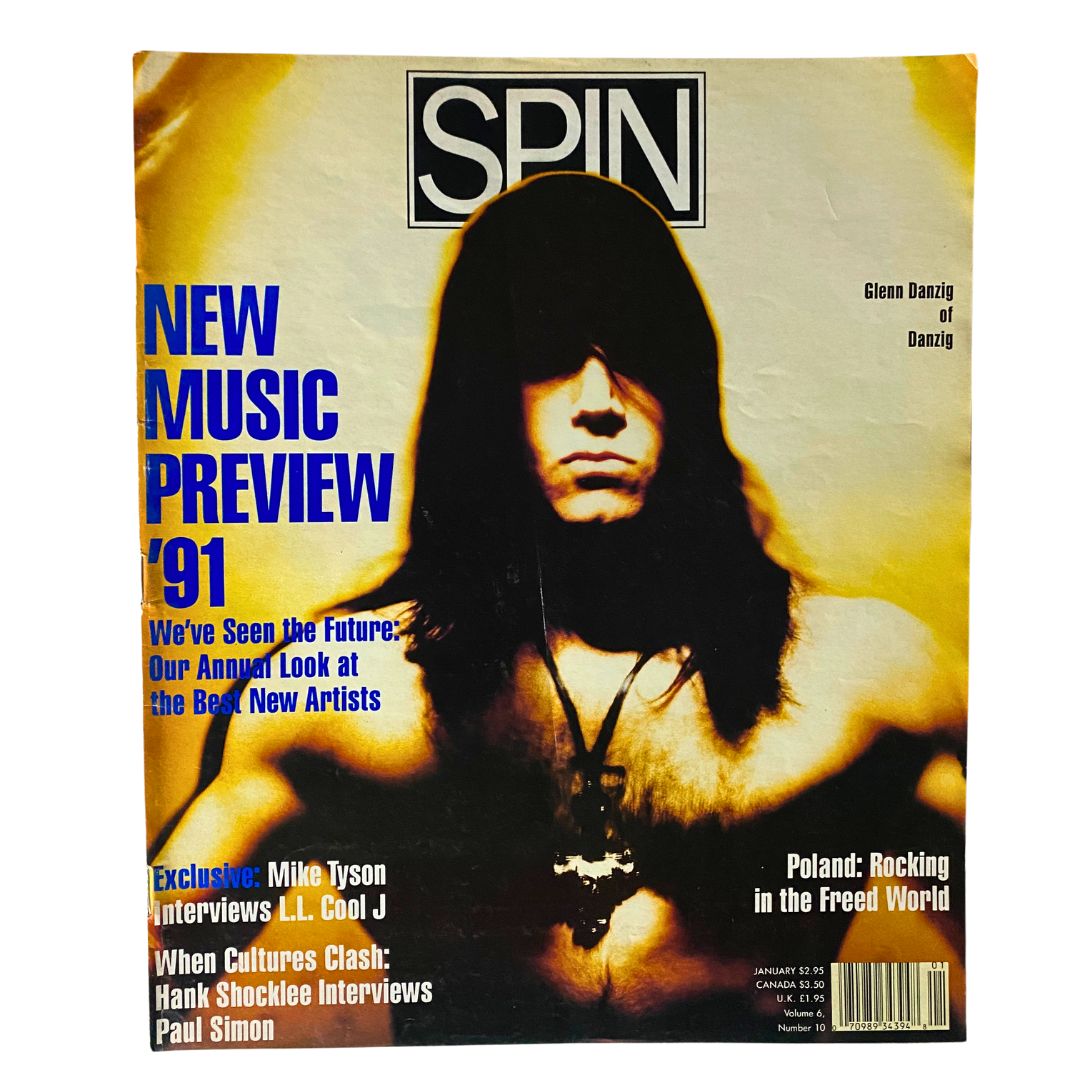
The January 1991 issue of Spin Magazine — Volume 6, Number 10 — is a document of a specific and genuinely fascinating moment in heavy music's relationship with the mainstream press. Glenn Danzig's appearance on the cover marks a point at which the man and his band had crossed a threshold that very few artists operating in his corner of the underground had managed before. Danzig the band had released their third album, Lucifuge, in 1990 on Def American Recordings, and it had pushed the project further into mainstream visibility than anything in Danzig's prior catalog — including his years fronting the Misfits and Samhain — had ever reached. A Spin cover in January 1991 was not a token gesture toward the metal audience. It was a genuine editorial statement that Glenn Danzig had become a figure the broader alternative music readership needed to understand. For collectors tracing the arc of his public presence across print media, the depth of available material in the Spin Magazine archive reflects just how seriously the publication took artists operating at the intersection of rock's harder and more adventurous edges throughout this era.
January 1991 is a charged date in music history for reasons that extend well beyond any single artist. The alternative rock ecosystem was in a state of intense, almost pressurized anticipation — Nirvana's Nevermind was still nine months away, but the underground infrastructure that would make its crossover possible was already fully operational, and publications like Spin were the connective tissue holding it together. Danzig occupied a genuinely unusual position within that world: too heavy and too occult-focused for mainstream pop audiences, too polished and melodically sophisticated for the pure underground, and too historically significant — given his Misfits lineage — to be treated as a simple hard rock act. A cover story at this particular moment in the magazine's history captures that complexity in amber. The full range of 1991 magazines from this period collectively document the twelve months immediately preceding alternative rock's commercial explosion, making them unusually valuable for anyone serious about understanding how that shift actually happened at the level of music journalism and editorial taste-making.
Glenn Danzig's cultural footprint in 1991 was built on layers that most of his peers simply could not claim. He had already been a foundational figure in punk and horror punk through the Misfits, had bridged that world toward something darker and more ritualistic with Samhain, and had then assembled Danzig as a vehicle for a sound that drew equally on Black Sabbath, blues, and Elvis Presley — a combination that should not have worked and yet produced one of the most distinctive bodies of work in American heavy music. By the time this issue reached newsstands, he had been operating at a serious artistic level for over a decade, and the Spin cover represented the mainstream press finally catching up to what the underground had known for years. That convergence — of critical recognition, commercial momentum, and genuine subcultural credibility — is precisely what makes this issue worth seeking out as a primary document of the era.
About the Publication
Spin Magazine was founded in 1985 by Bob Guccione Jr. as a direct challenge to the dominance of Rolling Stone, which many in the music world felt had grown too conservative and too tied to the classic rock establishment to adequately cover the new sounds emerging from punk, post-punk, hip-hop, and alternative rock. From its earliest issues, Spin positioned itself as the more adventurous, more culturally alert alternative — willing to put artists on its cover who would never have made it past Rolling Stone's editorial gatekeepers, and willing to treat underground credibility as a genuine value rather than a marketing liability. By Volume 6 in 1991, the magazine had developed a loyal readership among exactly the kind of music fan who cared about what was happening at the edges of the mainstream before it became the mainstream — college radio listeners, independent record store regulars, and the broader community of people who understood that the most interesting American music of the moment was being made far outside the major label system. Its editorial format balanced long-form feature writing with reviews, photography, and cultural commentary, and its cover selections in this period read today as a remarkably accurate map of which artists were about to matter most.
Key Highlights Inside
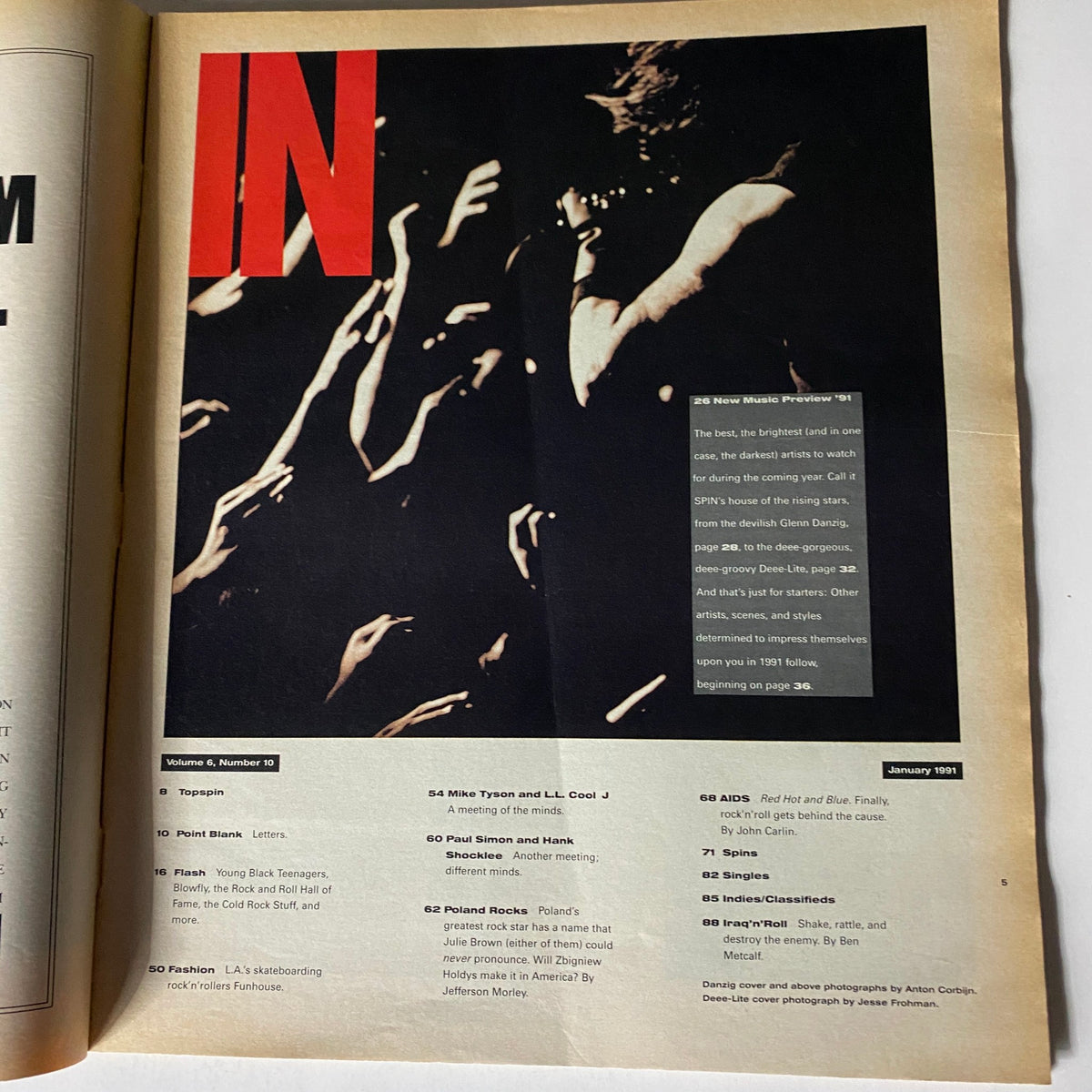
- Glenn Danzig cover feature — A cover appearance in Spin in January 1991 would have been accompanied by substantive interior coverage commensurate with the editorial weight the magazine placed on its cover selections. Danzig at this moment had the Lucifuge album and its accompanying touring cycle as the primary news hook, placing the feature at the intersection of a career retrospective and a current-moment profile of one of heavy music's most intellectually serious figures.
- Documentation of Danzig's post-Misfits legacy — Any serious profile of Glenn Danzig in this period would have necessarily engaged with his full career arc: the Misfits' foundational role in horror punk, the transitional work of Samhain, and the fully realized vision of Danzig the band. That historical depth is part of what distinguishes coverage of him from coverage of his contemporaries and gives this issue lasting reference value.
- Snapshot of alternative rock's pre-breakthrough moment — January 1991 Spin issues capture the magazine's editorial voice and taste at the precise moment before Nirvana's Nevermind reshaped the entire landscape. The surrounding coverage — reviews, features, and cultural commentary — reflects what serious music journalism looked like when alternative rock was still genuinely alternative.
- Early 1990s Spin visual identity — The magazine's design language in this period was sharp, aggressive, and distinctly of its moment — photography and layout choices that reflected the aesthetic sensibilities of the underground music world it was documenting rather than the glossier production values of more mainstream competitors.
- Note: Specific interior article titles, additional featured artists, and the full editorial contents beyond the confirmed cover subject have not been independently verified for this issue. The highlights above reflect what is documentable from the cover identification, publication history, and Glenn Danzig's career timeline at this date.
Condition & Rarity
This issue is presented without a mailing label, which is a meaningful distinction for Spin Magazine from the early 1990s. The publication operated primarily on a subscription model throughout this era, and the overwhelming majority of surviving copies carry address labels applied directly to the front cover — labels that after three decades have typically bonded to the surface in ways that make clean removal impossible without damaging the underlying print. A label-free copy indicates newsstand origin or, in rarer cases, a subscription copy from which the label was removed very close to the time of original receipt. Either way, a clean cover substantially elevates presentation quality relative to the typical surviving example of any given issue from this period. The plastic protective covering described in this listing is consistent with long-term intentional storage rather than casual shelf survival, which correlates with better page integrity, reduced toning, and more stable spine condition than copies that have simply been stacked in storage without protection. Collectors evaluating surviving copies of this issue should examine the spine carefully — Spin's perfect-bound format from this era is prone to stress cracking at the spine edges under less-than-ideal storage conditions — as well as the cover's color saturation and the interior pages for brittleness or foxing along the outer margins. A copy presenting without label damage and with active protective storage behind it represents a notably cleaner find than most of what reaches the market from this volume year.
Looking for More Issues Like This?
Glenn Danzig cover appearances in the mainstream music press are relatively rare given his career-long ambivalence toward conventional publicity, which makes surviving copies of this issue particularly sought after among collectors working at the intersection of punk history and early 1990s alternative rock documentation. If this January 1991 issue is no longer available, the Spin Magazine collection at OriginalMagazines.com is the most thorough place to explore what else has surfaced from the publication's run — it spans the full breadth of the magazine's most important years and covers an extraordinary range of artists who defined the alternative era. For collectors building a broader picture of the musical and cultural moment this issue captures, the 1991 magazines collection brings together titles across the full spectrum of music, film, and general interest publishing from that pivotal year.