




Description
Collector's Note – Why This Issue Matters
March 3, 1980 is one of the most historically significant publication dates in the entire run of Sports Illustrated — this is the issue that documented the Miracle on Ice in its immediate aftermath, when the emotional reality of what the United States hockey team had accomplished was still being processed by the American public in real time. The game itself had been played on February 22, 1980, when the American team — composed entirely of amateur and collegiate players — defeated the Soviet Union squad that was widely regarded as the greatest hockey team on earth, a team that had won every Olympic gold medal since 1964 and had comprehensively beaten the NHL All-Stars in the preceding years. The victory over the Soviets was not merely a sports result but a cultural event of extraordinary resonance — arriving at a moment of deep American national anxiety, with the Iran hostage crisis entering its fourth month and the broader sense of American international weakness that had defined the late Carter years creating a psychological context that made the hockey team's improbable victory feel like something more than athletic achievement. The subsequent victory over Finland that secured the gold medal completed the story, and Sports Illustrated's coverage in this March 3 issue — written by E. M. Swift, who would become the definitive chronicler of this team and this moment — represents the primary journalistic document of the Miracle on Ice as it was understood in the days immediately after it happened. For collectors building an archive of Sports Illustrated issues from the most historically significant moments in American sports, this is one of the handful of issues that belong in every serious collection.
The specific authorship of the hockey coverage — E. M. Swift, who also wrote the Eric Heiden piece in the same issue — is a significant collector detail. Swift's March 1980 coverage of the Lake Placid Olympics produced some of the most celebrated sports journalism in the magazine's history, and his accounts of the U.S. hockey team's victory have been reproduced, quoted, and referenced in virtually every subsequent treatment of the Miracle on Ice across four decades of retrospectives, documentaries, books, and cultural commentary. The original publication in which that journalism appeared — this Sports Illustrated issue of March 3, 1980 — is the primary document from which all subsequent accounts derive, which gives it a bibliographic and historical significance that extends well beyond its status as a collectible sports magazine. The Eric Heiden story in the same issue adds a further layer of Olympic historical significance: Heiden's five individual gold medals in speed skating at Lake Placid constituted one of the most extraordinary individual athletic performances in Olympic history, and his sister Beth's tears following her bronze medal result give Swift's account a human dimension that makes the broader Olympic coverage in this issue a complete and emotionally resonant document of the Lake Placid Games at their most dramatic. Collectors researching sports and cultural magazines from 1980 will find this issue the single most important American sports magazine of the year — and an argument could be made that it is among the most important of the entire decade.
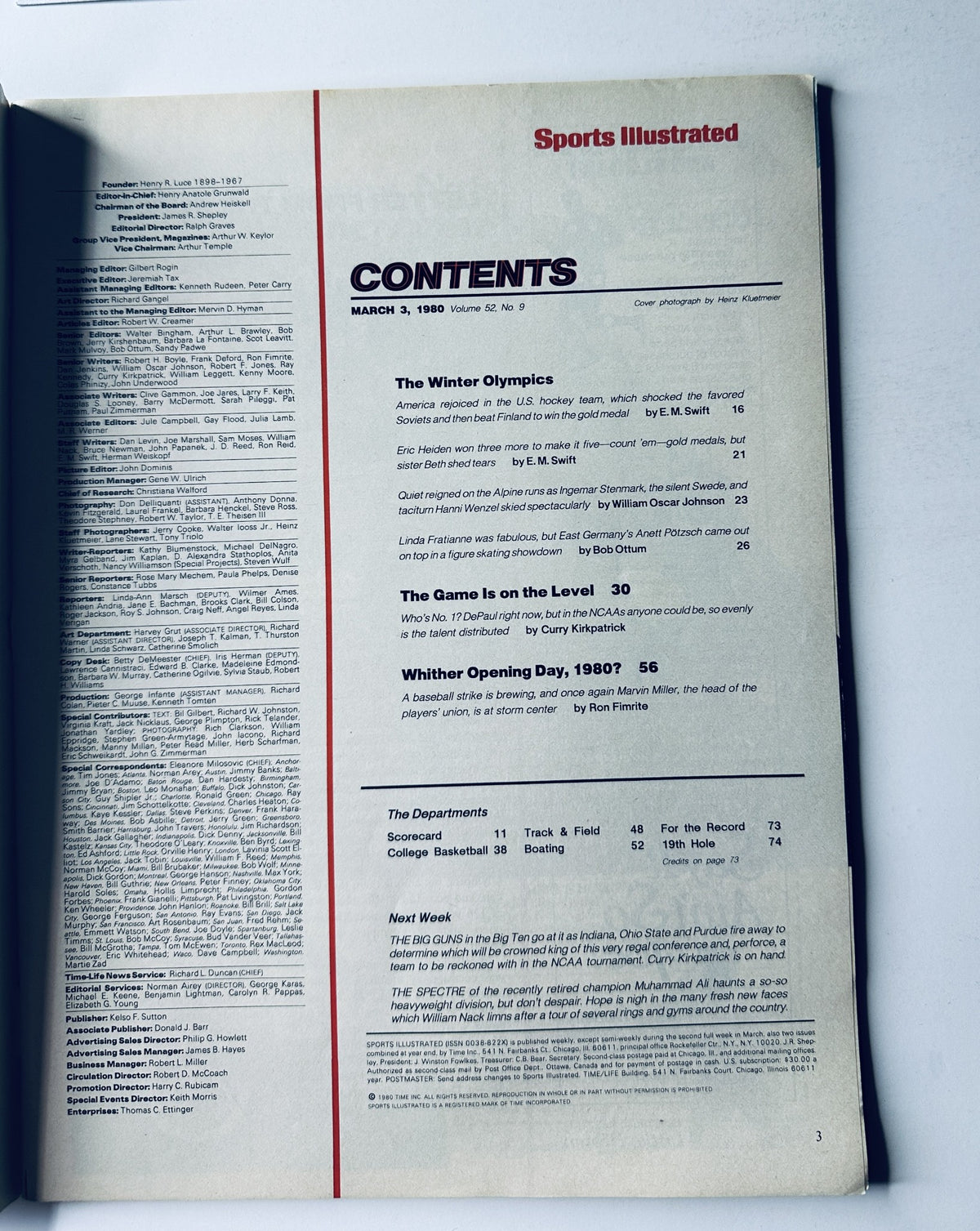
The supporting coverage documented in the table of contents adds further historical texture to an already historically saturated issue. The Ingemar Stenmark and Hanni Wenzel Alpine skiing coverage by William Oscar Johnson documents two of the most dominant Alpine skiers of the era at their respective Olympic peaks. Linda Fratianne's figure skating coverage engages the American skater who had been heavily favored but finished second to East Germany's Anett Pötzsch — a result whose Cold War athletic politics gave it a significance beyond pure sport in the specific context of February 1980. The DePaul college basketball feature by Curry Kirkpatrick captures a program at the height of its Mark Aguirre-era prominence. And Ron Fimrite's coverage of the looming baseball strike — which would eventually produce the infamous split-season work stoppage of 1981 — documents a labor dispute whose first warnings were being sounded in the same issue that celebrated American amateur athletes achieving the impossible. That juxtaposition — the pure athletic idealism of the Miracle on Ice alongside the labor economics of professional baseball — is itself a document of American sports culture at a specific and complex moment.
About the Publication
Sports Illustrated was founded by Henry Luce and Time Inc. in 1954 and by 1980 had established itself for more than two decades as the dominant sports journalism publication in the United States, combining serious long-form writing with high-quality photography and a genuine editorial ambition that distinguished it from purely commercial sports media. Its weekly format and national distribution made it the primary vehicle through which the American sports audience processed major athletic events, and its cover — one of the most recognized in American publishing — carried a cultural weight that extended well beyond the sports press. E. M. Swift's presence as the primary author of the Lake Placid hockey coverage reflects the magazine's consistent investment in developing staff writers capable of the kind of sustained, narrative-driven sports journalism that made individual issues documents of historical significance rather than mere event reports. The March 3, 1980 issue represents Sports Illustrated operating at the intersection of its editorial ambitions and one of the most culturally resonant moments in American sports history — a combination that makes this specific edition among the most historically significant issues in the magazine's entire run.
Key Highlights Inside
- E. M. Swift's primary journalistic account of the U.S. hockey team's victory over the Soviet Union and subsequent gold medal win over Finland — the original publication of what would become the defining written document of the Miracle on Ice, representing the first comprehensive journalistic treatment of the event and the source from which virtually all subsequent accounts of the story derive their factual and narrative foundation.
- E. M. Swift's Eric Heiden coverage documenting the American speed skater's unprecedented five individual gold medals at a single Winter Olympics — one of the most extraordinary individual athletic achievements in Olympic history, given its own full treatment alongside the hockey story and collectively making this issue the primary journalistic document of the two most significant American athletic performances at the 1980 Lake Placid Winter Games.
- William Oscar Johnson on Ingemar Stenmark and Hanni Wenzel's Alpine skiing dominance — coverage of two of the era's most technically accomplished Alpine skiers at their Olympic peaks, providing the full competitive context of the Lake Placid Games beyond the American stories that dominated the domestic sports press.
- Bob Ottum's figure skating coverage engaging Linda Fratianne's second-place finish behind East Germany's Anett Pötzsch — a result whose Cold War athletic politics gave it a resonance beyond pure sport in the specific geopolitical context of February 1980, and which documents the figure skating competition as a full narrative rather than a simple results record.
- Ron Fimrite's baseball strike preview on page 56 — a documented early warning of the labor dispute that would produce the split-season work stoppage of 1981, published in the same issue as the Miracle on Ice coverage and constituting a primary source record of the contrast between amateur athletic idealism and professional sports labor economics at a specific moment in American sports history.
- Curry Kirkpatrick on DePaul basketball's national prominence and NCAA tournament implications — coverage of a college basketball program at the height of its Mark Aguirre-era prominence, alongside Track and Field, Boating, and College Basketball departments providing the full multi-sport weekly context that defined Sports Illustrated's editorial identity at its operational peak.
Condition & Rarity
Sports Illustrated issues from March 1980 are approaching their forty-sixth year of existence, and the condition landscape for surviving copies of this specific issue reflects both the general attrition of that age and the specific collecting pressure that the Miracle on Ice cover has generated over four-plus decades of sustained interest. Good condition with moderate signs of age, corner creases, and light surface wear is an honest and appropriate assessment for a forty-six-year-old weekly sports magazine that has circulated in the collector market — it describes a copy that retains structural integrity and readable content, with the honest evidence of age that distinguishes an authentic survivor from an artificially preserved example. The listing's confirmation that this is a complete copy is a meaningful condition positive: the completeness of all pages and content, including the full E. M. Swift hockey account, is the primary condition attribute most directly relevant to this issue's research and collector utility. Corner creases and light surface wear are among the most common condition factors in surviving SI issues from this period and do not compromise the issue's documentary completeness. The plastic protective sleeve provides ongoing archival protection. Collectors evaluating surviving examples of this issue should prioritize content completeness — the full Swift hockey and Heiden accounts — cover legibility, and spine integrity as the primary condition criteria, understanding that the documentary significance of this issue's contents is entirely independent of its physical condition grade.
Looking for More Issues Like This?
A complete copy of Sports Illustrated from March 3, 1980 with E. M. Swift's original Miracle on Ice coverage is one of the most historically significant issues in the magazine's entire run — the primary journalistic document of one of the most culturally resonant moments in American sports history, and an issue that serious collectors of either the Lake Placid Olympics or the Sports Illustrated archive pursue with sustained interest. If this issue is no longer available, the full Sports Illustrated collection at OriginalMagazines.com is the most comprehensive place to browse surviving issues from across the publication's history and locate other historically significant covers, Olympic issues, or notable moments from the magazine's decades of sports journalism. The 1980 magazine collection brings together surviving issues from across that year's major sports and cultural publications for collectors working to document the full breadth of American print journalism during one of the most emotionally charged years in the country's recent history.