
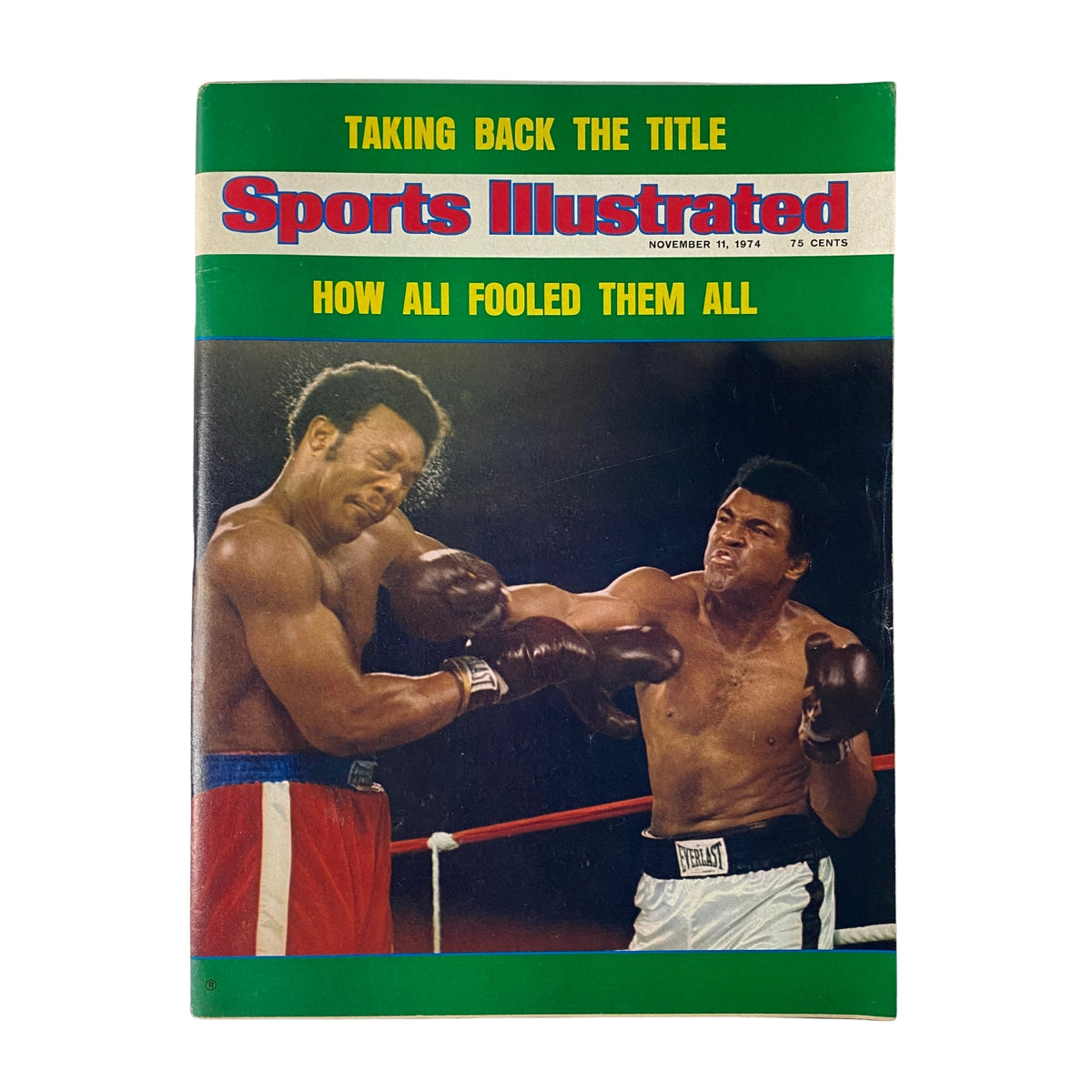


Description
Collector's Note – Why This Issue Matters
Sports Illustrated's November 11, 1974 issue, photographed by Ken Regan, arrives in the immediate aftermath of one of the most remarkable athletic performances of the twentieth century. The Rumble in the Jungle — Ali versus George Foreman in Kinshasa, Zaire on October 30, 1974 — had taken place just twelve days before this issue appeared on newsstands. What made the fight extraordinary was not merely the outcome but the method. Ali had entered as a significant underdog against a Foreman who had demolished both Joe Frazier and Ken Norton — the two men who had beaten Ali — in a combined total of four rounds. Instead of the dancing footwork he had promised and the boxing world expected, Ali retreated to the ropes and absorbed Foreman's punches across multiple rounds, allowing his younger opponent to exhaust himself before stopping him in the eighth. The rope-a-dope, as it became known, was a strategy Ali had concealed entirely until the night itself. The lead feature, "Breaking a Date for the Dance," addresses exactly this — the gap between what Ali had promised and what he delivered, and why that gap was itself a kind of genius. For collectors who focus on Muhammad Ali magazine covers, the November 1974 Sports Illustrated is among the most essential post-fight issues in his entire archive, documenting the Rumble in the Jungle at the moment its full significance was just coming into focus.
The fight's historical weight only deepened over time. Ali had regained the heavyweight championship he had been stripped of in 1967 for refusing military induction. The victory over Foreman — widely considered the most physically dominant heavyweight since Sonny Liston — validated not only Ali's boxing ability but the entirety of the path he had taken through exile, legal battles, and two comeback losses. At 32, he was heavyweight champion again. Sports Illustrated's coverage in the weeks following Kinshasa was, in retrospect, documenting the peak of Ali's career — the moment before the long, punishing run of defenses in the mid-to-late 1970s began to accumulate their costs. Beyond the Ali cover, this issue is a genuine cross-section of American sports in November 1974: Texas A&M football rising, the Charles River regatta, Bobby Frankel's emergence in horse racing, tennis fever sweeping the country, and a cultural baseball matchup between Hank Aaron and Japan's Sadaharu Oh. Collectors building out a serious vintage Sports Illustrated archive will find this issue among the richer single-issue packages from the mid-1970s run. The 1974 magazine archive reflects a year of exceptional sports storytelling, and this November issue captures it across multiple disciplines simultaneously.
About the Publication
Sports Illustrated launched in August 1954 under Time Inc. and by the mid-1970s had established itself without dispute as the authoritative voice of American sports journalism. Its combination of long-form narrative writing, serious photography, and willingness to engage with the cultural and political dimensions of sport gave it an authority no competitor matched. The weekly format allowed it to respond to major events within days, and its editorial team in the 1970s — covering Ali, the NFL, the tennis boom, baseball's integration era, and the emerging internationalization of American sports — produced some of the strongest sports journalism of the century. Its audience was primarily adult American sports fans, though its cultural reach extended well beyond any single demographic or sport.
Key Highlights Inside
- "Breaking a Date for the Dance" — in-depth coverage of Ali's rope-a-dope strategy against George Foreman in Kinshasa, published twelve days after the fight and examining the calculated deception behind one of boxing's most famous tactical innovations.
- Cover photograph by Ken Regan — credited photography adds documentary specificity to this post-fight issue, placing it within the context of Sports Illustrated's serious photographic tradition.
- "Men with a Yen for the Fences" — a cultural baseball feature pairing Hank Aaron with Japan's Sadaharu Oh, documenting the internationalization of baseball at a historically significant moment for both players.
- "The Aggie Joke Is on Its Way Out" — coverage of Texas A&M's rise into the college football Top 10, reflecting Sports Illustrated's consistent attention to college football's regional power structures.
- "Now Everybody Has the Bug" — a feature on tennis fever sweeping the United States, capturing the sport's mid-1970s boom at its peak moment of popular expansion.
- Additional features on the Charles River regatta, Bobby Frankel's emergence as a top horse racing trainer, and French illustrator Sempé's contribution on distance running — reflecting the issue's unusually broad cross-sport range.
Condition & Rarity
This issue presents in Good condition, with light wear consistent with a fifty-year-old weekly magazine, and no subscription label present — the preferred state for display-focused collectors, as the Ken Regan Ali cover survives without defacement. The exact copy shown in the listing photographs is the one available, which allows condition to be assessed from images rather than assumed from a general grade. A protective plastic sleeve has been applied, appropriate for long-term preservation. At Good grade with no label, the cover image and interior content should be fully readable and structurally intact, with any wear confined to edges and surfaces. For a Sports Illustrated featuring Ali in the direct aftermath of the Rumble in the Jungle — one of the most consequential boxing events of the twentieth century — collector demand at any presentable grade is consistent and multi-directional, drawing both Ali specialists and general sports history collectors.
Looking for More Issues Like This?
Ali's mid-1970s Sports Illustrated appearances — particularly those tied to his championship fights — are among the most consistently pursued issues in the magazine's back catalog, and the post-Rumble in the Jungle November 1974 cover is one of the most historically significant entries in that sequence. The dedicated Muhammad Ali magazine collection at OriginalMagazines.com gathers his appearances across publications and decades in one place. The broader Sports Illustrated archive covers the full run of the magazine's history, and the 1974 magazine collection is worth exploring for collectors interested in the full sports and cultural landscape of the year Ali reclaimed his championship.