
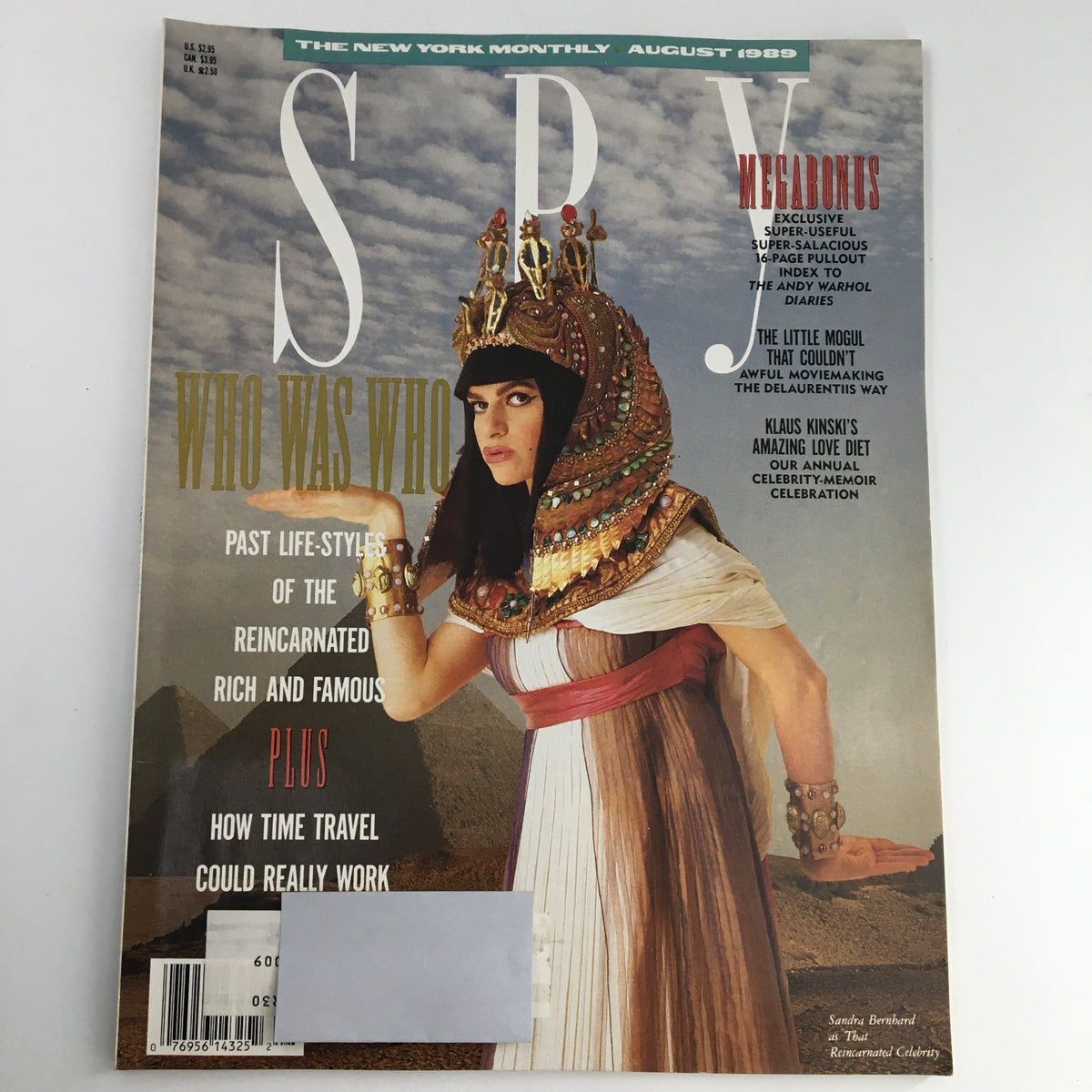

Description
Collector's Note – Why This Issue Matters
The August 1989 issue of Spy magazine — featuring Sandra Bernhard and a feature on the Andy Warhol Diaries — is a document of two of the most culturally distinctive and intellectually provocative figures in American entertainment and art at a specific and historically interesting moment. Andy Warhol had died in February 1987, and his posthumously published diaries — released in April 1989, just months before this August issue — were one of the most discussed books of that year, a massive, unfiltered record of his social observations, celebrity encounters, and daily life that was simultaneously illuminating and scandalous, confirming his status as the supreme chronicler of his own era's social surfaces while revealing the more anxious and commercially calculating private consciousness beneath the famously opaque public persona. A Spy feature on the Warhol Diaries in August 1989 is a document of that publication event at the height of its public discussion — the diaries were still fresh, the arguments about what they revealed and what they obscured were still active, and the question of Warhol's legacy in the two years following his death was being negotiated in exactly the cultural spaces that Spy occupied and served. For collectors who focus on vintage Spy magazine issues from the publication's golden era, an August 1989 issue engaging with the Warhol Diaries is a primary document of New York intellectual and celebrity culture processing one of its most significant recent losses.
Sandra Bernhard's presence in this issue adds another dimension that is historically revealing in its own right. By August 1989, Bernhard was at a specific and interesting moment in her career — she had made her breakthrough as a comedian and performer throughout the 1980s, her friendship and much-discussed relationship with Madonna had been the subject of enormous tabloid and cultural press attention, and her work was consistently engaging with questions of celebrity, authenticity, and the construction of public identity that made her a natural fit for a Spy feature. The combination of Bernhard and the Warhol Diaries in the same issue is in many ways characteristic of Spy's specific editorial intelligence: both subjects were concerned, at their core, with the performance of celebrity and the gap between public persona and private reality — Warhol through his art and his famous opacity, Bernhard through her provocative and self-aware comedy. A Spy issue that engaged both subjects simultaneously was operating at the intersection of the publication's most distinctive concerns. Collectors building archives around the cultural and media landscape of 1989 will find this issue a document of New York's specific cultural moment with unusual editorial intelligence and thematic coherence.
The broader context of Spy in August 1989 is worth situating carefully for collectors who approach the magazine as a historical artifact. By the summer of 1989, the publication founded by Kurt Andersen and Graydon Carter in 1986 had fully established itself as the most distinctive and most influential media criticism and celebrity journalism publication in America — a magazine that had made the targets it most loved to skewer simultaneously its most devoted readers, and whose combination of sharp political and cultural satire with genuinely rigorous journalism had given it a cultural authority that its relatively modest circulation dramatically understated. Its influence on the media culture of the late 1980s and 1990s was disproportionate to its readership size, and its treatment of figures like Warhol and Bernhard reflected the specific quality of its editorial vision: a willingness to take seriously subjects that mainstream journalism either ignored or treated superficially, filtered through a critical intelligence that refused the received hierarchies of cultural prestige.
About the Publication
Spy magazine was founded in New York City in October 1986 by Kurt Andersen and Graydon Carter, and within its first years had established itself as one of the most culturally significant and most widely discussed American publications of its era — a monthly magazine that combined sharp satirical commentary on New York social and political life with genuinely serious journalism, media criticism, and cultural analysis aimed at an educated, culturally engaged readership that valued wit and precision in equal measure. Its treatment of celebrities, politicians, and media figures as subjects for rigorous analytical scrutiny rather than promotional coverage gave it an influence on American journalism and media culture that far exceeded its circulation numbers, and its issues from the late 1980s are among the most historically significant in the publication's run — the period when its editorial voice was at its most fully formed and its cultural impact at its most concentrated.
Key Highlights Inside
- A feature on the Andy Warhol Diaries — engaging with the posthumously published diary that had appeared in April 1989 and was one of the most discussed books of the year, providing Spy's characteristic critical intelligence to a publication event that was reshaping how Warhol's legacy, his social observations, and the gap between his public and private personas were being understood in the two years following his death.
- A feature on Sandra Bernhard — documenting the comedian and performer at a specific moment of heightened public visibility, engaging with her work's consistent preoccupation with celebrity, authenticity, and performed identity in ways that connected naturally to the Warhol Diaries' own concerns with the construction and maintenance of public persona.
- Editorial content consistent with Spy's August 1989 editorial identity — a magazine operating at the peak of its cultural influence, bringing its characteristic combination of satirical precision and genuine journalistic rigor to the New York social, political, and media landscape of the late 1980s.
Note: Specific additional article titles, bylines, and further interior details beyond the named features are unconfirmed for this issue from available sources. The highlights above reflect verifiable historical context drawn from the named features, publication date, and the well-documented editorial character of Spy Magazine during this period.
Condition & Rarity
This copy is described as used but in excellent condition with smooth edges and overall very good shape, carrying an address label on the front cover and a plastic protective sleeve. The address label identifies it as a subscription copy that entered circulation through the magazine's fulfillment system — the label's placement on the cover relative to the cover art is the primary display consideration for collectors, who should assess the provided photographs to determine its visual impact on the cover presentation. The smooth edges and excellent overall condition indicate a copy that has been stored rather than actively handled, with page integrity and cover presentation well maintained. The plastic sleeve provides ongoing conservation value. For a Spy issue of this editorial specificity — Warhol Diaries and Sandra Bernhard in August 1989, at the peak of the publication's cultural influence — a subscription copy in excellent condition with smooth edges represents a well-preserved and historically meaningful acquisition for collectors of late-1980s New York cultural and media history.
Looking for More Issues Like This?
A Spy issue engaging with the Andy Warhol Diaries and Sandra Bernhard from the summer of 1989 is a culturally specific and editorially rich find within the collector market for this influential publication's golden-era issues — these are the issues that most fully capture the magazine's particular intelligence and its specific cultural moment. If this August 1989 issue has already found a home, the broader vintage Spy magazine collection at OriginalMagazines.com is an excellent resource for other significant issues from the publication's remarkable late-1980s and early-1990s run. Collectors focused on the New York cultural landscape, media criticism, and celebrity journalism of the late 1980s will find it well worth exploring the full 1989 magazine archive, which brings together publications from one of the most culturally distinctive and historically resonant years of the decade.