
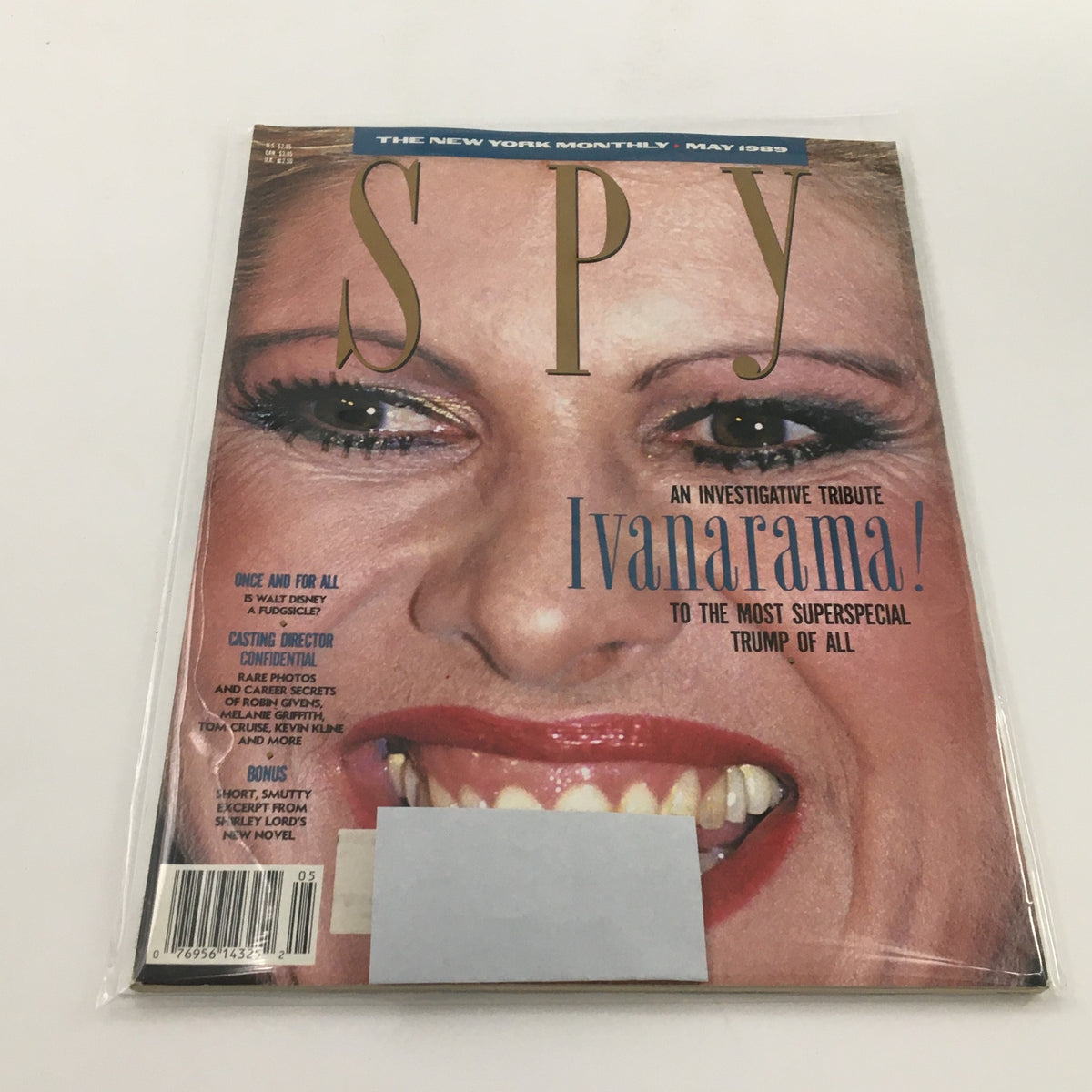


Description
Collector's Note – Why This Issue Matters
The May 1989 issue of Spy Magazine featuring "An Investigative Tribute to Ivana Trump" is a primary document of one of the most culturally consequential satire magazines in American publishing history at the peak of its creative authority — and of the specific celebrity subject whose combination of genuine glamour, media-constructed mythology, and cultural over-exposure made her the ideal target for Spy's particular brand of investigative mockery. Spy had been founded in 1986 by Kurt Andersen and Graydon Carter, and by May 1989 was in the middle of the three-year period that historians of American media consistently identify as its most creative, most influential, and most widely read phase. The magazine's specific satirical method — applying the tools of investigative journalism to subjects that the mainstream press treated with deference, combining rigorous research with aggressive wit, and targeting the specific intersection of wealth, celebrity, and self-promotion that defined 1980s New York — found its perfect subject in the Trump family, and the Trumps became among the most consistent and most specifically researched targets in Spy's roster of recurring subjects. Ivana Trump in particular represented everything that the late-1980s New York celebrity apparatus produced and celebrated: the self-made immigrant success story, the power couple's indispensable half, the interior decorator turned corporate executive turned celebrity brand, the subject of the kind of credulous profile journalism that Spy was founded specifically to interrogate. A May 1989 "Investigative Tribute" to Ivana was therefore precisely the kind of editorial project that Spy was best positioned to produce, and the result is a primary document of the magazine's satirical method applied to one of its most characteristic subjects. Collectors building a focused archive of Spy's most historically significant issues will find the Spy magazine collection at OriginalMagazines.com the most comprehensive resource for issues across the publication's remarkable run.
The May 1989 date gives this issue a specific and historically revealing position in the arc of the Trump family's public profile. In May 1989, Donald and Ivana Trump were still presenting a unified public front — their separation would not become public until December 1989, when the tabloid coverage of Donald Trump's relationship with Marla Maples would produce one of the most intensively covered celebrity divorces of the decade. Ivana Trump in May 1989 was therefore at the peak of her specific celebrity as the Trump empire's co-architect and most visible representative — the subject of fawning profiles in exactly the publications that Spy was founded to counter — and an "Investigative Tribute" at this moment was a document of her celebrity at its maximum uncritical inflation, produced by the one publication that was rigorously unwilling to treat it on those terms. The specific framing as a "tribute" — the satirical deployment of the hagiographic format against its most characteristic 1980s subject — was precisely the kind of formal wit that distinguished Spy's approach from simple mockery, and the May 1989 issue is a primary artifact of that approach at its most fully realized. The 1989 magazines collection at OriginalMagazines.com gathers publications from the last full year of the decade whose excesses Spy had been most systematically documenting.
Spy's broader significance in the history of American satirical journalism gives this May 1989 issue a collecting dimension that extends beyond the individual subject it was skewering. The magazine's alumni — writers and editors who developed their voices in its pages — went on to define American cultural journalism for the following two decades, and its specific approach to celebrity culture, political power, and media mythology was directly influential on the satirical and investigative journalism that followed. A May 1989 issue at the peak of the magazine's creative authority is a primary document not merely of the Trump celebrity apparatus but of the specific journalistic method that was most rigorously challenging it.
About the Publication
Spy Magazine was founded in 1986 by Kurt Andersen and Graydon Carter in New York City as a monthly satirical publication that combined the tools of investigative journalism with the sensibility of literary comedy, targeting the specific intersection of wealth, celebrity, media, and self-promotion that defined 1980s New York and American culture more broadly. Its format combined long-form satirical profiles, investigative fact-checking of celebrity claims, recurring features tracking the excesses of specific public figures, and the kind of visual humor and typographic wit that gave it a distinctive aesthetic identity. By May 1989, the magazine was at the peak of its circulation and creative influence, with a readership of approximately one million and a cultural authority disproportionate to that number.
Key Highlights Inside
- "Investigative Tribute to Ivana Trump" — Spy's satirical method at peak authority — a major feature deploying the "tribute" format satirically against the subject of late-1980s celebrity journalism's most credulous attention, applying Spy's characteristic combination of rigorous research and aggressive wit to Ivana Trump at the specific moment of her maximum uncritical media celebration — seven months before the Trump divorce would permanently alter her public narrative.
- May 1989 — pre-divorce, peak Trump celebrity — published seven months before the December 1989 tabloid coverage of Donald Trump's relationship with Marla Maples that would produce the decade's most intensively covered celebrity divorce, this issue documents Ivana Trump's celebrity at its maximum inflation and most uncritically celebrated phase, giving the investigative tribute format its maximum satirical purchase.
- Spy at creative peak — 1986-1989 defining period — this issue belongs to the three-year phase that media historians consistently identify as the magazine's most creative and most influential, when its specific combination of investigative rigor and literary comedy was producing the American satirical journalism that would be most directly influential on the publications and writers that followed.
- Address label on front — subscriber copy provenance — the confirmed address label on the front cover is a condition attribute whose visual impact depends on placement relative to the cover design; its location should be assessed against the accompanying photographs, as placement in the border area has less visual consequence than obstruction of the primary cover imagery.
- Bagged and boarded — archival collector preservation confirmed — the confirmed bagged-and-boarded storage represents collector-grade archival preservation from an early point in the issue's life, producing a physical condition significantly more favorable than the typical surviving example from a monthly magazine of this era that circulated actively among readers.
Condition & Rarity
Very Good to Excellent condition with very light wear, smooth edges, bagged-and-boarded archival storage, and an address label on the front cover represents a particularly favorable condition profile for a thirty-seven-year-old monthly magazine. The bagged-and-boarded storage is the most significant positive condition attribute — confirming collector-grade archival preservation that has protected the issue from the handling wear and environmental damage that typical reader-use storage produces, and suggesting either collector-oriented original acquisition or unusually careful early preservation. The address label on the front is the primary display condition factor; its position relative to the cover design should be assessed against the accompanying photographs, as a label in the border area has less visual consequence than one intersecting the primary imagery. Very light wear with smooth edges and no significant damage confirms a physical profile that represents the most favorable condition range available for surviving examples of this issue. For a Spy issue from the publication's creative peak, with an Ivana Trump investigative tribute at the pre-divorce moment of her maximum celebrity — in archival collector storage with no significant damage — this condition profile represents a particularly complete and well-preserved artifact of one of American satirical journalism's most significant publications.
Looking for More Issues Like This?
Spy Magazine issues from the late-1980s creative peak — and the May 1989 Ivana Trump "Investigative Tribute," produced seven months before the Trump divorce would permanently transform her public narrative, is among the most historically specific and most collecting-significant examples from this period — are consistently sought by collectors who understand the magazine's central role in the history of American satirical journalism and its specific relationship to the 1980s celebrity culture it most rigorously documented. If you're building a collection of the publication's most historically significant issues from its defining years, the Spy magazine collection at OriginalMagazines.com is the most comprehensive place to browse. The 1989 magazines collection offers essential context from the last full year of the decade whose specific excesses and celebrity mythologies Spy had made it its business to systematically interrogate.